Iftekharuzzaman said an enabling ecosystem must be developed at the political and institutional levels to ensure genuine media independence.
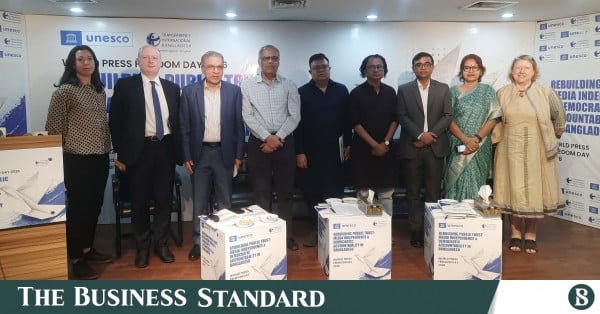
Panellists pose for a photo at an event marking World Press Freedom Day 2026, jointly organised by Unesco and TIB in Dhanmondi, Dhaka, on Sunday, 3 May. Photo: TBS
“>

Panellists pose for a photo at an event marking World Press Freedom Day 2026, jointly organised by Unesco and TIB in Dhanmondi, Dhaka, on Sunday, 3 May. Photo: TBS
Transparency International Bangladesh (TIB) Executive Director Dr Iftekharuzzaman has said government policy and governance must create a conducive environment for the media to function independently, warning that self-regulation alone is not sufficient without institutional support.
He made the remarks at a discussion organised in the capital on the occasion of World Press Freedom Day today (3 May).
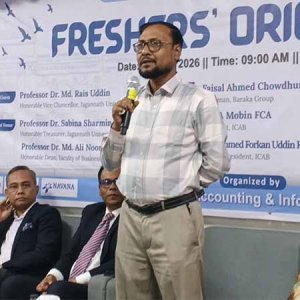
The event, titled “Rebuilding Public Trust: Media Independence and Democratic Accountability in Bangladesh”, was jointly organised by Unesco and TIB in Dhanmondi.

Iftekharuzzaman said an enabling ecosystem must be developed at the political and institutional levels to ensure genuine media independence.
“Ensuring media freedom is not possible through self-regulation alone unless there is a supportive environment within the political and governance structure. Self-regulation can sometimes be used as a tool of control, which may undermine media freedom,” he said.
He also stressed the need to assess whether laws or ordinances introduced to regulate the digital space are promoting media freedom and self-regulation.
Political influence, partisan control, and divisions within the media, he said, continue to hinder independent journalism.
Susan Vize, head of office and representative of Unesco to Bangladesh, said freedom of expression lies at the core of Unesco’s mandate and that World Press Freedom Day serves as a global reminder of its importance.
She said Unesco works to raise awareness about both the value of freedom of expression and the growing threats against it. As the lead agency for the UN Plan of Action on the Safety of Journalists, Unesco also develops media development indicators and publishes global reports on trends in media freedom.
Vize said recent global findings show that media independence is increasingly under pressure worldwide.
“This is not just a Bangladesh issue – it is a global phenomenon,” she said, noting that independent media face repression, attacks, and structural barriers.
She added that regulation can play a constructive role if designed properly, and cited Sweden as an example where regulation facilitates rather than controls media operations.
German Ambassador to Bangladesh Dr Rüdiger Lotz said media freedom is not only for journalists but for society as a whole, describing it as a cornerstone of democracy.
He said that although Bangladesh has demonstrated democratic practices, including elections observed by the European Union, the state of media freedom remains a concern.
“The rankings of Bangladesh in terms of media freedom are quite disappointing,” he said.
He stressed the need for a “new narrative” that reflects Bangladesh as a democratic country that respects the role of the media.
According to him, a free media environment is essential for transparency, accountability, and good governance.
Lotz also highlighted the economic importance of media freedom, noting that access to reliable information is crucial for business decision-making and investor confidence.
Kamal Ahmed, consulting editor of The Daily Star, said the credibility of the media in the country has declined significantly due to long-standing political control and the influence of ownership and corporate interests.
“In many cases, editors are unable to make independent decisions due to pressure from owners,” he said, adding that some media outlets omit the names of their own owners when publishing reports on money laundering or loan defaults.
Shakhawat Liton, executive editor of The Business Standard, said a key problem in journalism is “post-mortem journalism”, where criticism is often absent while a government is in power but emerges after it leaves office.
“Media freedom is also linked to economic performance. Research has shown that if media freedom decreases, GDP growth can drop by 1 to 2%,” he said, citing data from the Global Investigative Journalism Network.
He said an independent media also contributes to the stability of the banking and financial sectors, referring to research by economists, including Joseph Stiglitz.
At the event, Zahed Ur Rahman, the prime minister’s adviser on information and broadcasting, said the current government allows public criticism, describing it as a positive sign.
“The government can be criticised loudly; we want this to continue,” he said, adding that a vibrant media environment should be encouraged.
He said a democratically elected government should avoid conflict with the media and confirmed plans to hold a meeting with the Media Reform Commission to discuss implementable steps.
Participants at the discussion also called for the release of journalists detained after 5 August 2024. The adviser said the issue has been raised at the highest level and is under consideration.
According to the World Press Freedom Index 2026 published by Reporters Without Borders on 30 April, Bangladesh has slipped three places to 152nd among 180 countries.
Jamuna TV CEO Fahim Ahmed, Dhaka Tribune Editor Reaz Ahmad, and journalist Shahnaz Munni, among other media representatives also spoke at the event, while Iftekharuzzaman moderated the discussion.
About The Author