Dr Muhit said Bangladesh currently lacked a specific policy or definition for emergency ambulance services.
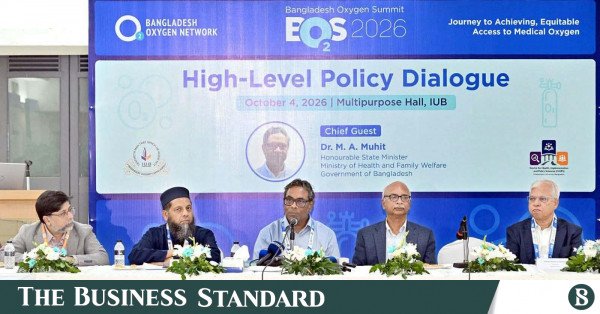
Health State Minister Dr MA Muhit speaking at the closing session and high-level policy dialogue of the two-day Bangladesh Oxygen Summit at Independent University, Bangladesh (IUB) on Sunday (4 October). Photo: TBS
“>

Health State Minister Dr MA Muhit speaking at the closing session and high-level policy dialogue of the two-day Bangladesh Oxygen Summit at Independent University, Bangladesh (IUB) on Sunday (4 October). Photo: TBS
- Government targets improved national oxygen management
- Medical curricula to include oxygen therapy training
- Ambulance services to receive legal standards
- National roadmap proposed for 2026-2030
The government plans to establish integrated medical oxygen systems in at least 20 districts this fiscal year as part of efforts to strengthen healthcare capacity and improve access to essential medical services, Health State Minister Dr MA Muhit said today (4 October).
He made the remarks at the closing session and high-level policy dialogue of the two-day Bangladesh Oxygen Summit at Independent University, Bangladesh (IUB).
The summit was jointly organised by IUB’s Centre for Health, Implementation and Policy Sciences (CHIPS) and the Bangladesh Oxygen Network.

Dr Muhit said the government was also focusing on developing an “Oxygen Access Scorecard” in line with recommendations from the Lancet Commission to assess the overall performance of Bangladesh’s medical oxygen system.
“Following the experience of the Covid-19 pandemic and the World Health Organization’s 2023 resolution, medical oxygen has become an essential component of health security, rather than merely an immediate need,” he said.
“We want to raise the management of oxygen used in Bangladesh’s healthcare sector to a standard that allows us to demonstrate success on global scorecards,” he added.
Referring to past crises and gaps in oxygen management, the state minister said a lack of coordination had led to duplication in some areas while equipment remained unused elsewhere.
“The current government has taken effective initiatives to resolve this deadlock. A high-level committee has already been formed at the ministry and work on the Development Project Proposal (DPP) is underway. Through this, an integrated oxygen network will be established in at least 20 districts as quickly as possible during the current fiscal year,” he said.
Dr Muhit also called for an effective National Oxygen Roadmap 2026-2030 and greater emphasis on domestic innovation in healthcare.
He urged the Bangladesh Medical and Dental Council (BMDC) and the Nursing and Midwifery Council to incorporate practical and systematic training on oxygen therapy into medical and nursing curricula.
The state minister also stressed the need to ensure uninterrupted oxygen supplies for marginalised communities, women and children with disabilities, including those with cerebral palsy.
Dr Muhit said Bangladesh currently lacked a specific policy or definition for emergency ambulance services.
“The practice of operating any vehicle as an ambulance simply by displaying a light must end. The government has begun work on a legal framework and standardisation to ensure modern, quality ambulance services, which will also include an effective oxygen supply system,” he said.
About The Author