The government borrowed Tk20,000 crore from Bangladesh Bank in March alone, effectively injecting high-powered money into the economy; a move that could intensify inflationary pressure, according to Ashikur Rahman, the chief economist of Policy Research Institute (PRI) of Bangladesh.
Ashikur said that the borrowing represents newly created money. “This is high-powered money; essentially printed money, which may push inflation upward,” he warned.
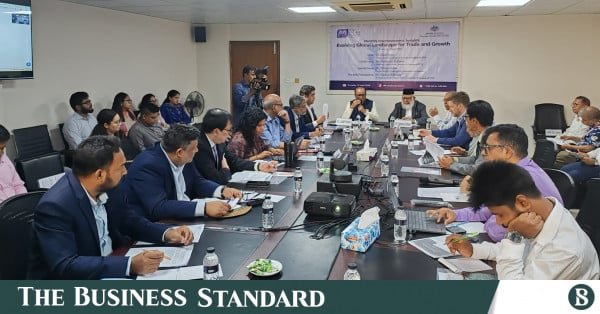
He made the observations while presenting the keynote at a Monthly Macroeconomic Insights event, titled “Evolving Global Landscape for Trade and Growth”, in Dhaka today (23 April). The event was organised by PRI with support from the Australian government’s Department of Foreign Affairs and Trade (DFAT).

Ashikur said Bangladesh’s economic stability is currently under strain due to global uncertainties, including geopolitical tensions in the Middle East, policy unpredictability and the challenges of graduating from least developed country (LDC) status.
“Stepping back from reforms at this stage would be self-defeating,” he said, urging the government to review bank resolution mechanisms and avoid creating unnecessary tensions around International Monetary Fund (IMF) programmes.
Speaking at the event, Mahbubur Rahman, president of International Chamber of Commerce, Bangladesh (ICCB), pointed to persistent gas and electricity supply disruptions as a major deterrent to investment.
“Entrepreneurs remain uncertain about whether they will get gas and electricity, which is slowing investment expansion,” he said, calling for stronger coordination between the government and the private sector.
He also flagged structural weaknesses in the banking sector, difficulties in accessing credit and rising non-performing loans as key constraints on investment. As a result, businesses are taking a cautious stance on new industrial ventures and expansion.
Mahbubur further noted that high inflation is increasing the cost of living, putting pressure on low- and middle-income groups.
He urged policymakers to avoid excessive money supply and unnecessary public spending, while restoring discipline in the banking sector, including considering bank mergers if necessary.
Challenges on domestic and external fronts
Speakers at the event stressed that IMF-backed reforms should not be viewed merely as conditionalities but as essential measures for long-term economic stability.
Khondokar Shakhawat Ali, visiting research fellow at Brac Institute of Governance and Development (BIGD), said Bangladesh is facing challenges on both domestic and external fronts.
He warned that a form of “crony capitalism” has emerged, undermining the investment climate and distorting economic dynamics.
Despite growth in bank deposits, governance deficits persist in the financial sector, he added, stressing the need to curb money laundering and ensure transparency.
Shakhawat also cautioned that financing subsidies through excessive money creation would further fuel inflation, directly impacting ordinary citizens. Stagnation in employment, he noted, is emerging as an additional economic risk.
In his remarks, PRI Chairman Zaidi Sattar said the proposed economic reforms should be seen not as IMF conditions but as “national economic imperatives”.
Failure to implement them would amount to “self-inflicted damage” to the economy, he said, adding that an elected government has the capacity to undertake such reforms.
He referenced the sweeping reforms of 1991 under an elected government, which significantly altered Bangladesh’s economic trajectory, suggesting that the current moment presents a similar opportunity for major structural changes with IMF support.
Among others, Clinton Pobke, deputy head of mission at the Australian High Commission, former NBR chairman Muhammad Abdul Mazid, and Meghna Group of Industries Director Tanjima Mostafa also spoke at the event. The session concluded with remarks from PRI Research Director Bazlul H Khondker.
About The Author