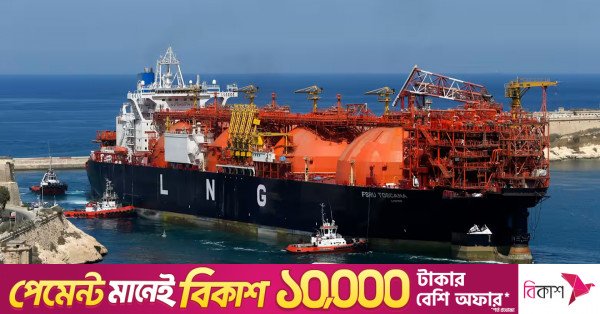
Cabinet committee also clears emergency purchases of LNG and LPG through direct procurement.
Bangladesh imports about 95% of its energy and faces rising pressure on the budget, the balance of payments and inflation. Photo: REUTERS
“>

Bangladesh imports about 95% of its energy and faces rising pressure on the budget, the balance of payments and inflation. Photo: REUTERS
Highlights:
- Charging stations and related infrastructure also to be bought directly.
- Eight LNG cargoes cleared amid geopolitical uncertainty.
- Committee also approves purchase of 5,000 tonnes of LPG.
The government today (6 August) gave in-principle approval to directly procure eight cargoes of liquefied natural gas (LNG), 5,000 tonnes of liquefied petroleum gas (LPG) and 200 electric buses for the Bangladesh Road Transport Corporation (BRTC), without inviting tenders.

The approvals came at a meeting of the Cabinet Committee on Economic Affairs, chaired by Finance Minister Amir Khosru Mahmud Chowdhury at the Secretariat.
The committee approved four separate proposals to procure a total of eight LNG cargoes from the international market through direct procurement to meet emergency domestic gas demand amid geopolitical instability linked to the Iran conflict and the US-Israel war.
Under the approved proposals, two LNG cargoes each will be purchased from UK-based Blackcube International Limited, Australia-based Global Fuel Supplies Pte Ltd, Malaysia’s Plenitude Energy Sdn Bhd and Oman-based Maxwell International SPC.
The committee also approved the direct purchase of 5,000 tonnes of LPG from Speed Marketing Corporation (Speed Group) through the international market to meet emergency demand, increase the government’s share in the LPG market and help stabilise supplies.
The LPG will contain 35%-40% propane and 60%-65% butane and will be purchased at Saudi Aramco Contract Price (CP) plus $97 per metric tonne on a CFR basis.
In a separate decision, the committee approved the direct procurement of 200 electric buses for BRTC under a government-funded proposal submitted by the Road Transport and Highways Division.
The project also includes the installation of charging stations and construction of related infrastructure through direct procurement. The fleet will include buses designated for women passengers.
About The Author