A sharp decline in liquefied natural gas supplies has plunged Bangladesh into a severe energy and power crisis, forcing gas-fired plants to operate at a fraction of their capacity, triggering long queues at CNG filling stations and leaving consumers across the country facing prolonged blackouts.
Severe power outages prompted officials of the Rural Electrification Board (REB) in several areas to seek police protection amid growing public anger.
LNG supply to the national grid fell to just 408 million cubic feet per day (mmcfd) today (12 August), down from 563.4 mmcfd on Tuesday and far below the combined regasification capacity of 1,100 mmcfd of the country’s two floating storage and regasification units (FSRUs).

Petrobangla usually supplies around 900-950 mmcfd of LNG to the national grid.
Petrobangla said the supply had to be reduced because an LNG cargo could not be docked with the Summit FSRU due to turbulent weather at sea. The cargo currently being processed by the FSRU is also nearing completion, it said.
According to Petrobangla data, total gas supply stood at 2,199 mmcfd against a demand of 3,854 mmcfd on 10-11 August.
The power sector, which requires around 2,524.9 mmcfd of gas, received only 744.1 mmcfd.
State Minister for Power, Energy and Mineral Resources Anindya Islam Amit said today that the government has adopted measures to improve the situation.
“We adopted a strategy from this evening. We hope the power situation will improve from this evening,” he said.
“Considering the public suffering, we are making every possible effort. I believe the people understand that there is no lack of effort on our part,” he added.
Gas-fired generation hit
The gas shortage has severely affected gas-fired power generation, with output falling to around 4,000MW against total gas-based generation capacity of 12,154MW.
Bangladesh has a total installed power generation capacity of 28,827MW. Coal-fired plants account for 6,509MW and heavy fuel oil-based plants for 5,637MW, while the remainder comes from diesel, hydropower, solar power and electricity imports.
The power crisis has also been compounded by lower electricity imports from Adani Power. The plant, which usually supplies more than 1,400MW, has been supplying around 900–1,000MW.
Bangladesh Power Development Board officials said heavy rain had drenched coal during transportation, hampering Adani Power’s ability to operate at full capacity.
CNG queues stretch for hours
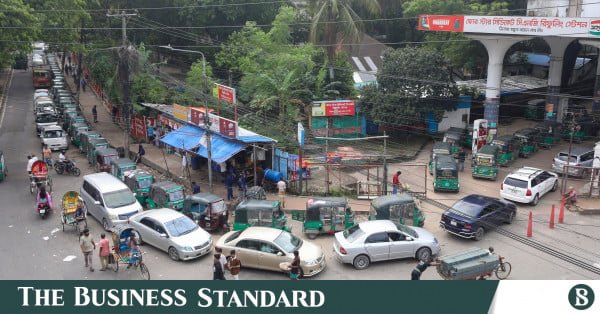
The gas shortage has also caused long queues at CNG filling stations across the country.
“I have been in the queue for more than 3.5 hours. I am not sure when I will get the gas,” driver Robiul Hossen told The Business Standard while waiting at a filling station in Dhaka.
“As we are spending 4–5 hours at the station just for gas, it is affecting our income. Waiting in the queue for hours in the heat is also making us physically tired,” he added.
Rural areas bear brunt of load shedding
The electricity shortage has been particularly severe in rural areas.
Rural Electrification Board data show a 24-26% supply deficit in its service areas between 8 and 10 August. On 11 August, demand in REB areas stood at 10,699MW against supply of 8,281MW.
Mymensingh, Sylhet and Rangpur were among the worst-affected areas.
In Mymensingh, supply stood at 738MW against demand of 1,072MW on 10 August, representing a 31% deficit. Sylhet faced a 107MW shortfall, with supply of 334MW against demand of 441MW, while Rangpur recorded a 27% deficit against demand of 651MW.
REB officials, speaking on condition of anonymity, said the official demand figures were understated, with actual average demand in REB areas reaching 11,000-12,000MW.
Amid prolonged load shedding, REB officials in Gopalganj, Rajshahi, Nilphamari, Cox’s Bazar and several other areas have sought additional police protection for substations and field-level staff, fearing public anger.
REB officials also held a meeting with the ministry on Tuesday, seeking increased electricity supplies and security support.
TBS correspondents in Lakshmipur, Sylhet and Tangail reported that consumers were facing 6–10 hours of load shedding a day.
National power deficit tops 3,000MW
The national power deficit crossed 3,000MW again today.
At around midnight, load shedding reached 3,056MW, with supply at 13,387MW against demand of 16,443MW.
According to Bangladesh Power Development Board and Power Grid Bangladesh data, maximum load shedding has remained above 3,000MW for several days.
It reached 3,757MW by 8pm on 10 August, the highest level in recent times, compared with 3,671MW the previous day.
About The Author