From village homestays to building businesses and raising families, a growing number of foreign visitors are finding reasons to venture beyond the usual tourist trail
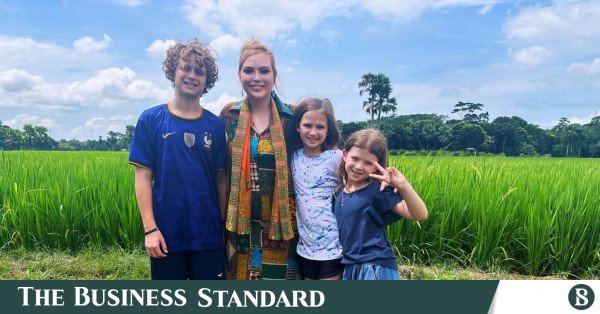
Joya Berlin has been living in Bangladesh with their children and husband since 2022. Photo: Jacob Berlin
“>

Joya Berlin has been living in Bangladesh with their children and husband since 2022. Photo: Jacob Berlin
For the last few years, foreign vloggers, especially those from developed countries, have been visiting Bangladesh and posting their content on social media.
Until recently, their travels were largely limited to cities such as Dhaka, Sylhet and Chattogram, and major tourist attractions outside them.
Now, many travellers are reaching deep into rural neighbourhoods. While some simply visit, others have put down roots in Bangladesh.

Ekduaria village: A role model for rural tourism
Nadine Albrecht, a German traveller and school teacher, recently visited Ekduaria village in Monohardi upazila, Narsingdi district, and was mesmerised by the “epic friendliness” of its people.
Photo: Sarah Steiner
“>

Photo: Sarah Steiner
“I have been in many places across Europe and Asia but never had the experience of cooking on a mud stove. I first saw it here,” Albrecht told The Business Standard.
“People are really friendly, like everybody is trying to help you, even if there is a language barrier. Like, I don’t speak Bangla; they don’t speak English, but still they are trying to help me and ensuring my experience is a great one,” the German national added.
Behind the steady flow of visitors is Jafar Haidar Tuhin, a young entrepreneur from the village who has been involved in tourism for more than a decade.
“As I was involved in tourism in Dhaka, I knew many foreign travellers. After Covid-19, in 2022, I thought, why don’t I invite them to my village?” Jafar recalled.
He had seen how rural destinations in countries such as Thailand, Indonesia and Vietnam had turned ordinary agricultural landscapes into attractions. In some places, travellers pay to stay among rice fields, participate in farming activities and experience village life rather than simply observe it from a tourist bus.
“I host the travellers in my own home, introduce them to the whole village, and go visit other sites during their stay,” he explained.
Since then, the village has hosted more than 100 travellers from around the world, over 20 of whom stayed at Jafar’s homestay last year alone. Some visitors who first came in 2022 or 2024 returned in subsequent years.
Photo: Sarah Steiner
“>

Photo: Sarah Steiner
Sarah Steiner stayed in Ekduaria for a month with her family at Jafar’s homestay. “A homestay in Bangladesh… is the chance to experience the culture and hospitality of rural Bangladesh,” she wrote in her blog Away with the Steiners.
Taz and Libby, a British couple who have visited the village three times, had a similar hands-on experience. Libby helped Jafar’s family in the kitchen, prepared meals and milked cows. Taz swam in a pond, played with children and caught fish with villagers.
“It is a simple village with paddy fields, ponds, and households. And we love it,” Libby told TBS in a video report while they were visiting Ekduaria for the second time in March this year.
“Honestly, it felt so unreal as we were both raised in a city,” said Taz. “When we first visited the village, it was for only two days. And we went back again for almost a week and never got bored.”
In Ekduaria, the attraction is the ordinary. A cow being milked becomes an experience. Cooking on a mud stove becomes an activity. A pond becomes a place to fish. A paddy field becomes a landscape worth travelling across continents to see.
Jafar charges around $400 for a two-day visit for two people and $350 for one person, covering transport, food and homestay costs.
The model remains small. But it points towards a possibility that Bangladesh’s tourism industry has rarely explored seriously: the rural landscape itself can be the destination.
Those who stay back
For some foreigners, however, the relationship with Bangladesh does not end with trips.
One of the most striking examples is the Berlin family. Jacob and Joya Berlin, an American couple, first came to Bangladesh more than a decade ago. Jacob arrived in 2011 for work and later returned with Joya. They spent years in Bangladesh, returned to the US in 2019, and came back with their children in 2022. Today, they call Bangladesh home.
Photo: Jacob Berlin
“>

Photo: Jacob Berlin
Their connection deepened in Faridpur, where Jacob worked as a project director and taught English while Joya became involved in work related to women’s mental health.
The family eventually built Action-Joy Enterprise, a social business that sells handicrafts made by marginalised women in Faridpur to customers in the US. The enterprise employs around 40 permanent staff and works with more than 500 women from different upazilas of Faridpur.
For Joya, the transition was not instantaneous. “To be honest, in the beginning I did not like Bangladesh at all,” she said. “But gradually, I fell in love with the people here.”
She learnt Bangla, and how to cook Bangladeshi food from her neighbours in Faridpur. The family now speaks Bangla fluently, including the children, who also have Bangla nicknames.
For Jacob, Bangladesh was love at first sight. “Since childhood, I have enjoyed making friends with people from different countries,” he said. “After spending three months in Bangladesh, I felt I had found the workplace I had always imagined.”
The family now dreams of obtaining Bangladeshi citizenship and eventually building a home in Faridpur.
Then there is Steve Long, a German YouTuber who came to Bangladesh in 2018 after learning about the Rohingya refugee crisis. At the time, he was working for GoPro in Germany. He initially came to help at the camps through a local NGO and began making videos because he felt the crisis deserved greater attention in his home country.
He later rose to vlogging fame and launched Stryker, his own line of electrolyte drinks made in Bangladesh.
“I am a normal human, not a super-rich foreigner who rides a fancy car and has curated experiences,” he told TBS. “I do all the local things, I eat local foods, and ride local buses.”
Whether they come for two days in a village or settle for good, what draws these foreigners is not the spectacle but the everyday. For these foreigners, Bangladesh is no longer just a stop on the route; for some, it has become the destination.
About The Author