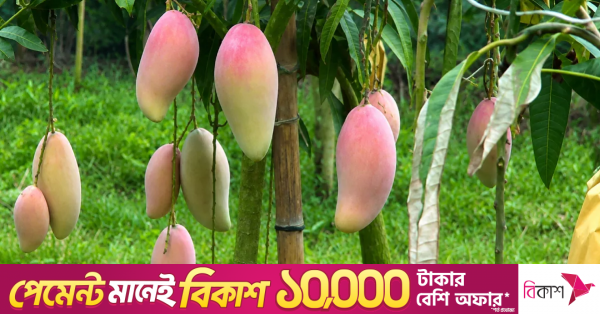
In Bangladesh’s famed mango-producing district of Chapainawabganj, a striking crimson fruit is turning heads and drawing curious visitors, offering a glimpse of how exotic varieties could diversify the country’s mango industry.
Rows of ‘Red Ivory’ mangoes now hang in clusters from trees in a two-bigha orchard at Basantapur village in Shibganj upazila, where farmer Kabir Ali has successfully cultivated the foreign variety, attracting growers, students and fruit enthusiasts from across the district.
Known primarily as a vegetable farmer, Kabir’s journey into cultivating the exotic mango began during a visit to Gaibandha, where he first encountered the Red Ivory variety. Impressed by its vibrant red colour, large size and commercial potential, he decided to bring the variety to his hometown.

Two years ago, he collected 340 saplings and established the orchard beside his home at a cost of around Tk1,50,000.
The trees produced fruit for the first time last year, yielding about five mounds of mangoes, which he sold at Tk5,500 per mound.
This season, however, nearly every tree has borne fruit.
Large crimson mangoes now cover the orchard, and the fruits are expected to reach the market within the next few weeks.
“Last year the harvest was small, but I received a good price.This year the trees are heavily laden with fruit. If the market price remains favourable, I hope to recover my investment and earn a profit,” Kabir told UNB.
Growing curiosity
The unusual appearance of the mangoes has transformed Kabir’s orchard into an attraction, with visitors arriving daily to see the rare variety firsthand.
Sanaullah, a local college student, said he had previously seen Red Ivory mangoes only on YouTube.
“Now I can see and even taste them in my own area. It’s a wonderful experience. The mango looks beautiful and tastes excellent as well,” he said.
Ataur Rahman, a mango grower from Laughatta area of Shibganj, said he visited the orchard after hearing about the foreign variety.
“The fruits are surprisingly large. Each mango appears to weigh between 800 grams and over one kilogram. The market value also seems promising. Seeing the orchard has inspired me to cultivate this variety next year,” he said.
Another visitor, Robiul Islam from Chapainawabganj town, said he had also seen videos of the variety online but wanted to experience it in person.
“I am truly impressed after seeing the orchard with my own eyes,” he said.
Promising market prospects
Habibur Rahman, who has been caring for the orchard since its establishment, said consumer response to the fruit was encouraging from the very beginning.
“When we harvested the first batch last year and took it to Kansat market, the mangoes sold out within a very short time,” he said.
“We received a good price, and there was strong demand. This year almost every tree has produced fruit. We are hopeful of another successful season.”
He added that people visit the orchard almost every day to learn more about the variety.
DAE sees potential
Deputy Director of the Department of Agricultural Extension (DAE) in Chapainawabganj, Md Atikul Islam, said the district is home to more than 300 mango varieties, with growers increasingly showing interest in introducing foreign cultivars.
“The DAE is providing technical support and guidance to farmers who want to cultivate new varieties,” he said.
According to the official, Red Ivory is a late-season variety, allowing growers to market the fruit after the peak mango season when supplies are lower and prices are generally higher.
He expressed optimism that Kabir Ali would benefit financially from this year’s harvest
The success of Red Ivory cultivation is being seen as more than an individual achievement.
Local farmers and agricultural officials believe the variety could open new opportunities for Bangladesh’s mango sector by extending the marketing season and introducing a premium fruit with strong consumer appeal.
If proper orchard management and marketing systems can be ensured, they say, the vivid red mango could emerge as a profitable addition to the country’s expanding fruit industry while encouraging more growers to experiment with high-value exotic varieties.
About The Author