The Agriculture Department has reported that at least 2,000 farmers in the region are facing similar difficulties
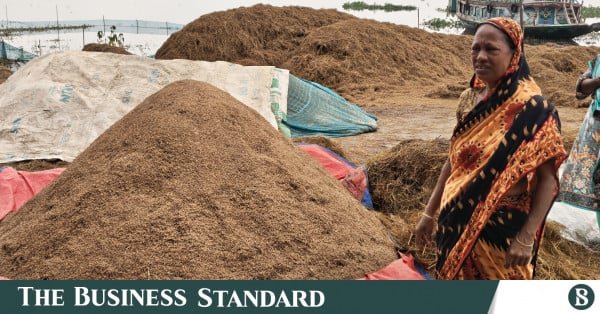
Bilkis Khatun stands beside harvested rice piles in Nasirnagar, Brahmanbaria, as she faces significant financial hardship due to low prices and labor shortages for her crops. Credit: TBS
“>

Bilkis Khatun stands beside harvested rice piles in Nasirnagar, Brahmanbaria, as she faces significant financial hardship due to low prices and labor shortages for her crops. Credit: TBS
Farmers in Nasirnagar, Brahmanbaria, are facing significant challenges as heavy rainfall and upstream floodwaters have submerged their rice fields, causing severe economic hardships.
“I’ve spent Tk22,000 on wages to harvest rice from 3 kanis of land. I harvested 20 maunds of rice. But because I had to harvest the rice before it fully ripened, I am not getting a fair price. The trader is offering only Tk10,000 for it. What should I do with this? How will I pay my loan installments? There is no way out except death!” said Bilkis Khatun, a farmer from Nasirnagar.
This year, approximately 17,500 hectares of rice was cultivated in Nasirnagar, with around 11,000 hectares in the haor areas.

The flooding has impacted 305 hectares of rice fields in Medir Haor, which includes Bilkis Khatun’s remaining crops. Due to a labour shortage, she is unable to continue harvesting.
The Agriculture Department has reported that at least 2,000 farmers in the region are facing similar difficulties.
Initially, farmers were able to harvest rice with double the usual labour wages, but as water levels in the haor continue to rise, labourers have become scarce, leaving farmers struggling to harvest their crops.
Even the rice harvested before the rains is at risk of rotting due to inadequate drying conditions.
Bilkis Khatun explained, “I cultivated rice on 22 kanis of land, both my own and leased land. I borrowed money from relatives to cover the cultivation costs. Although I managed to harvest some rice before the rain, the remaining rice ripened late, and I had to harvest it later.”
“Now, 10 kanis of my rice fields are underwater. Even though I’m offering Tk1,200 a day, I can’t find labourers. The fields are flooded, and it’s impossible to harvest. I had planned to use the rice money for various needs, but now everything is lost,” she added.
Another farmer from Medir Haor, Abul Kashem, shared his frustrations, stating, “I rely on selling rice to support my family of five. The education expenses for my three children come from the income I earn from rice. But now, because of the floodwaters, all my rice is submerged. Even if I manage to harvest it, the quality won’t be good, and I won’t receive a fair price in the market.”
Imran Hossain, the Agricultural officer of Nasirnagar, said, “While the water levels in the haor are still rising, no new land has been submerged.”
However, he pointed out that 60% of the rice had already been harvested before the rains, which helped limit the overall damage.
The Agriculture Department is actively preparing a list of affected farmers to provide assistance, he added.
About The Author