The proportion of extremely poor households among participants declined from 62.7% to around 22%, while stunting among children under five fell from 48% to 22.8% and wasting declined from 17% to 12.4%.
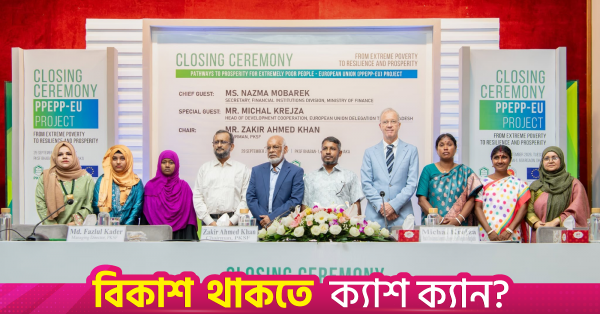
PKSF Chairman Zakir Ahmed Khan, EU Delegation Head of Development Cooperation Michal Krejza, and PKSF Managing Director Md Fazlul Kader, among other guests and project representatives, attend the closing ceremony of the PPEPP-EU project at PKSF Bhaban in Agargaon, Dhaka today (29 September). Photo: Courtesy
“>

PKSF Chairman Zakir Ahmed Khan, EU Delegation Head of Development Cooperation Michal Krejza, and PKSF Managing Director Md Fazlul Kader, among other guests and project representatives, attend the closing ceremony of the PPEPP-EU project at PKSF Bhaban in Agargaon, Dhaka today (29 September). Photo: Courtesy
The Palli Karma-Sahayak Foundation’s (PKSF) Pathways to Prosperity for Extremely Poor People European Union (PPEPP-EU) project has significantly reduced extreme poverty among participating households while improving nutrition, livelihoods and financial inclusion.
Funded by the European Union, the four-year project was implemented from October 2022 to September 2026, providing integrated support to extremely poor households in climate-vulnerable and hard-to-reach areas.
The proportion of extremely poor households among participants declined from 62.7% to around 22%, while stunting among children under five fell from 48% to 22.8% and wasting declined from 17% to 12.4%.

The findings were presented at the project’s closing ceremony held at PKSF Bhaban in Agargaon yesterday.
The project provided integrated services to around 860,000 people from 215,000 extremely poor households through 19 partner organisations across 145 unions in 34 upazilas of 12 districts.
PKSF Chairman Zakir Ahmed Khan chaired the ceremony, while Michal Krejza, head of Development Cooperation of the European Union Delegation to Bangladesh, attended as special guest. PKSF Managing Director Md Fazlul Kader delivered the welcome address and Project Director Selina Sharmin presented the keynote paper.
A speech by chief guest Nazma Mobarek, Secretary of the Financial Institutions Division under the Ministry of Finance, was read out at the event.
“An important lesson from PPEPP-EU is that the ultimate goal of poverty reduction is not dependence on assistance, but capability and self-reliance,” Nazma said.
Krejza stressed the need to sustain the project’s achievements, saying, “The end of a project’s funding should not mean the end of its impact.”
Fazlul Kader said the EU provided a grant of €22.81 million, while around Tk3,217 crore in affordable loans was disbursed among project households through PKSF and its partner organisations.
He said beneficiaries would continue to use their enhanced capabilities, while PKSF and its partner organisations would carry forward lessons from the project.
The project director highlighted six policy recommendations, including linking social protection with productive inclusion, strengthening market access for the extreme poor, integrating climate resilience into poverty-reduction programmes and promoting evidence-based replication of the pathways-out-of-poverty approach.
Around 400 representatives from PKSF, the EU, government agencies, partner organizations and other stakeholders attended the closing ceremony.
About The Author