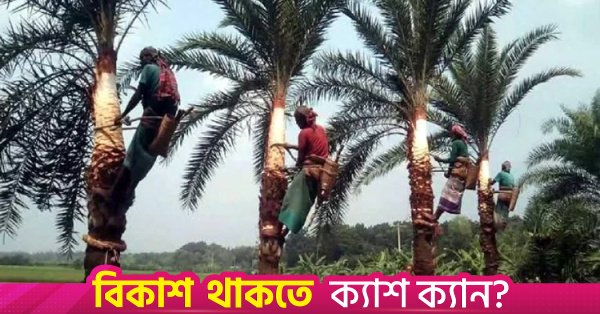
From the early hours of the morning, tappers are climbing date palm trees, collecting fresh sap from earthen pots hung on the trees.
Tappers are climbing date palm trees and collecting fresh sap in Dinajpur. Photo: BSS
“>

Tappers are climbing date palm trees and collecting fresh sap in Dinajpur. Photo: BSS
The traditional business of collecting date palm sap and producing jaggery has gained momentum in Nawabganj upazila of the district with the onset of winter, bringing seasonal workers from different parts of the country to the area.
From the early hours of the morning, tappers are climbing date palm trees, collecting fresh sap from earthen pots hung on the trees and boiling it in large metal pans over traditional clay stoves to produce date palm jaggery.
A recent visit to Daudpur area found a group of workers busy with the seasonal work, preparing fresh jaggery to meet growing demand for the traditional winter delicacy.

Hazrat Ali, a member of the group, told BSS that six workers from Bagmara upazila of Rajshahi district had been coming to Nawabganj every winter for the past four years to collect sap and make jaggery.
This season, the team started work in mid-Kartik after taking 232 date palm trees in Daudpur and adjoining areas on a contractual basis from their owners.
He said the workers had been engaged in jaggery production for years, travelling to different parts of the country for around five months annually to earn their livelihood from the seasonal business. During the rest of the year, they return home and engage in farming and other small businesses.
Hazrat Ali said he had inherited the traditional profession from his forefathers and continued to pursue it as his main seasonal occupation.
“We collect sap from date palm trees under contracts with their owners, prepare jaggery and sell it in local markets. We came to Nawabganj on the 22nd day of Ashwin this year,” he said.
Describing the production process, he said a prepared tree initially yields around two to two-and-a-half kilogrammes of sap daily. The amount gradually rises to three to four kilogrammes as the season advances.
The team currently produces around 25 to 30 kilogrammes of jaggery a day, but daily output is expected to increase to one or two maunds during the peak winter season.
The workers sell jaggery to wholesalers at Tk 230 per kilogramme and to retail buyers at Tk 260.
The fresh jaggery has already started drawing customers to the production sites. Demand for date palm sap and traditional winter delicacies, including pitha, payesh, muri and murki, is also increasing with the change in weather.
Local schoolteacher Rafiqul Islam, who was buying jaggery directly from the workers, told BSS that date palm jaggery was an indispensable ingredient in traditional winter foods because of its distinctive taste and aroma.
He said he preferred purchasing it directly from the production sites, where buyers could see the entire process of sap collection and jaggery preparation, ensuring confidence in the product’s freshness and quality.
He added that many people visit the sites every day to purchase freshly made jaggery.
Nawabganj upazila BNP President and former union parishad chairman Tarikul Islam said he had recently visited the jaggery production sites along with Upazila Nirbahi Officer (UNO) Bidhan Kanti Haldar.
He said the locally produced jaggery was delicious and increasingly popular among consumers.
UNO Bidhan Kanti Haldar said the workers had been advised to maintain proper cleanliness and hygiene during the production process and were complying with the instructions.
The seasonal trade is not only preserving a long-standing rural tradition but also creating employment opportunities for migrant workers who travel to Nawabganj every winter.
About The Author