Chattogram handled a record 3.41m TEUs in 2025.
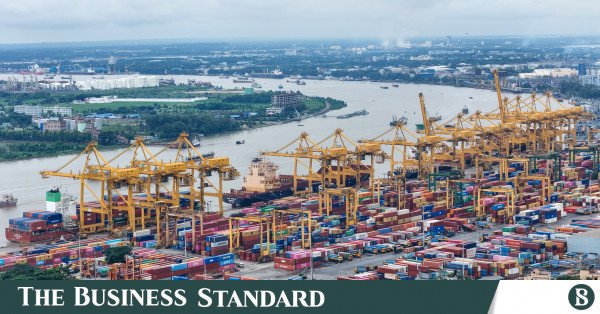
The photo shows a view of the New Mooring Container Terminal of Chattogram Port. A growing logjam of stranded import cargo at the port is eroding nearly two-fifths of the port’s operational capacity, dragging down turnaround times and inflicting severe losses on the country’s trade-driven economy. The photo was taken on Wednesday. Photo: Mohammad Minhaj Uddin
“>

The photo shows a view of the New Mooring Container Terminal of Chattogram Port. A growing logjam of stranded import cargo at the port is eroding nearly two-fifths of the port’s operational capacity, dragging down turnaround times and inflicting severe losses on the country’s trade-driven economy. The photo was taken on Wednesday. Photo: Mohammad Minhaj Uddin
Highlights:
- Chattogram handled 3.41m TEUs last year
- New terminals expected to boost future capacity
- Shanghai remained world’s busiest container port
Chattogram Port retained its 68th position in the global ranking of container ports despite recording a 4.1% year-on-year increase in container handling in 2025.
The ranking, based on container throughput at ports worldwide in 2025, was published by London-based shipping and ports publication Lloyd’s List in its latest special report, Lloyd’s List: One Hundred Ports 2026.

According to the report, Chattogram Port handled 3,409,069 twenty-foot equivalent units (TEUs) of containers in 2025, up from 3,275,627 TEUs in 2024.
The port slipped one place to 68th in the 2025 edition of the ranking after holding 67th position for two consecutive years.
Despite handling a record volume of containers in 2024, Chattogram fell in the ranking as other ports recorded faster growth.
Lloyd’s List said growth at Chattogram remained limited, but major investments by APM Terminals, MSC and Red Sea Gateway are reshaping the future of Bangladesh’s main container port.
Saudi Arabia-based Red Sea Gateway Terminal (RSGT) began partial operations at Chattogram Port’s newly built Patenga Container Terminal (PCT) in June 2024 and started full-scale operations at the terminal this year.
Meanwhile, Danish terminal operator APM Terminals is set to begin construction of the Laldia Container Terminal this month. The foundation stone for the terminal is scheduled to be laid on Sunday.
China’s Shanghai Port retained the top position after handling 55,062,500 TEUs in 2025, while Singapore Port ranked second.
Historical data show that Chattogram Port has seen significant fluctuations in the Lloyd’s List ranking over the past decade.
In the 2024 edition, based on 2023 data, the port retained 67th place despite a 2.9% decline in container handling.
In the 2023 edition, based on 2022 data, Chattogram slipped three places to 67th after handling 3,142,504 TEUs, down 2.2% from the previous year.
The port moved up three places to 64th in 2022.
Before that, Chattogram had advanced steadily for seven consecutive years. But in the 2021 edition, based on 2020 data, it dropped nine places to 67th, largely because the Covid-19 pandemic disrupted garment exports and reduced container handling.
The port ranked 58th in 2020, 64th in 2019, 70th in 2018, 71st in 2017, 76th in 2016, 87th in 2015 and 86th in 2014.
Port users, however, say the Lloyd’s List ranking should not be treated as a complete measure of a port’s overall performance.
They point out that the ranking is based primarily on container throughput, meaning a port can fall in the rankings even when its operational capacity or efficiency improves if other ports record faster growth.
For Chattogram, the latest investments in new terminals are expected to increase handling capacity and reshape its position in global rankings in the coming years.
About The Author