Researcher claims 72 canals once existed in Chattogram, most now encroached, narrowed or lost
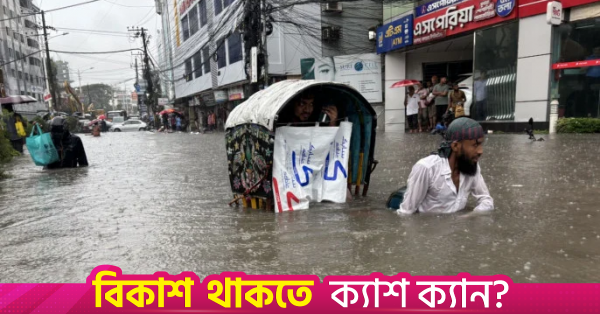
A rickshaw pulls a passenger through chest-deep water after the season’s first downpour leaves many streets in Chattogram waterlogged. The photo was taken on 28 April 2026 from the city’s Prabartak intersection. Photo: Md Minhaj Uddin/TBS
“>

A rickshaw pulls a passenger through chest-deep water after the season’s first downpour leaves many streets in Chattogram waterlogged. The photo was taken on 28 April 2026 from the city’s Prabartak intersection. Photo: Md Minhaj Uddin/TBS
Drainage improvement projects in Chattogram have been implemented without proper feasibility studies, local context assessment, or consultation with key stakeholders, alleged urban planner and environmental researcher Manzoorul Kibria at a seminar today (9 May).
Speaking at a seminar titled “Sources of Urban Waterlogging Crisis in Chattogram and Civic Accountability” held at the Chattogram Press Club, he said, “In many areas, solid walls have been constructed without properly demarcating canal boundaries. This has narrowed canals, increased encroachment and disrupted water flow.”
He added that according to the 1995 CS survey, Chattogram had 72 canals, many of which have now been lost, encroached upon, or severely narrowed. “Until these 72 canals are recovered and brought under proper planning, a permanent solution to waterlogging will not be possible,” he said.

Manzoorul further claimed that project implementation did not adequately involve local residents or stakeholders, despite their practical knowledge of drainage routes and blocked water channels.
“Even ordinary residents can identify where canals once existed or which structures are blocking water flow. But implementing agencies have largely ignored field-level input,” he said.
He also noted that while primary canals are being prioritised in current projects, numerous secondary and tertiary canals connected to the city’s drainage system remain neglected. “Focusing only on main canals will not work. Without restoring the full network, the system will fail,” he warned.
The researcher identified unplanned urban expansion, including the filling of wetlands and natural water bodies for housing developments, as a major cause of waterlogging.
He also criticised the city’s waste management system as “outdated and labour-dependent.”
“Waste management is still largely sweeper-dependent. We need to shift towards a technology-based system and turn waste into a resource,” he said.
He also questioned the technical capacity and coordination among implementing agencies, saying lack of coordination has led to poorly planned execution of several projects. He added that the removal of multiple bridges without alternative arrangements ahead of the monsoon season has worsened public suffering.
Urban planner Jerina Hossain, also speaking at the seminar, said Chattogram’s urbanisation has become profit-driven, posing serious risks to its future livability.
“Those who own land are constructing buildings to maximise profit, without considering open spaces, trees or water retention areas,” she said.
She noted that rising land prices are largely driven by public investment, but private development is not aligned with sustainable planning. “Basements are being constructed across entire plots. In the future, urban water scarcity will increase. If this continues, the city will no longer remain livable,” she warned.
Jerina Hossain also highlighted the lack of playgrounds, walking spaces and safe mobility for children. “Why do young people want to go abroad? Because they cannot walk safely, play or travel to school securely here,” she said.
She further criticised the gradual enclosure of open urban spaces, saying the city is being fragmented into compartments rather than preserved as shared civic space.
Addressing street management, she said hawkers should not be removed entirely but brought under proper regulation to ensure pedestrian mobility. “Ensuring that people can walk freely is a civic right,” she added.
Chattogram City Corporation Mayor Shahadat Hossain, the chief guest at the seminar, claimed that the city’s waterlogging situation has improved compared to previous years.
He said, “Compared to 2023 and 2024, when areas like Bahaddarhat, Muradpur and Chawkbazar were heavily inundated, the situation in 2025 has improved to some extent. People were at least able to move around this time.”
He attributed recent waterlogging to unusually heavy rainfall during Baishakh and said even major global cities are facing similar challenges due to climate change.
Explaining recent disruptions, the mayor said temporary embankments constructed for retaining wall works under the Chattogram Development Authority (CDA) drainage project being implemented by the Bangladesh Army’s 34 Engineer Construction Brigade were not removed on time.
He said this, combined with simultaneous tidal and rainwater flow, worsened drainage conditions.
“I am a practical person. If I feel I cannot work, I will step down. But before that, I will try my best,” he said.
The mayor added that a two-month special cleaning drive is currently underway to clear drains and canals across the city.
He expressed hope that completion of sluice gates and pumping stations would further improve the situation.
The seminar was chaired by Chattogram Press Club President Zahidul Karim Kachi. It was inaugurated by Ekushey Padak recipient and Daily Azadi Editor MA Malek. MP Abu Sufian, engineer Nurul Karim, and Shamsul Haque Haidary also spoke at the event.
About The Author