The Business Standard was the media partner of the workshop.
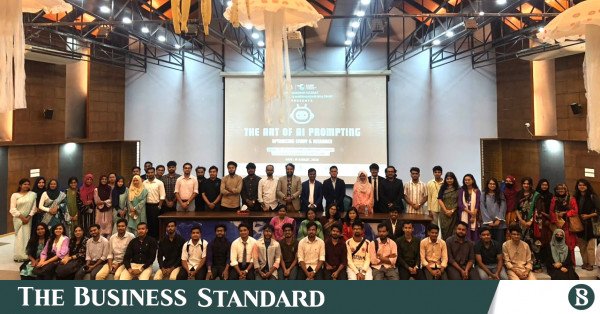
Participants and organisers pose for a group photo at the day-long workshop “Art of AI Prompting: Optimising Study and Research” organised by the Chittagong University Scientific Society (CUSS) at Chittagong University on 19 August 2026. Photo: TBS
“>

Participants and organisers pose for a group photo at the day-long workshop “Art of AI Prompting: Optimising Study and Research” organised by the Chittagong University Scientific Society (CUSS) at Chittagong University on 19 August 2026. Photo: TBS
Chittagong University (CU) held a day-long workshop on artificial intelligence (AI) prompting today (19 August) to train students to use AI effectively in academic studies, research and future careers.
Titled “Art of AI Prompting: Optimising Study and Research”, the workshop was organised by the Chittagong University Scientific Society (CUSS) at the Faculty of Marine Sciences and Fisheries. The Business Standard was the media partner.
The workshop provided students with practical training on AI prompting, prompt engineering, the use of AI in research and the application of various AI-powered tools.

The event was sponsored by Shahanshah Hazrat Syed Ziaul Haque Maizbhandari (R) Trust, with Nymph Solutions Limited and QA Harbour Limited as co-organisers and Autolynium as the technical partner.
The opening session was addressed by CUSS adviser and workshop convener Prof Dr Layla Khaleda, followed by speeches from CUSS General Secretary Rubaiya Yasmin, A Y Mohammad Jafar, secretary of the Shahanshah Hazrat Syed Ziaul Haque Maizbhandari (R) Trust, and CUSS Vice-President Atanu Singh.
The first two sessions were conducted by Minhaj Fahim, founder and chief executive officer of Autolynium and head of Autolynium Lab (ALAR).
The first session covered the basics of AI and prompting, how AI works and its effective use. The second focused on prompt engineering, the use of AI in study and research, and techniques for developing effective prompts through hands-on exercises.
The trainers demonstrated how to develop task-specific prompts using the COSTAR framework. Students were also introduced to AI-based tools including ChatGPT, NotebookLM, Semantic Scholar, ResearchRabbit and Zotero.
Participants took part in practical exercises involving prompt creation and different stages of the research process.
The workshop also highlighted the importance of verifying information, ensuring the reliability of citations and understanding the limitations of using AI-generated information in research.
Speaking at the event, CU Vice-Chancellor and CUSS adviser Prof Dr Mohammad Al Forkan said AI had become part of people’s lives and that it was no longer possible to remain completely removed from the technology.
“AI is now a part of human life, and it is not possible to stay away from this technology even if we want to. However, simply using AI is not enough. Emphasis should be placed on using AI properly to increase our knowledge, regularly updating ourselves and applying the skills we acquire in real and practical fields,” he said.
University Pro-Vice-Chancellor Prof Dr Md Shafiqul Islam also spoke at the event, highlighting the potential benefits of AI in research.
“AI can make research work easier and more effective in many ways. However, we should not completely rely on AI in research. Rather, AI can be used as an aid to make research work more accurate and organised,” he said.
Later, commemorative crests were presented to the workshop’s sponsors, co-organisers and technical partner.
The third session, titled “Career Talk on Artificial Intelligence”, focused on changes in the AI-driven job market, essential AI skills and ways students can prepare for future workplaces. Mirajul Mohin, a technical staff member of VLM Run, conducted the session.
The fourth and final session, titled “General Career Guidance Talk”, featured Kazi Shafayet Mahmud Abhi, co-founder and chief executive officer of Nymph Solutions Limited and QA Harbour Limited; Shahriar Bin Amin, co-founder and chief executive officer of Atensis; and Minhaj Fahim.
The speakers provided guidance on developing skills in a changing workplace and the competencies needed to remain competitive in the future job market.
Autolynium and Nymph Solutions also announced internship opportunities for students, allowing them to apply their skills in AI and prompt engineering in real-world workplaces.
At the closing session, CUSS Student Adviser and 2025-26 committee President KM Shifat Shahrin Swachha and Senior Vice-President Abidul Mowla Khan spoke. Kazi Shafayet Mahmud Abhi, Shahriar Bin Amin and Minhaj Fahim also addressed the session.
About The Author