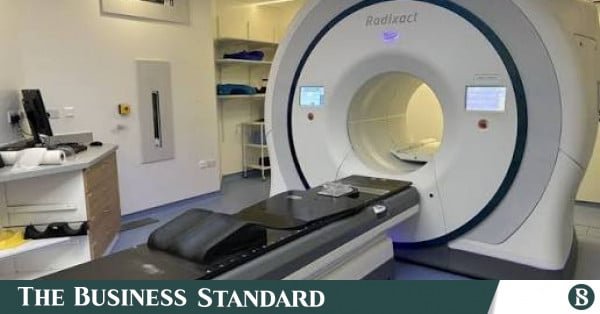
At the Cancer Institute, patients begin gathering outside the LINAC-2 room from 8am. Between 200 and 300 new patients seek radiotherapy there every day, while 6,500-7,000 are currently on the waiting list, according to hospital authorities.
Infographics: TBS
“>

Infographics: TBS
Six-year-old Abu Sufian sat outside Room 149 of the National Institute of Cancer Research and Hospital, his shaved head bowed over a mobile phone as he watched cartoons intently.
For the child from Alfadanga in Faridpur, the cheerful images on the screen offered a brief escape from a long and painful battle with cancer. He had already endured seven rounds of chemotherapy and surgery for bone cancer. Now, after waiting two months for radiotherapy, he had completed five of 30 sessions.
Like Sufian, thousands of cancer patients have to wait for months for radiotherapy due to an acute shortage of machines, particularly at state-run hospitals, where the treatment is more affordable than at private facilities.
Sufian’s cancer was detected last December when an MRI scan, conducted after he broke his leg, revealed a tumour in his knee bone. After seven rounds of chemotherapy, doctors surgically removed the tumour. His next challenge was securing a radiotherapy slot.

“If he had received radiotherapy two months earlier, it would have been better. But there are so many patients here,” Sufian’s father Abu Taher told The Business Standard, visibly distressed.
He said he had so far paid Tk11,500 under the treatment package.
“The cost is much lower at government hospitals. If there were more machines, ordinary patients like us would benefit the most,” he said.
Sufian is among thousands struggling to access radiotherapy amid a severe shortage of machines at public hospitals.
At the Cancer Institute, patients begin gathering outside the LINAC-2 room from 8am. Between 200 and 300 new patients seek radiotherapy there every day, while 6,500-7,000 are currently on the waiting list, according to hospital authorities. Some face waits of 12-18 months.
Guljan Begum of Sunamganj, who has cervical cancer, is one of them. She submitted her documents for radiotherapy on 21 September but was not given a treatment date. Instead, she was told to return after six weeks to learn when her treatment would begin.
According to the Bangladesh Cancer Society, an estimated 13 to 15 lakh people in Bangladesh are currently living with cancer. Around 2,00,000 new cases are diagnosed every year, while approximately 1,50,000 people die from the disease annually.
Two machines cannot meet demand
Dr Mostafa Aziz Sumon, director of the National Institute of Cancer Research and Hospital, told TBS that only two radiotherapy machines are currently operational, far below demand.
The hospital has three additional bunkers where machines were previously installed, but all are now out of order.
“If we had seven to 10 machines in operation, the waiting time could be reduced significantly,” he said.
More than 200 new patients arrive every day, but those with existing appointments have to be treated first.
“If doctors decide today that a patient needs radiotherapy, we cannot give them a date at all. We tell them to come back after six weeks because we have no slots to offer,” Dr Sumon said.
He said the two machines can treat a maximum of around 250 patients even when operated from 8am to midnight. But each patient requires a treatment course lasting around six weeks, meaning new patients cannot be accommodated until existing courses are completed.
Bangladesh needs around 300 radiotherapy machines based on its current cancer burden, he said. Government hospitals have only five, while private hospitals have around 30.
Dhaka Medical, BMU face same crisis
Professor Dr Aliya Shahnaz, head of its radiotherapy department at Dhaka Medical College Hospital, said the hospital has three bunkers but only one machine. That machine cannot provide all types of radiotherapy, she added.
At Bangladesh Medical University (BMU), around 70 patients are treated each day with its single radiotherapy machine, while 200-300 new patients arrive daily. The hospital consequently has a waiting list of around six months.
Professor Dr Sayed Md Akram Hussain, chairman of Clinical Oncology at BMU, told TBS that two of its three radiotherapy bunkers remain vacant.
Doctors said a three- to four-month delay in radiotherapy can allow cancer to become more advanced in some cases.
Funding for two new linear accelerators has been included in the 2025-26 and 2026-27 budgets. Procurement of the first is already underway, with the second expected to follow.
Two new machines planned for public hospitals
Professor Dr Zahid Raihan, director general (administration) of the Directorate General of Health Services, told TBS that a new Linear Accelerator (LINAC) for the Cancer Institute has already been purchased and is being installed.
“The machine has been purchased. All procedures have been completed. We hope it will become operational by January next year,” he said.
Another radiotherapy machine is also being procured for Kurmitola General Hospital, he said.
Dr Zahid said Dhaka Medical also needs another machine because its existing one cannot provide all types of radiotherapy, adding that the matter is under consideration.
He said the government had found LINAC machines at several medical colleges, including those in Faridpur and Khulna, deteriorating while still packed in boxes and never being put into operation.
“Lack of integrity in government equipment procurement is a major problem. We are trying to address these issues,” he said.
He added that inadequate development of public-sector cancer treatment capacity in the past had forced patients to rely on expensive private healthcare.
Radiotherapy costs vary widely between public and private hospitals, with a complete course costing Tk12,000-15,000 at the Cancer Institute, compared with around Tk2 lakh at private hospitals.
About The Author