The Cabinet also approves a proposal to amend a notification on the minimum price of low-tier cigarettes under the Value Added Tax and Supplementary Duty Act, 2012.
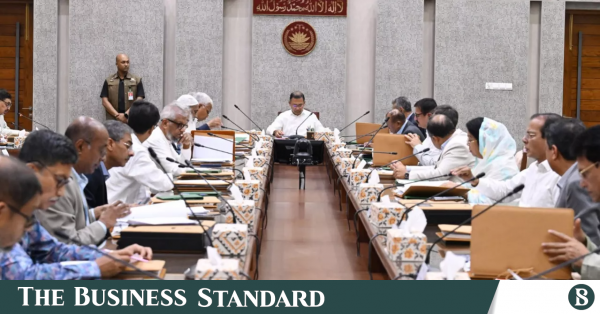
A cabinet meeting held today at the Bangladesh Secretariat. 17 March 2026. Photo: PID
“>

A cabinet meeting held today at the Bangladesh Secretariat. 17 March 2026. Photo: PID
The Cabinet yesterday (7 September) approved a proposal to provide duty and tax waiver facilities for the import of machinery and spare parts for renewable solar power generation.
The approval came at a Cabinet meeting held at the Cabinet Room of parliament complex with Prime Minister Tarique Rahman in the chair, according to a Cabinet Division press release.
Under the approved proposal, machinery and spare parts imported for setting up renewable solar power plants will be exempted from customs duty beyond 1%, entire regulatory duty, supplementary duty, value-added tax (VAT), advance tax and advance income tax for 180 days from the date of issuance of the notification.

The government expects the measure to help meet electricity demand by facilitating faster expansion of renewable solar power generation, while reducing the difficulties caused by power shortages and supporting uninterrupted industrial production.
The Cabinet also approved a proposal to amend a notification on the minimum price of low-tier cigarettes under the Value Added Tax and Supplementary Duty Act, 2012.
Under the amendment, the maximum retail price of low-tier cigarettes will be reset at Tk65 or above per 10 sticks, replacing the existing threshold of Tk 62 or above.
The amendment is also expected to help reduce illegal cigarette trade and revenue losses.
In another decision, the Cabinet approved a proposal to sign a Promotion and Protection of Investment Agreement between Bangladesh and Hong Kong.
The agreement is aimed at strengthening existing economic ties between the two sides and attracting new investment, particularly in sectors such as garments and textiles.
According to the proposal, the agreement will help ensure necessary security and protection for investments by both sides and contribute to industrialisation, employment generation, technology and knowledge transfer, and increased production capacity.
The agreement will remain valid for 10 years, while a provision has been included allowing both sides to amend it three years after its signing.
The agreement is also expected to establish an effective institutional framework to increase foreign investment flows between Bangladesh and Hong Kong.
About The Author