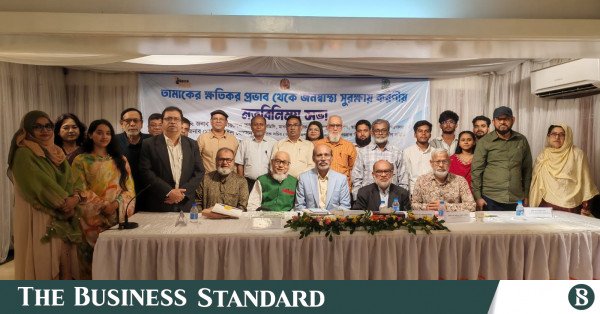
The Bangladesh Retired Government Employees Welfare Association (BRGEWA) has called for the prompt formulation of the rules under the Amended Tobacco Control Act 2026 and for stronger tobacco control measures to protect public health.
The Association also urged the government to protect young people from the harmful effects of e-cigarettes and nicotine pouches.
The demand was made at a discussion meeting titled “Protecting Public Health from the Harmful Effects of Tobacco: The Way Forward” jointly organised by the Bangladesh Retired Government Employees Welfare Association and the Development Organisation of the Rural Poor-DORP at Obosor Bhaban in the capital today (28 July).

Speaking at the meeting, Md Ismail Hossain, administrator of the Bangladesh Retired Government Employees Welfare Association, said that protecting public health and ensuring effective tobacco control are among the key commitments of the current government’s election manifesto. On the occasion of World No Tobacco Day 2026, Hon’ble Prime Minister Tarek Rahman reaffirmed the government’s strong commitment to protecting children, adolescents, and future generations from the harmful effects of tobacco and nicotine products. He added that discouraging the use of tobacco and nicotine products and protecting future generations from their harmful effects are among the government’s highest priorities in building a healthy and productive nation.
Retired Secretary Md Shamsul Alam Khan said that the FY 2026–27 national budget imposed taxes on nicotine pouches, nicotine granules and Heated Tobacco Products (HTPs). As a result, these emerging nicotine products are effectively receiving legal recognition and greater opportunities for market expansion. He warned that this could increase nicotine addiction, particularly among children, adolescents, and young people. He called on the government to adopt timely and effective policy measures to address this challenge.
Mohammad Ali, director of the Bangladesh Retired Government Employees Welfare Association, said that Bangladesh has the highest tobacco use prevalence in South Asia (35.3%), and tobacco-related diseases cause nearly 200,000 premature deaths every year. In 2024, the economic cost of tobacco-related health and environmental damage amounted to approximately TK87,000 crore, more than double the revenue generated from the tobacco sector.
He emphasised that, in light of this reality, the Smoking and Tobacco Products Usage (Control) Act, 2005 (Amended 2026) must be strictly enforced, and effective measures must be taken to prevent the spread of emerging nicotine products in order to protect public health.
The speakers thanked the government for amending the Smoking and Tobacco Products Usage (Control) Act, 2005 (Amended 2026) and expressed optimism that, in line with the commitments outlined in the government’s election manifesto, appropriate measures would be taken to strengthen tobacco control efforts, particularly to protect future generations from the harmful effects of tobacco and nicotine products.
Members of the Bangladesh Retired Government Employees Welfare Association also reaffirmed their commitment to actively contribute to the process of building a tobacco-free Bangladesh and pledged the Association’s full support toward achieving this national goal.
About The Author