Riding groups across Bangladesh are using motorcycles as a way to reconnect with old passions, organise charity and heritage events, support women riders and promote safer behaviour on increasingly dangerous roads
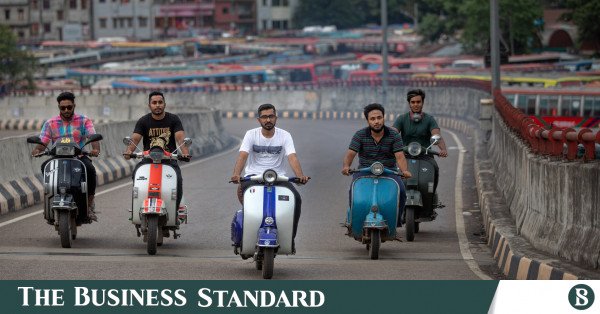
Vespa Club Bangladesh has built its community around social events, heritage and charity. Photo: TBS
“>

Vespa Club Bangladesh has built its community around social events, heritage and charity. Photo: TBS
Whenever Iftekhar Uddin Khan and his riding companions stop at a roadside tea stall outside Dhaka, they often draw a small crowd. People look at their jackets, boots and protective pads. Some take photographs, while others ask what the equipment is for.
“Many of them have no idea about this kind of safety equipment. They do not know that these things should be worn while riding a bike,” Iftekhar told The Business Standard.
Most members of his group, Enfield Brotherhood, are over 40. For them, riding is not about speed or showing off. It is a way to travel, spend time together and return to a part of life they had left behind.

Many rode motorcycles during their school or university years, but stopped as careers, businesses and family responsibilities took over. After a long gap, they have started riding again.
“Many of us used to ride bikes when we were younger. Then there was a long gap. Now we have started riding again, partly to return to that younger phase of our lives,” Iftekhar said.
Formed in 2025, Enfield Brotherhood has around 10 members. Four are childhood friends, while the others met at a riders’ gathering. The group includes doctors, engineers, businesspeople and others with demanding schedules.
They have completed around 15 tours, mostly day rides to Bhanga, Mymensingh, Gazipur, Kapasia, and Narayanganj. Cox’s Bazar, Kuakata, Rangamati and Bandarban are among the destinations they hope to visit soon.
When a tour is not possible, they arrange a lunch or dinner meetup. Sometimes they simply ride to a restaurant, have coffee and talk.
Social media has facilitated the formation of such large communities. Photo: Courtesy
“>

Social media has facilitated the formation of such large communities. Photo: Courtesy
For Iftekhar, this is reminiscent of how people travelled before organised clubs and social media. He began riding in high school, and his riding group was simply his circle of school and college friends.
“There was no Facebook or WhatsApp. When we were young, even mobile phones were not really part of our lives,” he said.
On a Friday, they might have suddenly decided to ride to Tangail or Mymensingh.
But later in life, work kept Iftekhar away from motorcycles for around 12 years.
“The main thing is to nurture that childhood passion and bring it back again,” he said.
Enfield Brotherhood deliberately remains small. It may increase its membership to 15, but Iftekhar does not want it to grow beyond that. Members must enjoy one another’s company and follow the same rules on the road.
“For a tour, I think a maximum of 10 people is ideal. If the group becomes much bigger than that, it becomes difficult to manage,” he said.
Heritage, charity and women on the road
While Enfield Brotherhood grew from a return to an old passion, Vespa Club Bangladesh has built its community around social events, heritage and charity.
Rupok Rahaman founded the club with one other person in 2013. Rupok said it now has around 42,000 Facebook members, more than 3,000 of whom are regularly active. The club is also affiliated with Vespa World Club.
It arranges monthly rides and an annual two-day event called Vespa Days Bangladesh. Another event, the Gentleman’s Ride, brings members onto Dhaka’s streets in formal clothes, including suits and boots.
“We ride through the city in a procession and then meet at a particular place. We spend time talking, sharing stories and eating together,” Rupok said.
Depending on the event, between 35 and 150 people may take part. One of the club’s most distinctive events is the Vintage Meets Heritage Ride, which takes riders on vintage scooters to historic sites around Bangladesh.
On a recent ride, the group visited Satair Shahi Jame Mosque in Faridpur. The historic nine-domed mosque is believed to have been built during the reign of Sultan Alauddin Husain Shah.
The journey is therefore connected to the destination. Members get a day on the road while visiting places that many Bangladeshis know little about.
A community like Bangladesh Women Riders Club can offer women practical support and greater confidence on the road. Photo: Courtesy
“>

A community like Bangladesh Women Riders Club can offer women practical support and greater confidence on the road. Photo: Courtesy
Safety is compulsory during these events. Nobody can join without a helmet, and riders are not allowed to speed or move recklessly through the group.
“Riders cannot ride recklessly or however they want. It should be ridden in a calm and responsible manner,” Rupok said.
The club also uses its network for charity. Members have supported flood-affected communities and arranged iftar programmes with orphans during Ramadan.
Both men and women participate in the club. In other parts of Bangladesh’s riding community, women have also formed their own networks to deal with challenges that male riders may not face.
The Bangladesh Women Riders Club was founded by computer engineer Israt Khan Mojlish in 2013 with two members. It became WIMA Bangladesh, the local chapter of the Women’s International Motorcycle Association, in July 2016.
According to WIMA Bangladesh, Israt bought her motorcycle in 2012, when there were very few women riders in the country. Women had little support when they faced problems on the road and also encountered verbal harassment and intimidation.
The group has worked with ActionAid during the “16 Days of Activism Against Gender-Based Violence”, supported underprivileged children and organised a self-defence workshop. Such a community can offer women practical support and greater confidence on the road.
From an online fan club to an owners’ network
Social media has also allowed communities to form before their preferred motorcycles were widely available in Bangladesh.
Corporate lawyer Rafiqun Nabi Mithu founded Royal Enfield Fan Club Bangladesh towards the end of 2019. At the time, Royal Enfield motorcycles had not officially entered the local market. The Facebook group therefore remained open to anyone interested in the brand. People shared photographs, discussed the motorcycles and posted about riding them during trips abroad.
The fan club has since grown to around 282,000 members. Alongside it, Rafiqun Nabi runs Royal Enfield Riders Club Bangladesh, a smaller group limited to verified owners. Around 300 requests were pending because the applicants had not provided proof of ownership.
Rafiqun Nabi was afraid of motorcycles as a child and became interested only near the end of university. His preference for Royal Enfield began after he saw the motorcycles on Kolkata’s streets in 2015.
The club does not organise official tours frequently because its administrators are busy. When it does, around 20 to 25 riders participate. They have travelled to Mawa, Faridpur, Manikganj, Tangail and the 300 Feet area.
Other rides form informally. A member may post his plan, and five, seven or 10 others join. It may not be an official club tour, but the community makes the trip possible.
Participants are expected to wear good-quality helmets, jackets, gloves, boots, knee pads and elbow pads. Rafiqun Nabi believes classic motorcycles attract relatively mature riders, although younger people are also joining.
Many of us used to ride bikes when we were younger. Then there was a long gap. Now we have started riding again, partly to return to that younger phase of our lives.
Iftekhar Uddin Khan, Enfield Brotherhood
As with Enfield Brotherhood, ownership is not the only condition for belonging. Rafiqun Nabi said a similar mentality matters. Members need to ride together, sit over coffee and enjoy one another’s company.
“Building a community around Royal Enfield is really the main thing,” he said.
That idea extends beyond any one make of motorcycle. Across these groups, the machines provide the first connection. What keeps people returning is the chance to travel, share an old passion, help others and find friends beyond their everyday professional lives.
A growing community — and a safety concern
These groups have grown alongside a rapid increase in motorcycle use. According to Bangladesh Road Transport Authority data, the country had nearly 4.98 million registered motorcycles by May 2026. They made up almost three-quarters of all registered motor vehicles.
The growth has also brought a serious safety concern. The Road Safety Foundation recorded 3,029 motorcycle crashes in 2025, killing 2,672 people. Motorcycles were involved in nearly 40% of all reported road crashes that year and accounted for more than 36% of road deaths, according to the organisation’s figures.
Organised groups say they are trying to create a different riding culture. Enfield Brotherhood requires licences, motorcycle documents and helmets. Jackets, riding trousers, boots and other protective equipment are required on longer routes.
Wearing full gear inside Dhaka can be difficult in the heat, Iftekhar acknowledged. Even then, members must use basic protection. He believes helmet use remains low in many places outside the capital.
Riders also face dangers created by the roads and other vehicles. Rickshaws, Nasimon and Karimon may change direction without warning. Pedestrians can suddenly enter a highway, while buses and trucks pose a greater danger.
The problem cannot be blamed on riders alone. Reviewing crashes between 2020 and July 2026, the Road Safety Foundation attributed 40% to cargo vehicles and around 36% solely to riders. It also identified poor roads and weak enforcement among the causes.
Iftekhar, who has driven extensively in Thailand, said highways there do not generally allow pedestrians to enter from anywhere. On Bangladeshi highways, riders must always be ready for someone or something to appear in front of them.
“You can never be sure that someone will not suddenly come in front of your bike or car,” he said.
About The Author