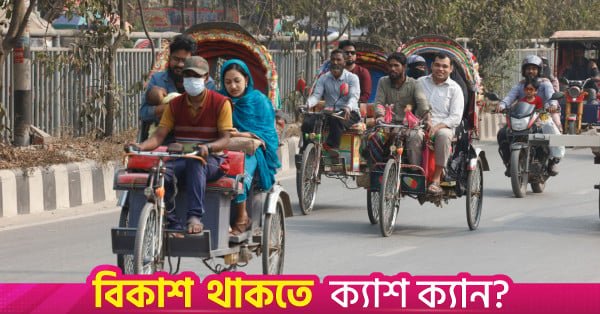
The government is moving to keep battery-powered rickshaws off Dhaka’s main roads, as the unregulated growth of the vehicles has turned them into a growing source of traffic congestion, road-safety risks and electricity consumption.
Battery-powered and electric rickshaws will not be allowed on Dhaka’s main roads under a proposed policy now in its final stage, State Minister for Local Government Mir Shahe Alam said yesterday (30 August).
Registered e-rickshaws carrying up to four passengers will, however, be allowed to operate on internal roads. The proposed framework also envisages mandatory technical certification, fitness certificates, licensed charging points, manufacturer registration, zone-based operation, and geofencing.

The announcement comes as Dhaka struggles with an increasingly visible problem: a mode of transport that once filled a gap in the city’s public-transport system has expanded largely outside any effective regulatory framework.
How did the boom begin?
Battery-powered three-wheelers are not new to Bangladesh. The first commercial battery-powered vehicles were introduced in Comilla in 2004, while Chinese-made three-wheelers were imported and marketed more widely from 2008.
By 2011, the government estimated that four to five lakh battery-run three-wheelers were already operating across the country.
Even then, authorities were concerned about safety and electricity consumption. In 2011, the government banned the import and assembly of the vehicles, while officials said a large proportion were being charged using electricity through unauthorised connections.
The vehicles subsequently spread rapidly because they offered something Bangladesh’s formal transport system often failed to provide: cheap, readily available and relatively fast short-distance transport.
A TBS analysis published in 2025 noted that battery-run rickshaws had been introduced in the late 2000s and had expanded rapidly because of their lower operating costs, passenger demand and higher earning potential for drivers.
From a few lanes to major roads
The fundamental problem is not simply that battery-powered rickshaws exist. It is the speed and scale at which they have multiplied without a corresponding regulatory system.
By 2024, estimates put the number of battery-powered auto-rickshaws in Bangladesh at up to four million.
Their proliferation has been driven by both demand and economics. A TBS analysis found that public transport accounts for less than 2% of registered vehicles in Bangladesh, leaving a huge gap that small vehicles have moved in to fill.
In Dhaka, the problem has become particularly acute. A 2025 Buet study cited by TBS estimated that the number of battery-powered rickshaws in Dhaka had crossed 600,000, after roughly 400,000 additional vehicles entered the city’s roads following the political transition in August 2024.
Other estimates are considerably higher. A TBS investigation later estimated that around one million battery-run rickshaws were operating in Dhaka.
Why are they dangerous?
The vehicles are often locally assembled or modified from conventional pedal rickshaws, with imported motors, batteries and other components. That creates a serious safety problem.
A conventional pedal rickshaw is not designed to travel at the speeds achievable after a motor is added. Many battery-powered rickshaws retain braking and structural systems designed for much slower vehicles.
According to Buet’s Accident Research Institute, 900 accidents involving battery-powered three-wheelers were recorded nationwide between January and October 2023, of which 582 were severe.
More recent data cited in a CPD study showed that electric three-wheelers accounted for 16.5% of reported road accidents and 21.01% of road fatalities in 2024.
The risks are amplified by untrained drivers, excessive speed, weak braking systems and unpredictable manoeuvring.
The vehicles frequently enter major roads, flyovers and intersections where they interact with buses, trucks, cars, motorcycles and pedestrians moving at very different speeds. That creates not only an accident risk but also a traffic-flow problem.
Another burden: Electricity
The battery-rickshaw boom has also created an unexpected pressure on the power system. A CPD study estimated that electric three-wheelers consume nearly 5% of Bangladesh’s daily electricity generation, equivalent to about 750MW.
The same study found that Dhaka had more than 48,000 illegal charging points, compared with only around 3,300 government-approved charging stations.
TBS has separately reported that illegal charging networks have expanded alongside the vehicles, with estimates of around Tk4,000 crore in annual power theft associated with the sector.
The problem therefore extends beyond traffic management. Unregulated charging means lost government revenue, additional pressure on distribution networks and heightened fire and electrical-safety risks.
An unregulated parts and manufacturing ecosystem
The vehicles’ rapid growth has been accompanied by a largely informal manufacturing ecosystem. While many vehicles are assembled locally, key components—including motors, controllers, chargers, differentials and batteries—are imported, predominantly from China.
The government itself now acknowledges the scale of the problem. State Minister Shahe Alam said authorities have no specific data on the number of factories manufacturing e-rickshaws.
Under the proposed policy, manufacturers will have to register and obtain licences, while vehicles will need designs certified by Buet or engineering universities before registration.
This is important because regulating only the vehicles already on the road will not solve the problem if new, non-compliant vehicles continue to enter the market.
So what is the way forward?
A blanket ban may be difficult to enforce—and could create a livelihood crisis for hundreds of thousands of drivers.
The better approach is to formalise the sector while restricting where and how it operates.
First, all vehicles should be registered and fitted with a unique identification system.
Second, manufacturers should be licensed and vehicles should meet mandatory standards for braking, speed, dimensions, lighting and structural strength.
Third, drivers should receive basic training and licences.
Fourth, battery rickshaws should be restricted to designated neighbourhood and feeder routes, with a firm ban on major roads, highways and expressways.
Fifth, charging stations should be licensed, metered and brought under the formal electricity system
Sixth, the government should stop the uncontrolled import of non-compliant components and require certification of imported motors, controllers, batteries and other critical parts.
Finally, Dhaka needs better public transport.
Battery rickshaws expanded partly because millions of commuters needed an affordable way to complete short journeys. If they are simply removed without providing reliable buses, mass transit and properly designed feeder services, the underlying demand will remain.
The government’s latest proposal—main-road restrictions combined with registration, technical certification, licensed charging, zoning and geofencing—therefore points in the right direction.
The real test will be implementation.
For nearly two decades, Bangladesh has tried to control battery-powered three-wheelers through bans and periodic crackdowns. The result has largely been more vehicles, more informal workshops and more charging points.
The challenge now is to ensure that the next phase is not another crackdown, but the beginning of a regulated electric three-wheeler industry that serves commuters without taking over Dhaka’s roads.
About The Author