
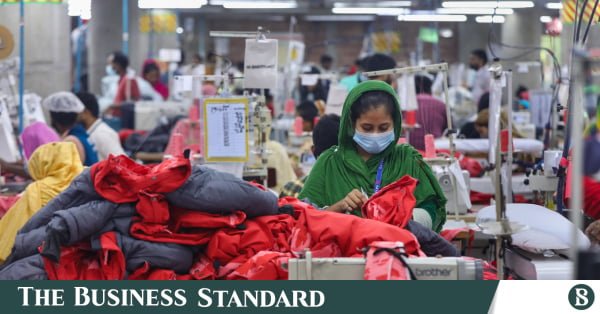
Garment workers have been protesting across Bangladesh since mid-October, with the unrest escalating over the past week into highway blockades, clashes with police and factory shutdowns in Dhaka, Gazipur and Ashulia. On 1 November, the government formed a six-member wage board to review workers’ pay, as protesters continued to demand a monthly minimum wage of Tk30,000, against the existing floor of Tk12,500.
At first glance, the dispute appears to present a familiar dilemma: how much can workers earn without making the industry uncompetitive? Factory owners warn that a substantial wage increase could push already struggling manufacturers towards closure, while workers argue that their current earnings are no longer enough to meet basic household expenses.
Both sides have legitimate concerns. But the debate is missing a fundamental question: who should pay for higher wages?

Bangladesh is one of the world’s largest apparel exporters, yet it has limited power to determine the prices at which its products are sold. International brands control much of the value chain, while local manufacturers compete for orders and absorb rising production costs.
Consequently, every wage negotiation becomes a struggle over who bears the additional expense, with workers and factories often left carrying the burden.
The Tk30,000 demand is therefore not simply a question of how much manufacturers can afford to pay. It also exposes a deeper structural weakness: an industry that generates billions of dollars in exports but has little leverage to secure a fairer share of the value its products create.
The workers’ case: Inflation has eroded purchasing power
Bangladesh’s current garment-sector minimum wage of Tk12,500 was announced in November 2023 following weeks of protests and negotiations. The 56.25% increase took effect on 1 December that year. Workers had initially demanded around Tk23,000, while factory owners proposed Tk10,400.
Nearly three years later, the gap between wages and living costs remains a central source of discontent.
According to the Bangladesh Bureau of Statistics (BBS), inflation stood at 8.34% in September 2026, while the national wage growth rate was 7.90%. Inflation has outpaced wage growth for 56 consecutive months, according to BBS data.
The Wage Rate Index (WRI), however, tracks low-paid skilled and unskilled workers across 63 occupations in agriculture, industry and services. It is a national indicator rather than a measure of wage growth specifically among garment workers.
Nevertheless, it offers an indication of the prolonged pressure on the purchasing power of lower-income wage earners.
The pressure extends beyond workers. A BBS Living Standard Survey 2025 found that 47.42% of households across Bangladesh had borrowed money to meet basic living expenses. The figure reflects a broader household financial crisis rather than conditions among garment workers alone.
The erosion of purchasing power becomes clearer when inflation is considered cumulatively. If prices increase by approximately 9% annually over three years, the cumulative rise would be around 30% (1.09³ ≈ 1.30). On that basis, a Tk12,500 minimum wage in 2023 would need to rise to roughly Tk16,200 today just to maintain its original purchasing power.
This is an illustrative calculation rather than an official estimate of cumulative inflation over the period. Actual household inflation may differ depending on consumption patterns, particularly for low-income families, which spend a larger proportion of their earnings on food, housing and essential services.
Even so, the calculation establishes an important point: inflation alone justifies a substantial adjustment to the existing minimum wage, although it does not explain the full Tk30,000 demand.
Workers argue that the problem goes beyond the minimum wage figure. Many depend on overtime to increase their monthly earnings, but even those receiving Tk18,000–20,000 struggle to cover household expenses, according to accounts reported by Al Jazeera.
The 2023 wage revision also left workers dissatisfied, as their original demand was substantially reduced during negotiations. The current demand, therefore, reflects not only accumulated inflation but also frustration with a wage-setting process that workers believe has consistently fallen short of their living costs.
The owners’ case: An industry under mounting pressure
Factory owners, meanwhile, point to weakening export performance and rising production costs to argue that the industry cannot absorb a near-tripling of the minimum wage without significant disruption.
Export data offer some support for their concerns.
Bangladesh’s ready-made garment (RMG) exports fell 1.64% to $38.70 billion in FY2025-26, down from $39.35 billion in the previous fiscal year, according to Export Promotion Bureau (EPB) data compiled by the Bangladesh Garment Manufacturers and Exporters Association (BGMEA).
Exports to the European Union, Bangladesh’s largest apparel market, declined 3.31% to $19.06 billion. Shipments to the United States, however, increased 2.63% to $7.74 billion.
The annual decline was relatively modest, but the performance in some individual months was considerably weaker. Apparel exports fell 14.23% year-on-year in December 2025 and 19.35% in March 2026.
The export downturn came amid weak global apparel demand, port-related disruptions and uncertainty surrounding the domestic political and economic environment. Manufacturers have also cited energy shortages, higher production costs and persistent pressure from international buyers to keep prices competitive.
The Bangladesh Knitwear Manufacturers and Exporters Association (BKMEA) highlighted the imbalance in December 2024, saying that product prices had fallen by around 5% while production costs had increased by approximately 50%.
The figures point to a sector facing a difficult combination of declining prices and rising costs. For smaller manufacturers, which generally have less financial flexibility and weaker negotiating power than large exporters, another substantial increase in operating expenses could be particularly difficult to manage.
A jump from Tk12,500 to Tk30,000 would represent a 140% increase in the minimum wage. While the actual impact on a factory’s total costs would depend on its workforce composition, worker grades and product mix, the increase would be substantial.
The owners’ concern, therefore, cannot simply be dismissed as resistance to paying workers more. The industry is operating in a competitive international market, and manufacturers fear that higher costs without corresponding increases in export prices could make their factories less attractive to buyers.
But this raises a more important question: why are Bangladeshi manufacturers so vulnerable to relatively small changes in their cost structures?
The real problem: Bangladesh has little pricing power
The answer lies partly in Bangladesh’s position in the global apparel value chain.
The widely used ‘smile curve’ model illustrates how value is distributed across the production process. Activities such as research, product development and design at one end, and branding, marketing and retailing at the other, tend to capture higher margins. Manufacturing, positioned in the middle, generally captures a smaller share.
Bangladesh remains heavily concentrated in the manufacturing segment, particularly cut-make-trim operations. International brands often determine product specifications and designs, while manufacturers depend substantially on imported fabrics and other inputs.
This limits the ability of local factories to negotiate prices independently.
A widely cited Fair Wear Foundation breakdown of an $18.25 Bangladesh-made polo shirt illustrates the imbalance. Workers received approximately $0.54, or around 3% of the retail price. The factory’s total manufacturing cost was $3.50, and it sold the product for $3.85, including a 10% margin.
Although the study is from 2019 and its dollar figures should be treated as illustrative rather than representative of today’s entire industry, the underlying distribution of value remains relevant.
The factory captures only a fraction of the final retail price, while a substantial share of the value is generated and retained further along the supply chain.
This imbalance also shapes wage negotiations.
A brand sourcing garments from Bangladesh can compare prices with manufacturers in Vietnam, Cambodia or India and shift orders when another supplier offers more favourable terms. A Bangladeshi factory, however, cannot easily replace a major international buyer without risking substantial losses.
A 2017 International Labour Organization (ILO) survey, conducted in collaboration with the Ethical Trading Initiatives and covering 1,454 suppliers across 87 countries, provides further evidence of this imbalance.
The survey found that only 17% of Bangladeshi suppliers said their buyers were willing to reflect minimum-wage increases in the prices paid. Globally, 39% of surveyed suppliers had accepted orders that did not cover production costs. The figure was 52% among textile and clothing suppliers.
The survey also found that, among suppliers that had accepted below-cost orders, 52% of Bangladeshi respondents identified pressure from buyers as a factor behind the practice.
These findings illustrate how limited suppliers’ bargaining power can make it difficult to pass higher labour costs on to international buyers.
The problem is not merely that brands negotiate aggressively. It is that suppliers often have little alternative when a buyer controls a substantial share of their orders. The ILO survey found that 54% of suppliers faced a high dependency risk, meaning their main buyer accounted for at least 35% of their production. The proportion was around 75% in the garment sector.
This reveals a structural contradiction. International brands increasingly promote ethical sourcing and responsible business practices, yet the pressure to maintain low procurement prices can make it difficult for manufacturers to provide workers with better wages.
In effect, Bangladesh’s weak position in the value chain means factories have limited control over the prices they receive, even as they remain responsible for paying workers, maintaining production facilities and managing rising costs.
Why higher wages are cheap at retail but expensive at the factory gate
The distribution of value becomes particularly important when the proposed wage increase is translated into the cost of an individual garment.
Consider the Fair Wear polo-shirt example. The product’s direct labour cost, including salaries, was $0.33, while indirect labour costs, including allowances, amounted to $0.21. Together, they represented $0.54 of the $18.25 retail price.
If, purely for illustration, the combined labour component increased 2.4-fold, corresponding to the ratio between the proposed Tk30,000 wage and the existing Tk12,500 minimum, it would rise to approximately $1.30. That would add around $0.76 to the garment’s cost.
Compared with its $18.25 retail price, the additional amount represents roughly 4.1%. For a European consumer purchasing the shirt, the difference would be relatively small.
But the calculation looks very different at the factory gate. The manufacturer sells the shirt for $3.85, meaning the additional $0.76 would equal nearly 20% of the selling price.
This is where the apparent affordability of higher wages becomes a much more complicated commercial question.
The additional cost may be small compared with the final retail price, but it is substantial for a manufacturer negotiating orders with international buyers. A sourcing manager comparing quotations from Dhaka and Hanoi will be concerned with the factory-gate price, not the final price paid by a European shopper.
There are important limitations to this calculation. The polo-shirt breakdown comes from a single product in a 2019 study, and labour costs vary according to garment type, factory efficiency and workers’ grades. Moreover, a 140% increase in the statutory minimum wage would not necessarily translate into an equivalent increase in every product’s labour cost.
The calculation is therefore a hypothetical illustration of how the same additional cost looks different at the retail and manufacturing stages, not an estimate of the actual impact of the proposed wage revision.
Nevertheless, it illustrates why both workers and factory owners can have legitimate concerns. Higher wages may be relatively inexpensive at the retail end of the supply chain but considerably more difficult to accommodate at the manufacturing stage.
The central issue is not simply the size of the wage increase. It is who pays for it.
If international buyers refuse to adjust their procurement prices, manufacturers are left with fewer options: absorb the cost through lower margins, improve productivity, reduce other expenses or pass the pressure down to workers. The last option, however, only perpetuates the problem that triggered the protests in the first place.
The LDC clock has been reset, but not removed
Bangladesh’s upcoming graduation from the United Nations’ least-developed country (LDC) category adds another dimension to the competitiveness debate.
One important development has changed the immediate timeline. Bangladesh was originally scheduled to graduate on 24 November 2026. However, on 29 October, the UN General Assembly approved a three-year deferral, moving the graduation date to 24 November 2029.
The decision gives the country additional time to prepare for the loss of trade preferences that have supported its export competitiveness, particularly in the European Union.
Under the EU’s Everything But Arms (EBA) scheme, Bangladesh currently enjoys duty-free and quota-free access for its exports. Following LDC graduation, the EU provides a three-year transition period before withdrawing EBA preferences.
With Bangladesh’s revised graduation date, preferential access could therefore continue until approximately late 2032, subject to the applicable EU transition arrangements.
After that, Bangladeshi garments could face higher import duties under the EU’s standard tariff regime unless the country secures GSP+ benefits or another preferential trade arrangement. GSP+ offers the possibility of retaining duty-free access for eligible products, subject to meeting the EU’s economic, human rights, labour rights and environmental requirements.
The challenge is significant because competitors such as Vietnam already benefit from a free trade agreement with the EU.
The three-year deferral has therefore eased the immediate pressure on Bangladesh’s export sector. It provides additional time to negotiate trade arrangements, improve compliance and strengthen the competitiveness of domestic manufacturers.
But it does not resolve the underlying weakness. Bangladesh still has a limited window to move towards higher-value production and reduce its dependence on competing primarily through low-cost manufacturing.
The additional time should not be mistaken for a solution. Without structural changes, the country could face the same competitiveness problems when preferential access eventually expires.
What a sustainable wage settlement should look like
The evidence suggests that neither accepting the Tk30,000 demand in full immediately nor maintaining the existing minimum wage offers a sustainable way forward.
A workable settlement needs to address both workers’ declining purchasing power and the industry’s structural weaknesses.
First, Bangladesh needs a more predictable wage-setting mechanism. The current system leaves workers waiting for years between major revisions, allowing inflation to erode their earnings and turning each wage review into a potentially disruptive confrontation. Linking minimum-wage adjustments to inflation through an annual review mechanism would make future increases more predictable for both workers and employers.
Second, any substantial increase could be implemented in phases. A staged adjustment would give manufacturers, particularly small and medium-sized factories, time to reorganise production costs and negotiate revised prices with international buyers.
However, phasing should not become an excuse to postpone meaningful wage improvements indefinitely.
Third, international buyers must become part of the wage discussion. Cost-transparency mechanisms, including Fair Wear’s Fair Price app, which is being adopted by the knitwear association, could help manufacturers demonstrate precisely how changes in wages affect garment prices.
Brands that publicly commit to responsible sourcing should be expected to reflect those commitments in their purchasing practices. Ethical sourcing cannot be meaningful if buyers demand higher labour standards while refusing to pay prices that allow suppliers to meet them.
Finally, wage policy must be connected to a broader industrial competitiveness strategy. Reliable energy supplies, more efficient ports, improved productivity, greater local capacity for producing fabrics and accessories, and a shift towards higher-value garments would all help manufacturers operate with stronger margins.
Bangladesh also needs to accelerate negotiations over post-LDC market access, particularly the possibility of securing GSP+ benefits in the European Union.
These are not separate policy questions. They determine whether factories can pay higher wages without losing their ability to compete internationally.
The question is bigger than Tk30,000
The Tk30,000 demand is likely to be difficult for many factories to accommodate immediately, and inflation alone does not justify the full increase. But that does not make the workers’ grievances any less legitimate. Years of inflation have reduced their purchasing power, while dependence on overtime has failed to provide many households with financial security.
Factory owners, meanwhile, are operating under genuine pressure from weaker export performance, rising costs and international buyers reluctant to pay higher prices.
Treating the dispute as a contest between workers and the industry, however, misses the central problem. Bangladesh has built a globally significant garment-export sector without acquiring comparable bargaining power over the value its products generate.
The experience of competitors such as Vietnam suggests that an apparel industry does not have to rely exclusively on low wages to remain competitive. Moving towards more sophisticated production capabilities, higher-value products and stronger supplier relationships can allow manufacturers to compete on quality, productivity and reliability rather than price alone.
Bangladesh cannot continue to rely indefinitely on low wages as its principal competitive advantage. Nor can it expect workers to absorb the cost of remaining competitive while international buyers and retailers retain a disproportionate share of the value.
The wage dispute will eventually produce a new minimum-wage figure. But unless Bangladesh changes its position in the global apparel value chain, the same confrontation is likely to return in the next wage review.
The real question is not whether Bangladesh can afford to pay garment workers more. It is whether the country can transform an industry that earns billions of dollars from exports but still struggles to secure a fairer share of the value it creates.
About The Author