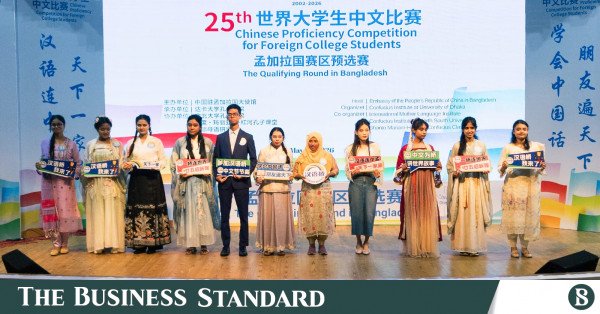
The International Mother Language Institute in Dhaka hosted the Bangladesh qualifying round of the Chinese Bridge Chinese Proficiency Competition for Foreign College Students on 14 May, bringing together young Bangladeshi learners of Mandarin to showcase their language proficiency and cultural talents.
The event was hosted by the Embassy of the People’s Republic of China in Bangladesh and organised by the Confucius Institute at the University of Dhaka, in coordination with the International Mother Language Institute, the Confucius Institute at North South University, and the Shanto Mariam–Honghe Confucius Classroom.
A total of 11 contestants competed in the qualifying round after advancing through earlier selection stages. The finalists demonstrated their Chinese language proficiency through prepared speeches delivered in Mandarin and through cultural performances that reflected different aspects of Chinese traditions. These performances included traditional music, dance, calligraphy and martial arts displays.
The competition aims to provide a platform for Bangladeshi university students who are learning Chinese to demonstrate their linguistic ability and creative talents. The winner of the Bangladesh qualifying round will represent the country at the global finals of the Chinese Bridge competition in China, while the runner-up will travel to China as an observing guest.

The Chinese Bridge Chinese Proficiency Competition for Foreign College Students is a large-scale international contest hosted by the Center for Language Education and Cooperation under China’s Ministry of Education. Since its launch in 2002, the competition has become one of the most prominent international platforms for students studying Chinese, often described as the “Olympics” of Chinese language learning.
Speaking at the event, Chinese Ambassador Yao Wen highlighted the growing importance of language exchange in strengthening relations between Bangladesh and China. He noted that the Chinese Bridge competition attracts more than 40,000 participants each year from over 130 countries and regions, reflecting the expanding global interest in learning Chinese.
The ambassador also praised the enthusiasm of Bangladeshi students participating in the competition, describing them as young cultural ambassadors who contribute to building stronger connections between the two nations. Through language learning and cultural exchange, he said, young people can play an important role in fostering mutual understanding and cooperation.
Beyond the competition itself, the event also reflected months of preparation by both organisers and participants. According to Zhao Jiangyan, a Chinese language teacher and one of the organisers, preparations for the programme began in February when the registration notice and preliminary materials were released.
More than 50 students initially registered for the competition. In April, they participated in the first round of selection where they were assessed through several components including Chinese character writing, speeches and talent performances. Following the evaluation process, 11 contestants were selected to compete in the Bangladesh qualifying round.
The final competition itself consisted of multiple segments. In the morning session, contestants took part in a quiz that tested their knowledge of Chinese language and culture. In the afternoon, they delivered prepared speeches in Chinese and presented their talent performances on stage.
Zhao noted that the contestants spent several months preparing under the guidance of their teachers, refining both their language skills and their cultural presentations. Many participants dedicated significant time to rehearsing their performances while improving pronunciation, vocabulary and public speaking in Mandarin.
The Confucius Institute at the University of Dhaka, which organised the programme, has been playing a key role in promoting Chinese language education and cultural exchange in Bangladesh. Through language courses, cultural activities and academic collaborations, the institute has contributed to increasing interest among Bangladeshi students in learning Chinese and understanding Chinese culture.
Events like the Chinese Bridge competition, organisers say, help bring that learning beyond the classroom by giving students a stage to demonstrate their achievements. By combining language proficiency with cultural performances, the programme highlights how language learning can also serve as a bridge for broader cultural dialogue.
As the competition concluded, winners were announced across several categories, including first, second and third prizes, along with honourable mentions. For the contestants, however, the event represented more than a competition – it was an opportunity to share their passion for language learning and to strengthen the growing cultural connection between Bangladesh and China.
About The Author