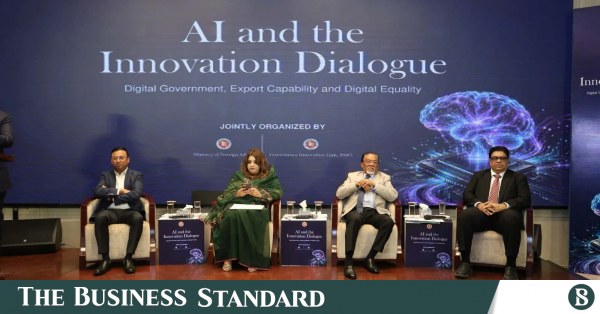
Bangladesh plans to place artificial intelligence (AI) at the centre of its technology diplomacy and public service delivery, senior government officials said at a dialogue in Dhaka today (8 October).
The Governance Innovation Unit (GIU) of the Prime Minister’s Office and the Ministry of Foreign Affairs jointly organised the “AI and Innovation Dialogue” at the Foreign Ministry auditorium in Segunbagicha.
The event was the third dialogue in a series that emerged from the third thematic session of the Trade, Growth and Economic Diplomacy Conference held in June, according to a press release.

Speaking as chief guest, Adviser to the Prime Minister on Public Administration and GIU Head Md Ismail Zabihullah stressed the need for a whole-of-government approach to maximise the benefits of AI.
He also highlighted the need for institutional coordination and seamless interoperability across public service delivery systems, the press release said.
Adviser to the Prime Minister for Posts, Telecommunications, Information Technology and Science and Technology Rehan Asif Asad said the government was placing greater emphasis on expanding public access to digital technologies.
He said Bangladesh would soon be able to produce advanced feature phones at affordable prices, attributing the development to policies adopted by the BNP government.
Rehan also said Bangladesh would have its own “sovereign AI” within the next 12 months, adding that the computing chips and memory modules required for the platforms had already been secured.
State Minister for Foreign Affairs Shama Obaed Islam said AI would be a key driver of the government’s ambition to build a trillion-dollar economy.
She also highlighted institutional reforms at the Foreign Ministry aimed at increasing its focus on the creative economy and other emerging sectors, according to the press release.
State Minister for Foreign Affairs Humayun Kabir said garments and remittances had long been the two major pillars of Bangladesh’s economy, but the country’s ambition of becoming a trillion-dollar economy would require a third pillar: knowledge workers.
Foreign Secretary Ambassador Salahuddin Noman Chowdhury said Bangladesh needed to focus on ensuring that the benefits of AI were distributed equitably.
“The fundamental question now is who controls AI and who benefits from it,” he said, adding that Bangladesh sought to become a beneficiary of AI rather than merely a consumer and aimed to act as a bridge between different global stakeholders.
Representatives from the Foreign Ministry’s ITIT Wing and the United Nations Development Programme presented technical papers on benchmarking and establishing an AI Policy Lab in Dhaka.
Lt Gen (retd) Md Mahfuzur Rahman, chairman of the Osmani Centre for Peace and Security Studies, discussed the security implications of AI for Bangladesh and beyond.
Joan Ai, co-founder and executive director of the Blanchard House Institute, also delivered a special address.
Around 25 international organisations and 85 Bangladeshi diplomatic missions joined the session online, while senior officials from government agencies, diplomats, development partners, technology companies, startups, businesses, chambers, academia and think tanks attended the dialogue.
About The Author