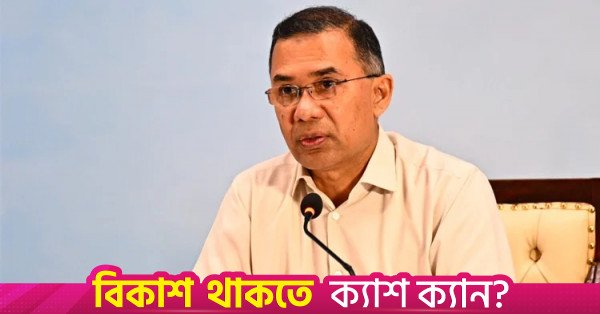
Prime Minister Tarique Rahman yesterday (24 September) announced Bangladesh’s return to ‘the path of democracy’ in front of the international community, and said his government was pursuing a ‘3-R strategy’ — Recovery, Restoration and Reconstruction — to rebuild the country after a prolonged period of what he described as ‘fascist’ rule and exploitation.
The PM, who started off by exchanging greetings with the president of the 81st session of the UNGA, his own foreign minister Dr Khalilur Rahman, quickly found his footing with a short but decisive introductory section: in it, he began by paying his deepest respects to “all the martyred freedom fighters of Bangladesh”.
He then recalled the contributions of those who have sacrificed their lives in the struggle to establish democracy, justice and the rights of people in Bangladesh, “since independence”.

Last but not least, he paid his sincere respects to “all those who were martyred and injured in the mass uprising of the brave students and people in July-August 2024 against fascism”.
The words were carefully chosen and uncontroversial. None was accorded greater or undue importance. It was as if he solved the puzzle dividing Bangladesh for the last two years with simple chronology.
He then briefed his audience on the results of the February 12 election (no, the referendum wasn’t mentioned, in case you were wondering), and allowed himself a moment of nostalgia to recall his illustrious parents, both of whom addressed the same august assembly, making him the third member of his family to address the UNGA – something that has had historians scratching their heads already this week to try and think of a precedent.
Around 3-4 minutes into his address, the prime minister segued into global issues and lamented the ‘tendency to divert development budgets towards military expenditure in various countries of the world,’ before making a strong stand for “complete and general disarmament”.
He even committed Bangladesh to “any initiative of the United Nations aimed at establishing global humanity and world peace.” And that brought us to Palestine – the first foreign country to be mentioned, in fact, one of only two in his entire speech (the other being Myanmar).
It is of course a bread-and-butter issue for any Bangladeshi leader, and the PM drove it home as well: “The people of Bangladesh, who cherish democracy, are deeply concerned about the suffering of the freedom-seeking Palestinian people. Bangladesh reaffirms its unwavering support for their legitimate demands, including their right to self-determination and their right to establish an independent State of Palestine.”
By sprinkling his words with these occasional references to the primacy of democracy as a ruling dispensation – even equating inclusive growth and prosperity with ‘democratisation of the economy’ – the PM was setting us up for the thrust of his message, which lay in passages such as the following:
“Having freed itself from the scourges of enforced disappearances and killings, abductions, corruption, looting and money laundering that had become the norm under fascist rule, Bangladesh is now once again embarking on the path of democracy. To repair Bangladesh, which was ravaged by fascist rule and exploitation, the government is pursuing a 3-R strategy – Recovery, Restoration and Reconstruction.”
There was no real elaboration on any of those, but I suppose we’re expected to “get it”. His government was involved in doing important work, nursing a country of 180 million people out of the clutches of fascism, and back to democracy.
He sought to reassure his audience that the women and the youth and different denominations all figured in his plans, as he explained some of the schemes his government has been implementing, such as the Family Card (and a number of other cards), the 250 million trees they’re planting, plans to gradually increase education spending to 5 percent of GDP, etc.
He then called on the United Nations to adopt an “effective policy framework” so that the benefits of the development and rapid expansion of artificial intelligence and social media can be used positively in countries around the world.
The Prime Minister said Bangladesh remained committed to ensuring regular, safe and orderly migration and called for stronger global cooperation to protect the rights, dignity and welfare of migrants.
As Bangladesh prepares to graduate from the UN’s Least Developed Countries category, he sought continued international support in financing, market access, technology transfer and capacity building to make the transition sustainable.
He also stressed the importance of trade facilitation, connectivity and regional cooperation, saying countries could help one another achieve prosperity through greater economic integration.
At one point, he presented a very interesting or in fact baffling statistic or calculation, saying precisely 73% of the 31-point programme on which the BNP ran its election campaign and got elected on “directly aligns” with the UN’s SDG theme of ‘Leave No One Behind’, while the remaining 27 percent have an “indirect alignment” with it.
Whatever that was supposed to mean, it sounded unnecessary and out of place, and most likely would have gone over most people’s heads. It was the one really dim moment in the 22-minute speech.
Rohingyas, climate change
The Prime Minister of course brought up that Bangladesh had been sheltering more than 1.2 million forcibly displaced Rohingyas from Myanmar for more than nine years, putting immense pressure on the country’s resources, environment, security and local communities. His most effective line on the issue was actually delivered earlier in the week at the high-level dialogue on the Rohingya crisis, when he said “humanitarian generosity must not become an excuse for international inaction.”
But given that there is no realistic possibility of any movement on the Rohingya issue as long as the civil war in Myanmar persists, the prime minister probably thought better of putting too fine a point on it.
Coming to climate change, he said Bangladesh expects stronger global action at the upcoming COP31, the UN’s annual climate change conference. He specifically mentioned climate justice, climate finance and adaptation support as priorities for Bangladesh.
Intriguingly, after going through some of his government’s environmentally-friendly or adaptation-oriented policies, Rahman mentioned that his government was implementing “the Teesta Master Plan” and the ‘Padma Barrage’ project – both of which carry sensitivities across the border. Particularly given the possibility of Chinese involvement in the former. But by-and-large, the speech steered clear of spewing any venom or vitriol against any other country.
Whether intentionally or otherwise, the best part of the PM’s speech was certainly kept for last – where he presented his most concise, coherent, and compelling vision for the future of Bangladesh.
“A state can never become strong by keeping its citizens powerless,” he began by saying, before instantly providing the meat to the bones of that idea. “By ensuring the political and economic empowerment of the people, we want to establish a prosperous, self-reliant, welfare-oriented democratic state where everyone, irrespective of political affiliation, religion or race, can live without anxiety and in safety, with equal rights, respect and dignity.”
He acknowledged that Bangladesh remained a work-in-progress; in numerous areas spanning “democracy, human rights, good governance, accountability, political stability and the investment environment”, there remains much work to be done. But this work, he said, is continuing, with the aim to establish “a safe and stable Bangladesh with a business-and investment-friendly environment.”
The PM even brought it all together nicely at the end, giving pride of place to “the assurance of a safe and peaceful life” in the Bangladesh he hopes to build. Which laid it up nicely for him to deliver an evolved version of what started out as his ‘Bangladesh First’ political mantra. It is now ‘Bangladesh First – Bangladesh For All’.
He ended his speech with the BNP’s trademark ‘Bangladesh Zindabad’.
About The Author