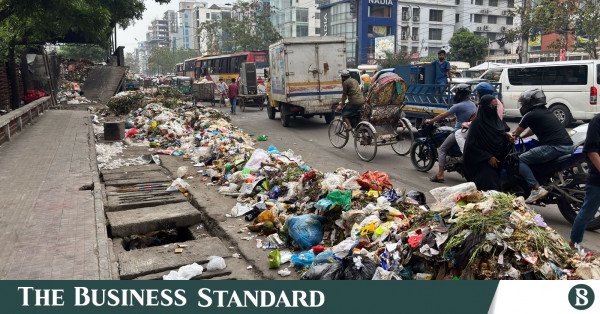
Bangladesh generates more municipal solid waste per capita than India and ranks third highest in South Asia, according to the World Bank.
The findings were published in the World Bank’s “What a Waste 3.0” report last month.
The country’s per capita waste generation stands at 0.52 kilograms per capita per day in 2022, above the regional average of 0.49 kilograms per capita per day.

The Maldives records the highest per capita generation at 1.18 kilograms per capita per day, followed by Pakistan at 0.55 kilograms per capita per day. Nepal reports the lowest at 0.18 kilograms per capita per day.
While India produces the highest total volume of municipal solid waste in South Asia, amounting to 202.25 million tonnes annually, its per capita generation of 0.40 kilograms per capita per day remains lower than Bangladesh’s, largely due to its population size.
In a broader global context, developed countries generate significantly more municipal solid waste per capita than Bangladesh, including the United States at 2.18 kilograms per capita per day, Canada at 2.25 kilograms per capita per day, and the United Kingdom at 1.28 kilograms per capita per day.
Waste generation set to rise sharply
Bangladesh’s municipal solid waste generation is projected to rise by 66% by 2050, reaching 50.66 million tonnes annually from 30.47 million tonnes in 2021, according to the World Bank.
It is projected to increase to 31.64 million tonnes in 2022, 35.83 million tonnes in 2030, and 40.27 million tonnes in 2040 before reaching the 2050 estimate.
The increase significantly outpaces the country’s projected population growth of 28% by 2050, meaning waste is expected to grow at more than twice the rate of population growth.
Alongside India and Pakistan, Bangladesh accounts for 97% of South Asia’s total waste generation.
Waste stream dominated by organic, recyclable materials
Bangladesh’s waste stream is largely dominated by organic and recyclable materials, the World Bank report says.
Food waste accounts for the largest share at 19.25%, followed by paper and cardboard at 18.36% and plastic at 17.65%, along with other fractions such as garden waste, rubber and leather, metal, textiles, glass and wood.
In terms of composition, Bangladesh stands out in the regional context.
It records the highest share of paper and cardboard at 18.36%, exceeding Nepal’s 16%, while its textile share of 9.95% is nearly double that of Afghanistan at 5.44% and India at 5.30%.
The gap is more pronounced in rubber and leather at 9.70%, far above most regional peers that remain below 2%, including India at 1.10%.
Similarly, its metal share of 9.49% is more than double Bhutan’s 4.40%, the next highest.
Collection strong, but treatment remains weak
Waste collection performance in Bangladesh shows relative strength, with total coverage at 80.63%, as per the World Bank report.
Urban areas record a collection rate of 96.96%, while rural coverage stands at 63.87%. This reflects a stronger urban system compared to the South Asian average, where urban collection is around 88%.
For example, Dhaka records an 89% collection rate, performing better than cities such as Lahore, Colombo and Karachi, though it still trails Delhi and Ahmedabad.
However, treatment and disposal practices remain heavily dependent on unsustainable methods.
Across South Asia, around 71% of waste is either uncollected or openly dumped, and Bangladesh mirrors this pattern, with over 55% disposed of in unspecified landfills and nearly 20% remaining uncollected.
Recycling remains limited at just 3.14%, while incineration accounts for only 0.29%, far below regional leaders such as Bhutan and Afghanistan, which recycle around 24% and 19% of their waste respectively.
Policy steps signal shift, implementation remains key
In response, Bangladesh has introduced the Solid Waste Management Rules 2021, including Extended Producer Responsibility and the 3R (reduce, reuse, recycle) strategy, signalling a shift towards structured waste governance.
However, effective implementation will be essential to address the country’s rapidly growing waste challenge.
About The Author