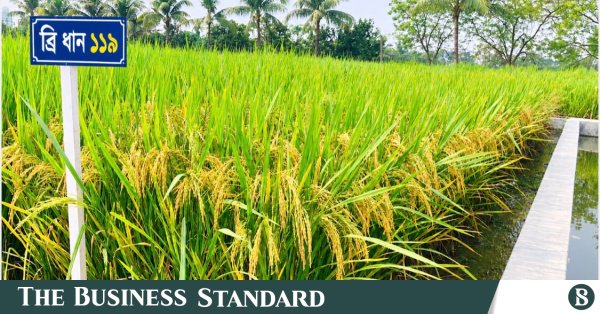
The Bangladesh Rice Research Institute (BRRI) has released a new salt-tolerant rice variety, BRRI Rice119, with a potential yield of up to 7.6 tonnes per hectare, offering a higher-yielding option for farmers in coastal areas.
The National Seed Board (NSB) gave final approval to the variety at its 116th meeting on 28 October 2026, clearing it for cultivation in both saline coastal regions and favourable non-saline environments.
According to BRRI, the variety produces an average yield of 5.7 tonnes per hectare under proper cultivation, with yields ranging from 4.8 to 7.6 tonnes depending on environmental conditions and salinity levels. It can yield around one tonne more per hectare than the existing BRRI Rice73 variety.

Developed by scientists at BRRI’s Plant Breeding Division under the Location Specific Technology Development (LSTD) project, BRRI Rice119 takes just 115 days to mature and has strong stems that help prevent lodging.
The variety produces an average of 215 filled grains per panicle, around 70-80 more than BRRI Rice73, owing to the presence of the effective Gn1a gene.
Its medium-slender white grains produce fluffy rice after cooking, making it suitable for local food preferences, the institute said.
BRRI Rice119 can tolerate salinity levels of up to 12 deciSiemens per metre (dS/m) for three weeks at the seedling stage. It can also maintain normal yields under salinity levels of 8-10 dS/m during sensitive growth stages, from vegetative development to reproduction.
Farmer-participatory field trials in saline and non-saline areas of Cox’s Bazar and Satkhira demonstrated the variety’s suitability for different growing conditions, BRRI said.
The variety was developed in seven and a half years, compared with the usual 11-12 years required to develop a new rice variety, using modern breeding techniques, including targeted crossing, modified field RGA and SNP detection.
Its short growing period could allow farmers to cultivate sunflower or salt-tolerant mustard on medium-high and high land after harvesting Aman rice, creating opportunities for an additional crop and higher income.
The variety has also demonstrated good yield potential in the Boro season and received recommendations following trials at 20 locations.
Mohammad Akhlasur Rahman, chief scientific officer at BRRI and leader of the research team, expressed hope that the new variety would help make the coastal agricultural economy more sustainable and prosperous.
BRRI Director General Md Rafiqul Islam said the variety demonstrated the institute’s modern breeding capabilities and would contribute to strengthening food security and increasing agricultural production and farmers’ incomes.
About The Author