Highlights:
- 15-year restriction on competing commercial airports accepted
- Four disputed provisions cover revenue sharing, Biman, changes in law and construction defects
- Bangladesh will receive 27% of relevant concession revenue
- Agreement expected to be finalised in November
- Partial operations targeted for 16 December
Bangladesh has accepted four disputed provisions in a proposed concession agreement with a Japanese consortium to operate Hazrat Shahjalal International Airport’s (HSIA) Third Terminal, including revenue sharing and changes in law.
Besides, the country has agreed to a 15-year restriction on commercial operations of competing civil airports within a 100km radius of Dhaka’s main aviation gateway.

However, the restriction will not prevent the planning or construction of another airport or the development of military facilities.
The deal decision, which overrides objections previously raised by the Civil Aviation Authority of Bangladesh (Caab), has raised concerns over the government’s negotiating position, potential financial implications and the country’s ambition to develop Dhaka into a regional aviation hub.
A senior Caab official familiar with the negotiations confirmed to TBS that the civil aviation and tourism ministry approved the provisions last week.
Negotiations between the parties have concluded, and the revised concession agreement has been sent to the Japanese consortium for final review. It will subsequently require approval from the law ministry, finance ministry, and the Cabinet Committee on Economic Affairs, the official said.
Caab expects the agreement to be finalised in November. Earlier, Civil Aviation and Tourism Minister M Rashiduzzaman Millat said it would be signed by 15 November.
The 15-year restriction has drawn particular attention as the Dhaka airport already faces runway-capacity constraints, while rapid urban development around the airport leaves little room for expansion.
Criticising the decision, former airline executive and aviation expert Wing Commander (retd) ATM Nazrul Islam told TBS, “We should not have accepted this condition. Even a 10-year restriction would have been acceptable as it would have given us time to build another airport if we wanted to. The existing runway is already unable to meet current demand.”
However, SM Lablur Rahman, Caab member (administration) and a member of the negotiation team, defended the provisions, saying developing another airport within 100km would be difficult and could take 10-15 years.
“Our existing runway capacity is not sufficient to meet the country’s growing demand, but there is little we can do other than make the best use of the existing infrastructure,” he said.
He added that modernisation could reduce aircraft turnaround times and improve operational efficiency. Constructing another runway at the existing airport could also be explored.
Four concessions reshape deal terms
The provisions also concern the defects liability period and the contractual treatment of Biman Bangladesh Airlines.
Under the agreed arrangement, Bangladesh will receive 27% of the relevant revenue generated through the concession. However, the full rate will not apply during the transition from partial to full operations.
“The revenue-sharing rate remains 27%,” the Caab official said, adding that the operator would pay a reduced percentage while the terminal was partially operational. The transitional rate and its duration were not disclosed.
The contractual treatment of Biman was another disputed issue. Biman operates both as an airline and as a ground-handling service provider. The Japanese consortium sought to extend certain payment-related provisions applicable to its ground-handling operations to its airline business.
A Caab official questioned the rationale, arguing that the two activities were separate commercial operations. However, the Japanese side subsequently approached the ministry, which accepted its position.
Two other disputed issues concern changes in law and construction defects. The agreement must clarify how legal changes affecting the Japanese operator’s costs or business will be handled, including possible compensation.
It must also specify the timeframe for reporting and fixing construction defects, who will be responsible and who will bear the repair costs. The Japanese side had disagreements over both issues, which the ministry has instructed officials to finalise.
Single-bidder deal raises bargaining concerns
The government’s negotiations with a single prospective operator have also raised questions about its bargaining power.
Former Caab chairman Air Vice Marshal (retd) M Mafidur Rahman previously warned that the absence of a credible alternative had weakened Bangladesh’s negotiating position, potentially allowing the consortium to secure terms more favourable to its commercial interests.
Meanwhile, the 15-year restriction could complicate the government’s longer-term airport development plans.
Earlier this month, Minister Millat said the government planned to build a full-fledged international airport in Trishal, Mymensingh, with a feasibility study expected soon.
The restriction raises questions about how the proposed project would be affected, particularly as the clause reportedly allows construction but prevents competing commercial operations.
Foreign ground handler to partner with local company
Four international ground-handling companies have been shortlisted by the Japanese consortium for Caab’s clearance: Türkiye’s Çelebi Aviation, UK-based Menzies Aviation, Switzerland’s Swissport and the UAE’s dnata.
The selected operator will provide passenger ground-handling services alongside Biman, ending the state-owned carrier’s long-standing monopoly in the sector.
Caab has insisted that the foreign operator establish a genuine equity partnership with a Bangladeshi company rather than simply hire local workers or subcontract services to a domestic firm.
The consortium has agreed to involve a local partner, although the domestic company’s ownership stake has yet to be determined.
The Japanese consortium comprises Japan Airport Terminal Co Ltd, Sumitomo Corporation, Nippon Koei and Narita International Airport Corporation.
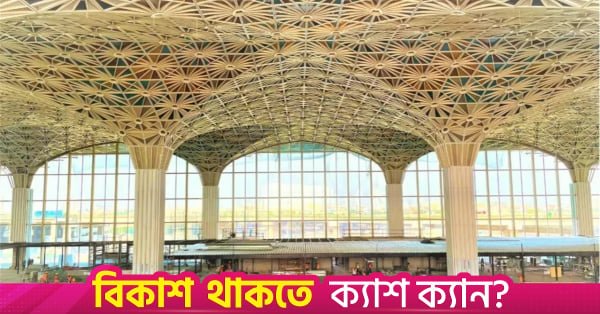
The terminal, developed with support from the Japan International Cooperation Agency, has remained unused for around 22 months despite being nearly 99% complete. The government still needs Tk902 crore to make it operational, while the facility is valued at around $2.1 billion.
The government is targeting partial operations by 16 December this year.
Once fully operational, the Third Terminal is expected to increase HSIA’s annual passenger-handling capacity from around eight million to 16-22 million passengers. Its cargo-handling capacity is also expected to increase by 500,000 tonnes annually.
About The Author