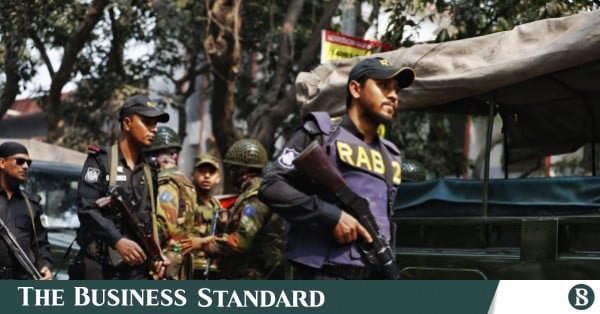
RAB’s record raises a fundamental question: can changing the force’s name and legal structure address the institutional conditions that enabled abuse?
Ahead of the upcoming 13th national parliamentary election and referendum, joint forces (RAB, Army and Police) conduct foot patrols in the Dhanmondi area on Tuesday. Photo: Rajib Dhar
“>

Ahead of the upcoming 13th national parliamentary election and referendum, joint forces (RAB, Army and Police) conduct foot patrols in the Dhanmondi area on Tuesday. Photo: Rajib Dhar
The abolition of the Rapid Action Battalion (RAB) and its replacement with a new Special Response Battalion (SRB) marks a significant change in Bangladesh’s security architecture.
But it also raises a more difficult question: what made RAB vulnerable to allegations of extrajudicial killings, enforced disappearances and corruption in the first place – and does the new structure address those underlying problems?
Parliament passed the Special Response Battalion Act, 2026 on 10 September, formally abolishing RAB and providing for the transfer of its personnel, assets, funds, contracts, records and operational powers to the new force.

The SRB has since begun operating as a specialised unit under Bangladesh Police. Changes to its logo, flag and uniform are also underway.
The transition followed the publication of the Special Response Battalion Act, 2026 in the government gazette on 15 September, formally dissolving RAB and establishing the SRB.

The government says the new force will be modern, professional, efficient and accountable. Opposition lawmakers, however, have argued that transferring RAB’s personnel and infrastructure to the SRB amounts to little more than rebranding. Rights groups and watchdogs have raised similar concerns, arguing that changing the institution’s name alone may not address the problems associated with its predecessor.
That points to the central issue: whether the SRB changes the conditions that allowed allegations of abuse and corruption to emerge under RAB.
Ultimately, the answer depends less on the force’s name than on the incentives, oversight mechanisms and accountability structures governing its operations.
How RAB became one of Bangladesh’s most controversial forces
RAB was created by the four-party alliance government led by the BNP under Prime Minister Khaleda Zia. Parliament passed the Armed Police Battalions (Amendment) Act in July 2003, amending a 1979 ordinance to give the force its legal footing. RAB was formally inaugurated on 26 March 2004, but it did not begin full operations until June that year, according to a 2006 report by Human Rights Watch (HRW).
Human Rights Watch is an independent, non-governmental organisation based in New York. It was founded in 1978 and investigates alleged abuses in dozens of countries. It says it refuses government funding to protect its independence. Its method is to interview victims, witnesses, lawyers, journalists and activists in the field, cross-check media and local rights-group records, put written questions to the authorities and then publish its findings with recommendations aimed at governments and donors. For its 2006 RAB report, HRW said it wrote to the home minister, the law minister and the RAB director general in June 2006 and received no reply. HRW is an advocacy organisation, so its reports carry a position, and its RAB figures rest on reported cases rather than independently verified ones – a limitation it acknowledges.
Members of the Rapid Action Battalion. File photo: Reuters
“>

Members of the Rapid Action Battalion. File photo: Reuters
RAB followed two earlier experiments. In October 2002 the government launched the army-led Operation Clean Heart, deploying more than 40,000 troops for 85 days. HRW reported that more than 10,000 people were arrested and at least 50 died in custody. Just before the operation ended, an indemnity ordinance granted immunity to those involved. The opposition, rights groups and two UN special rapporteurs said it shielded officials from accountability for custodial deaths. A police commando unit, the Rapid Action Team, followed in early 2003 but, in HRW’s account, proved ineffective. In June 2003 the cabinet committee on law and order decided to replace it with the battalion model.
RAB was designed as a composite force comprising personnel seconded from the army, navy, air force, police and other law-enforcement agencies, commanded by an officer not below the rank of deputy inspector general of police or an equivalent. The 2003 law gave it tasks including internal security, criminal intelligence, recovery of illegal arms, arrest of criminals and investigation of any offence on the government’s direction. It began with seven battalions and about 5,000 members; by late 2006 it had 12 battalions and about 8,500 members, HRW said.
Its stated purpose was to tackle serious crime, terrorism, illegal arms and other threats that conventional policing struggled to address. Then law minister Moudud Ahmed argued that the police lacked sophisticated weapons and sufficient training, HRW noted.
At first, the force was popular. HRW found that many Bangladeshis believed RAB had reduced crime, and that residents in some areas cheered when it killed local criminals, because they believed the police and courts could not or would not act.
That popularity coexisted with a pattern that was visible in the press almost from the start. RAB’s statements typically said that a “top criminal” had died in “crossfire” or a shootout after being taken to recover weapons or arrest associates. HRW said the statements often followed near-identical wording, that bodies were sometimes left in public view, and that “crossfire” had become a verb in everyday Bangladeshi speech.
HRW compiled a database of reported RAB killings between June 2004 and September 2006, drawn primarily from Bangladeshi media reports, along with local human rights groups and its own research. It counted 367 people killed in that period, and 77 percent were described as “crossfire” deaths. Reported killings ran at roughly 12 a month in 2004 and 10 a month in 2005, then rose sharply in 2006, with 37 deaths reported in June 2006 alone. HRW cautioned that it had not investigated every case and that some killings may have been lawful uses of force.
The figures were consistent with what RAB’s own sources told the press. The Daily Star reported, citing RAB sources, that 458 people died in “crossfire” between the end of 2004 and the end of 2007. In March 2010 the RAB director general said 622 people had been killed since 2004, and the Bangladeshi rights group Odhikar counted at least 732 by March 2011, according to HRW’s 2011 report on “crossfire” killings.
One of the most prominent cases involving RAB officers came in April 2014. Seven men – among them Narayanganj City Corporation councillor and panel mayor Nazrul Islam and senior lawyer Chandan Sarker – were abducted from the Dhaka–Narayanganj link road on 27 April. Their bodies were later found in the Shitalakkhya river, according to media reports.
The courts have since ruled on RAB’s role. On 16 January 2017 a Narayanganj court sentenced 26 people to death, including expelled Awami League leader Nur Hossain and three RAB-11 officers: Lt Col Tareque Sayeed Mohammad, Maj Arif Hossain and Lt Cdr Masud Rana. Nine others received prison terms. On 22 August 2017 a High Court bench of Justices Bhabani Prasad Singha and Mustafa Zaman Islam upheld the death sentences of 15 people, including Nur Hossain and the three officers, and commuted the sentences of 11 others to life imprisonment. The full verdict was released in November 2018. In April 2026, Prothom Alo reported that the sentences had still not been carried out and the victims’ families were waiting.
By December 2021, the abuses had drawn a response from Washington. On 10 December, the US Treasury’s Office of Foreign Assets Control (OFAC) sanctioned RAB as an organisation and six of its current and former officials under Executive Order 13818, the Global Magnitsky programme, according to the Treasury’s announcement. RAB itself was designated as a foreign entity responsible for, complicit in, or directly or indirectly engaged in serious human rights abuse.
The six individuals were then director general Chowdhury Abdullah Al-Mamun; former director general Benazir Ahmed; and four current or former additional directors general (operations): Khan Mohammad Azad, Tofayel Mustafa Sorwar, Mohammad Jahangir Alam and Mohammad Anwar Latif Khan. Treasury said they were designated as leaders or officials of an entity that had engaged in serious human rights abuse during their tenures. The State Department separately imposed visa restrictions on Benazir Ahmed.
The Treasury announcement did not present its own count of victims. It described the alleged abuses as part of the government’s war on drugs and cited allegations by non-governmental organisations that RAB and other law enforcement were responsible for more than 600 disappearances since 2009 and nearly 600 extrajudicial killings since 2018, along with torture. It added that some reports suggested opposition members, journalists and activists were targeted.
Was the problem the officers or the system?
This is where the RAB experience becomes more complicated.
One explanation is that individual officers committed abuses. The Narayanganj verdict lends some support to that reading. The High Court bench observed that the illegal acts of a few members could not make the whole force liable.
But a broader institutional explanation points to the way the organisation operated. RAB was given significant operational power and was expected to deliver visible results against crime and terrorism. HRW reported that some officials privately acknowledged the government had given RAB a mandate to kill as a way to fight crime. It said one senior official described a list of most-wanted criminals drawn up for RAB. Publicly, then state minister for home affairs Lutfozzaman Babar said “criminals cannot have any human rights” at RAB’s first anniversary, HRW recorded.
At the same time, allegations of abuse rarely resulted in credible and effective punishment. HRW found that the machinery for holding RAB members to account was weak at almost every level. RAB’s own special and summary courts, modelled on courts-martial, listed offences such as insubordination and abandoning a post, but did not list excessive force, torture or murder. The ordinance shielded members from prosecution for acts done “in good faith.” The criminal procedure code required government sanction before courts could take up offences by public servants on duty. Police often refused to register complaints against RAB, and families feared reprisals.
RAB-10 Commander Additional DIG Mohammad Asaduzzaman briefs the media at RAB Media Centre in Karwan Bazar on Monday, 7 September 2026. Photo: TBS
“>

RAB-10 Commander Additional DIG Mohammad Asaduzzaman briefs the media at RAB Media Centre in Karwan Bazar on Monday, 7 September 2026. Photo: TBS
As a result, HRW said, no RAB member was known to have been criminally convicted of torturing or unlawfully killing a detainee as of 2006. The most serious known punishment for a “crossfire” death was dishonourable discharge, an administrative sanction. The US State Department’s 2006 human rights report noted that after the law minister said in 2004 that “crossfire” deaths in RAB or police custody would not count as custodial deaths, no RAB member had been prosecuted for a killing.
That combination creates a dangerous incentive structure. If an officer believes that an unlawful killing will be accepted as a legitimate operation, the legal and disciplinary cost of using excessive force stays close to zero. This is the central logic of impunity: when misconduct repeatedly goes unpunished, it can become normalised inside an organisation.
The Narayanganj case stands out against that record. It ended in the conviction of RAB officers who were serving at the time of the crime, but the victims included a councillor and a prominent lawyer, and, more than a decade later, the sentences have not been carried out.
The term “crossfire” became particularly significant in this context. Rights groups argued that describing deaths as the result of armed encounters often prevented proper scrutiny of whether suspects had actually been killed unlawfully.
The issue therefore went beyond individual misconduct.
The same institutional conditions that allow excessive violence can also create opportunities for corruption.
A specialised security force with weapons, intelligence capabilities, detention powers and operational autonomy possesses significant coercive capacity. If external oversight is weak, that capacity can potentially be diverted from public-security objectives towards political or private interests. Allegations involving enforced disappearances and coercion in political and commercial disputes illustrated this broader concern.
RAB-2 recovered one illegal locally made pistol and 10 rounds of bullets from Mohammadpur. Photo: Collected
RAB-2 recovered one illegal locally made pistol and 10 rounds of bullets from Mohammadpur. Photo: Collected
About The Author