The ministry said the measure aims to curb illegal entry, human smuggling, unauthorised labour brokers and employers who evade responsibility for workers they bring into the country.
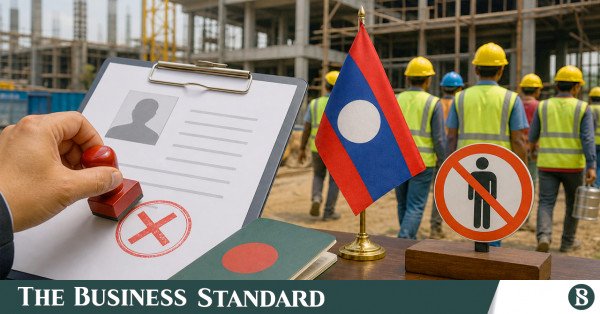
Representational image. Photo: AI Generated
“>

Representational image. Photo: AI Generated
Laos has suspended approval of new work permits, labour import plans and labour projects for Bangladeshi nationals nationwide from 1 September through the end of 2026, citing concerns over illegal entry, human smuggling and unauthorised labour recruitment.
The suspension was reported by English-language Lao news website Laotian Times on 14 September, citing a directive issued by Laos’ Ministry of Labour and Social Welfare on 9 September.
The ministry said the measure aims to curb illegal entry, human smuggling, unauthorised labour brokers and employers who evade responsibility for workers they bring into the country. However, the directive did not explain why Bangladeshi nationals were specifically targeted.

Major government-approved priority projects with fixed contract schedules will be exempt from the freeze.
The order bars individuals, companies, employers and labour operators from independently authorising the entry or employment of Bangladeshi nationals. Laos has also stopped approving Labour Visa (LA-B2) permits for Bangladeshi workers through the end of 2026.
Violators could face fines, deportation and possible revocation of business licences. Employers importing or employing workers without authorisation face a fine of LAK2.5 million, or about $110, per worker per violation. The same penalty applies to those importing workers for redistribution to other labour units.
Employers using or accepting workers assigned to another labour unit face a fine of LAK2 million, or about $89, per worker per violation.
Workers moving to unauthorised worksites without permission face a LAK1 million, or about $44, fine per instance and deportation within 30 days. Employers or other violators must bear deportation and travel costs.
Repeat violations within the same category could result in triple fines and possible legal prosecution, according to the report.
The Lao ministry did not disclose the number of Bangladeshi workers currently employed in the country or the sectors most affected. Bangladeshi workers in Laos have traditionally been employed mainly in construction and manufacturing, according to Laotian Times.
Bureau of Manpower, Employment and Training (BMET) data show that about 3,300 Bangladeshis received clearance to travel to Laos for work until September this year.
About The Author