The discussion reviewed the draft law’s provisions on the commission’s independence, accountability, appointment process, finances, investigations and access to remedies.
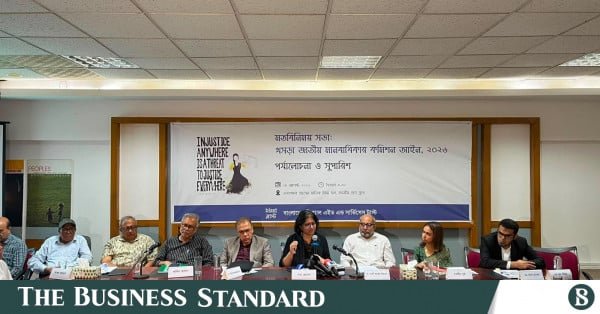
Human rights activists, lawyers, journalists and civil society representatives attend a consultation on the proposed National Human Rights Commission Act, 2026, organised by Bangladesh Legal Aid and Services Trust (BLAST) at the National Press Club on 24 August 2026. Photo: TBS
“>

Human rights activists, lawyers, journalists and civil society representatives attend a consultation on the proposed National Human Rights Commission Act, 2026, organised by Bangladesh Legal Aid and Services Trust (BLAST) at the National Press Club on 24 August 2026. Photo: TBS
Human rights activists, lawyers, journalists and civil society representatives have called for a more inclusive and independent selection committee to appoint members of an effective National Human Rights Commission (NHRC), warning that excessive government control could undermine its ability to investigate violations and ensure remedies.
They made the remarks at a consultation on the proposed National Human Rights Commission Act, 2026, organised by Bangladesh Legal Aid and Services Trust (BLAST) at the National Press Club yesterday (24 August).
The discussion reviewed the draft law’s provisions on the commission’s independence, accountability, appointment process, finances, investigations and access to remedies.

Transparency International Bangladesh Executive Director Iftekharuzzaman said six of the eight members of the proposed selection committee, including the chairman, would be government-appointed, raising doubts about the commission’s independence.
“This structure does not assure us that an independent human rights commission can be established or that effective remedies for violations can be ensured,” he said.
Lawyer and rights activist Naushin Noor also questioned the committee’s composition, saying its structure itself raises concerns about impartiality. Supreme Court lawyer Khan Khalid Adnan noted that although Bangladesh is party to several international human rights treaties, the proposed committee includes no member with expertise in international law.
Former NHRC and enforced disappearance inquiry commission member Nur Khan Liton questioned a provision requiring government permission before investigations. “If government permission is required every time in cases of enforced disappearance, murder or similar crimes, questions will arise over how independent such investigations can be,” he said.
Zakir Hossain, chief executive of Nagorik Udyog, said merely declaring an institution independent in law would not make it so. He called for transparent financial rules, adequate autonomy and a separate fund for the commission.
Speakers also warned that government control over its organisational structure and deputed appointments could undermine institutional independence, despite provisions allowing the commission to frame its own regulations and employment conditions.
Concerns were raised over downgrading the National Preventive Mechanism (NPM) from a “Division” to a “Unit”, excluding military detention facilities from places subject to inspection, and relying on general government allocations instead of a separate protected budget.
Participants also called for easier access to remedies for victims, travel and accommodation support for litigants from outside Dhaka, and safeguards against conflicts of interest.
BLAST and Supreme Court panel lawyer Kazi Zahid Iqbal said draft Section 16(5), which provides for referring cases to courts, does not clarify their subsequent legal status or the status of commission reports submitted to courts.
In closing, BLAST Honorary Executive Director and Supreme Court Senior Advocate Sara Hossain said lessons from the NHRC’s experience since 2009 should inform a stronger law.
“How can the law still say we cannot know about any cell run by the military after seeing Aynaghar?” she asked.
She welcomed the draft but called for specific changes to establish a transparent and effective legal and justice framework.
About The Author