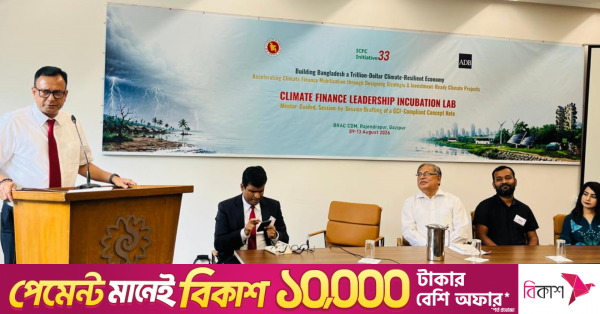
A five-day climate finance leadership lab in Gazipur has helped around 35 professionals from 23 organisations turn climate-related ideas into 35 project concepts aimed at potential financing from the Green Climate Fund (GCF).
The concepts focus on climate mitigation, adaptation, resilience and climate insurance for vulnerable communities.
The Climate Finance Leadership Incubation Lab was held at BRAC CDM in Rajendrapur from 9 to 13 August.

It was organised by the International Climate Finance Cell (ICFC) of the Economic Relations Division (ERD) under the Ministry of Finance, with financial and technical support from the Asian Development Bank, reads a press release.
Unlike conventional classroom-based training, the programme focused on hands-on development of GCF concept notes through mentoring, evaluation and project pitching.
Participants included government officials, development practitioners, bankers, researchers, civil society representatives and journalists. They worked on key GCF requirements, including climate rationale, financing structures, country ownership, safeguards, risks and potential transformational impact.
Ten concept notes received recognition, with three receiving Diamond, three Gold and four Silver status.
AKM Sohel, additional secretary and UN Wing chief at ERD, said the programme was an important step towards developing a national pool of professionals capable of preparing proposals for international climate finance.
“Go to GCF literature and talk in the GCF language,” he told participants, stressing that proposals must clearly demonstrate why an intervention qualifies as climate action and requires climate finance.
He said the ICFC plans to organise a second batch of the programme in December with around 40 participants.
Participants from the first batch will also receive further mentoring, while promising concepts could be considered for inclusion in the ERD’s project pipeline.
Dr Shah Abdul Saadi, joint secretary at ERD and course coordinator, said climate finance proposals should not simply attach a climate label to conventional development projects.
Project developers must identify climate-related emissions and vulnerabilities and demonstrate how proposed interventions would reduce risks and strengthen resilience, he said.
“Sectoral ownership is the bottom line,” Saadi said, emphasising that climate interventions need clear institutional responsibility and measurable results.
Juel Mahmud, GCF liaison officer at ERD, said a promising idea alone was not enough to secure international climate finance.
He advised participants to review existing projects before developing new concepts to avoid duplication and demonstrate additional value. Proposals also need stronger climate rationale, measurable impacts, technical and financial feasibility and a clear investment case, he said.
Dr Ahsan Uddin Ahmed, a former member of the GCF Independent Technical Advisory Panel, said developing a strong concept note was challenging but achievable through continued learning and mentoring.
The training also covered financing structures, including grants, non-grant instruments and co-financing, as well as the justification for seeking GCF resources.
Participants represented six broad sectors, including government, development organisations, the private sector and banking, academia and research, civil society and media.
The programme concluded with five-minute pitches of the 35 concepts before mentors and evaluators.
Organisers said the awards marked only the beginning of the process, with the broader goal of refining promising concepts into technically sound, financially credible and investment-ready proposals that could eventually enter Bangladesh’s climate finance pipeline.
About The Author