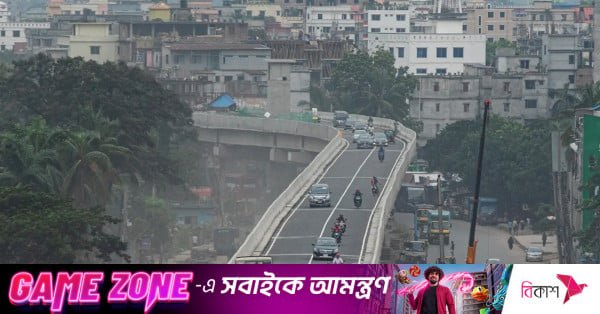
After more than a decade of delays, repeated cost escalations and mounting criticism over its planning and design, Bangladesh’s first Bus Rapid Transit project now faces a fundamental question: should it ever operate as a BRT system at all?
A recent review by a Bangladesh University of Engineering and Technology (Buet) expert team, commissioned by the interim government, has concluded that the Gazipur-Airport BRT corridor, conceived back in 2012, should not be launched as a Bus Rapid Transit service.
Instead, the partially completed infrastructure should be repurposed as an improved highway facility for long-distance and high-speed traffic.

However, the recommendation effectively calls into question the original objective of a project that has already consumed more than Tk4,000 crore over 12 years, yet remains non-operational despite reaching roughly 97% physical progress.
“It would be prudent to abandon BRT operations. Accordingly, any further investment aimed at making the BRT system operational, including the procurement of buses, would not be justified,” the Buet team said in its report submitted to the Road Transport and Highways Division in late March.
The experts warned that operating the system as a BRT service – whether through private operators or the Bangladesh Road Transport Corporation (BRTC) – is unlikely to deliver meaningful benefits and could create additional inconvenience for road users.
“Similar to the improvement of the N-2 (Dhaka-Sylhet) corridor, the BRT lanes with the existing eight overpasses could function as a high-speed through-traffic road, while the adjacent lanes would operate as service roads for local traffic,” the report said, outlining how the modified road system could still be used effectively.
“The halted BRT project should therefore be formally closed after completing the remaining structural components compatible with the proposed plan,” suggested the team, headed by Md Shamsul Hoque, professor of Civil Engineering at Buet.
Other members of the expert panel included Sheikh Mokhlesur Rahman, Raquib Ahsan, and Ishtiaque Ahmed, all professors in the Department of Civil Engineering at Buet.
The findings come after the interim government rejected a proposal seeking an additional Tk2,000 crore to complete the remaining 3% of the project and instead ordered a reassessment of alternatives and an investigation into responsibility for the project’s failures.
Repeated revisions increased the estimated cost to Tk4,268 crore and extended the deadline to December 2024. A fourth revision later proposed raising costs to Tk6,598 crore and extending implementation until December 2029.
A project that never worked
The BRT Line-3 (North) project was conceived as Bangladesh’s pioneering mass transit initiative connecting Gazipur and the airport along the N-3 national highway. Instead, according to the Buet review, the ill-conceived project became expensive and disruptive and severely compromised the operational efficiency of one of the country’s busiest transport corridors.
The review stated that prolonged construction caused immense suffering for commuters and residents living along the corridor while degrading the level of service on the highway linking Dhaka with northern districts through Mymensingh.
In the report, the Buet team argues that planners failed to properly understand the corridor’s complexity, travel demand and traffic composition before designing the project.
Among the most visible problems were low-height concrete footbridges that reduced usable footpath space because landings were constructed directly on footpaths. The structures also created restrictions for abnormally high freight vehicles serving industries along the corridor due to limited vertical clearance.
The experts concluded that the selected corridor lacked sufficient width for a BRT system and that planners underestimated the volume of long-distance passenger and cargo traffic using the route.
An overly BRT-focused planning approach, without adequate consideration of land use and traffic dynamics, contributed significantly to the project’s problems, the report said
However, the project’s design flaws were not a new concern. In October 2022, then Road Transport and Bridges Minister Obaidul Quader acknowledged the problems with the project while speaking to journalists, saying, “There are some complications on this route. The project started before I took office. The current state of this project, which is in disarray, is a result of flawed planning.”
Despite acknowledging the shortcomings, he directed officials to complete the project. “I’ve instructed the project officials to wrap it up at any cost, so that we can open it in March-April next year [2023].”
His comments came two months after five members of a family, including two children, were killed when a BRT project girder fell onto their vehicle in Uttara.
Who is responsible?
One of the review’s key objectives was to identify those responsible for the project’s failures. The Buet team examined reports prepared by the Roads and Highways Department’s Planning and Maintenance Wing (PMW) and the Technical Services Wing (TSW), both formed after the interim government rejected the latest cost revision proposal.
The review assigned significant responsibility to the Asian Development Bank (ADB), which approved the project, as well as consultants involved in its feasibility study and design. It noted that the project was not included in the Strategic Transport Plan (STP) 2005 but originated as an ADB-led initiative before being handed over to the Roads and Highways Department (RHD).
Describing it as an “unsolicited initiative” by ADB, the report said the lender could not evade responsibility for approving a BRT corridor lacking sufficient width and suitability. It identified feasibility study consultants Advanced Logistics Group (ALG) of Spain and BETS-TMB JV, along with design consultants SMEC International, SYSTRA and ACE Consultants, as key parties behind the project’s shortcomings.
TBS contacted ADB’s Dhaka office regarding the findings, but the organisation declined to comment.
When contacted by email, feasibility study consultant ALG said the study had been conducted many years ago and was extensively discussed with public institutions, multilateral development banks and other stakeholders.
What happens next?
Despite recommending the abandonment of BRT operations, the Buet team argued that the infrastructure already built could still provide substantial benefits if repurposed appropriately.
The report said road users are already experiencing improved mobility along the access-controlled, junction-free BRT lanes, which have reduced travel times and generated economic benefits.
To maximise those gains, the experts proposed converting the dedicated lanes into a controlled-access highway facility with toll collection.
Under the proposal, access-control barriers would be installed along both sides of the corridor, BRT lanes would be separated by high concrete barriers, and unfinished flyovers would be completed.
The report also recommended closing all entry and exit points to elevated stations and preventing passengers from boarding or alighting on the flyovers.
Existing BRT stations would not need to be demolished immediately. Instead, they could be converted into toll plazas, with one station modified at the 10-lane Tongi overpass section.
Given the large number of garment factories and heavy pedestrian activity along the route, the experts stressed the need to complete all unfinished footbridge works and construct additional crossings where demand exists.
A comprehensive safety audit should also be carried out before opening the corridor for general traffic, the report said.
“…the corridor may be opened for general traffic with necessary engineering modifications so that the developed infrastructure can function effectively as an improved highway corridor,” it added.
The project’s future now appears to rest with the Cabinet, with the road transport ministry expected to place the matter before it soon for a final decision based on two ministry committee reports and the expert review, according to officials.
About The Author