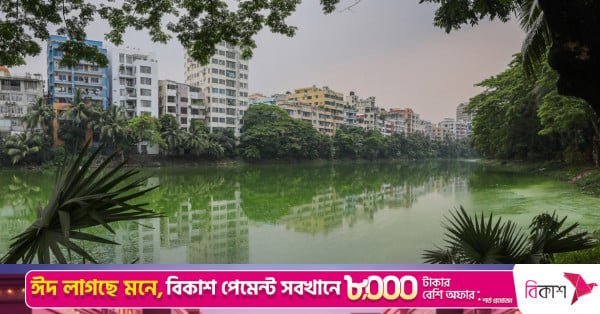
Following the prime minister’s directives, the government decided to take strict measures to keep the Gulshan-Banani-Baridhara Lake in Dhaka free from waste and pollution, aiming to transform it into an environmentally friendly, visually appealing and citizen-friendly space.
The decision was taken at a meeting held on 10 May at the Secretariat conference room of the Ministry of Housing and Public Works, according to meeting sources.
Today (19 May) also, Prime Minister Tarique Rahman issued directives to develop the lake into an environment-friendly, aesthetically improved, and citizen-friendly urban space, according to the BNP Media Cell.

The issue of water pollution control, ecological balance, beautification, and the expansion of modern public amenities around the lake was discussed at a meeting at the Prime Minister’s Office.
At the meeting, officials presented the current condition of the lake and shared proposals and plans for ensuring long-term and sustainable development.
At the 10 May meeting, the ministry set deadlines for relevant agencies to implement major interventions, including cleaning floating waste, removing sludge from the lakebed, stopping sewage inflow, demolishing illegal structures, constructing new bridges, and rehabilitating nearby slum areas.
The decisions follow an earlier meeting on 28 April, when the public works ministry finalised a set of decisions to transform the lake into a cleaner and more accessible public space.
Responsibilities for protecting the lake have been assigned to agencies including Rajuk, the Public Works Department, Dhaka North City Corporation, Dhaka Wasa and the police.
What are the measures
Public works officials said a memorandum of understanding must be signed within one month among Gulshan, Banani, and Baridhara societies, Rajuk, Dhaka North and Wasa to ensure biannual cleaning of the the lake, including removal of sludge and contaminated sediment, and prevention of sewage inflow.
They also said progress reports on the activities must be submitted twice a month, on the 15th and 30th.
Authorities have been instructed to finalise a plan within 15 days, in coordination with DMP and Dhaka North, regarding the removal of Mariam Tower adjacent to the Indian High Commission office in Gulshan.
The 20-storey building is located beside Gulshan Lake along the Badda-Baridhara link road near Banshtola. Built in 1994, it has long faced allegations of encroaching on lake land since its construction.
Officials said Rajuk will issue directives within one month requiring owners of all buildings in Gulshan, Banani and Baridhara to install soak pits within six months. Legal action will be taken against non-compliance. Progress on this initiative will also be reported to the ministry twice a month.
A soak pit is an underground structure that allows treated wastewater or septic tank effluent to gradually percolate into the soil.
To improve traffic flow around the lake, Rajuk has been instructed to submit project proposals within three months for constructing the New Market–Gulshan-2 link road bridge (Felani Avenue) and the Gulshan-1–Badda link road bridge.
Separately, discussions were also held on a proposed project to build modern housing in the Karail, Bhasantek, Sat Tola and Cantonment slum areas. An update on the matter has been sought in 15 days.
At the end of the meeting, Housing and Public Works Secretary Md Nazrul Islam urged all concerned agencies to take swift steps to implement the decisions.
Long-standing sewerage issue
In 2023, Dhaka North City surveyed sewerage systems in Banani, Baridhara, Niketan, and Gulshan East and West, covering 3,830 households. It found 2,265 homes were discharging waste into the lake through their sewerage connections.
Officials said this was damaging the lake’s aesthetics and fuelling mosquito infestation. The city corporation later instructed residents to disconnect illegal links, but the then mayor Atiqul Islam said compliance remained limited.
Gulshan Society President Barrister Omar Sadat told the media that sewage from Gulshan, Banani and Baridhara DOHS areas is flowing into Gulshan Lake. He said residents pay Wasa for sewage treatment, but waste meant for the Dasherkandi plant is not being properly processed.
DNCC waste management officials said household sewage should go to Dhaka Wasa’s sewer network, while homes without connections must use septic tanks. However, they said both systems are poorly implemented in many cases, leading to discharge into open drains that flow into canals and lakes.
Sources said the sewerage network in Gulshan, Banani, Baridhara and Niketan is outdated and overloaded. Many homes also lack soak pits, prompting residents to connect outlets to Dhaka North’s stormwater drains that ultimately empty into nearby waterbodies.
About The Author