The Bangladesh Power Development Board (BPDB) plans to set up the solar power plant in Bagerhat’s Rampal with completion targeted for December 2030. The proposed electricity tariff is Tk6.18 per unit.
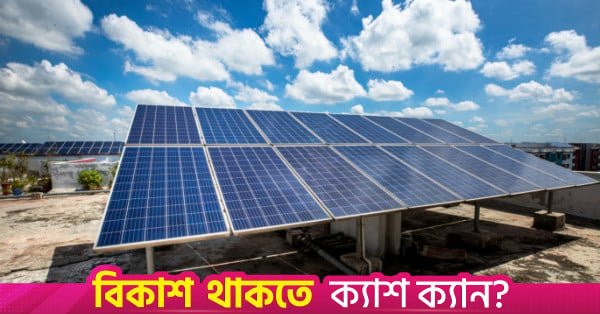
With clear billing rules, more residential rooftops can contribute to Bangladesh’s electricity supply while encouraging private investment in renewable energy. Photo: TBS
“>

With clear billing rules, more residential rooftops can contribute to Bangladesh’s electricity supply while encouraging private investment in renewable energy. Photo: TBS
The government is set to consider a proposal for the country’s largest 442-megawatt solar power plant at the upcoming meeting of the Executive Committee of the National Economic Council (Ecnec) on Wednesday (7 October).
The Bangladesh Power Development Board (BPDB) plans to set up the solar power plant in Bagerhat’s Rampal with completion targeted for December 2030. The proposed electricity tariff is Tk6.18 per unit.
According to the project proposal seen by The Business Standard, the estimated cost is Tk2,502.39 crore. Of this, Tk2,127 crore will be financed from the Power Development Fund, while Tk375.94 crore will come from BPDB’s own resources.


The initiative is aimed at diversifying the country’s primary fuel sources and strengthening energy security by increasing renewable power generation.
BPDB acquired 1,834 acres of land in Rampal in 2012, divided into Block-A and Block-B. Block-A currently hosts the Bangladesh-India Friendship Power Company Limited’s coal-fired power plant, while Block-B remains under BPDB. Land development and other preparatory work have already been completed in the area.
Of the 918.50 acres in Block-B, parts of the land have been allocated for a green belt, flood protection embankment and a lake. A feasibility study found 685 acres suitable for developing the proposed 442MWp solar plant.
The project was initially planned as a joint venture, but the process was halted after the repeal of the Special Power Act 2010, amended in 2021. Later, Infrastructure Investment Facilitation Company (IIFC) conducted a feasibility study in May 2025 and recommended a 442MW grid-connected solar power plant on the 685-acre site.
The feasibility study found that the site would require minimal additional land development, helping reduce construction costs and the unit cost of electricity. It also recommended international competitive bidding to secure better pricing.
The electricity generated will be evacuated by raising the voltage from 0.8kV to 33kV and then to 230kV before being connected to the national grid through the 400/230kV substation of Bangladesh-India Friendship Power Company Limited. A new substation and around 3km of 230kV transmission line will be required for the project.
The proposed Rampal project has a lower tariff and construction cost than the 220MW Sonagazi solar project in Feni, which was approved last December at an estimated cost of Tk1,888 crore.
According to BPDB’s analysis, the capacity utilisation factor of the Sonagazi project is 21%, compared with 17% for Rampal. However, the construction cost per MWp is Tk5.66 crore for Rampal, compared with Tk6.27 crore for Sonagazi.
As a result, electricity from the Rampal project is proposed at Tk6.18 per unit, compared with Tk8.87 for Sonagazi – around 43% higher. Annual revenue is projected at Tk352.41 crore for Rampal and Tk381.54 crore for Sonagazi.
Nur Ahmed, additional secretary of the Planning Wing of the Power Division, said the proposed project is a timely initiative that would add significantly to the country’s renewable energy capacity.
“The proposed Rampal solar project is a timely and highly positive initiative that will significantly strengthen the renewable energy sector,” he said.
He said the project proposal had already been submitted to the Planning Commission as a Development Project Proforma (DPP) and was being processed on a priority basis.
Compared with the 220MW Sonagazi project, the 442MW Rampal plant is nearly twice as large and has a comparatively lower unit cost, making it economically more viable, he added.
Bangladesh’s electricity demand is projected to rise significantly in the coming years. According to the Integrated Energy and Power Master Plan 2023, peak demand is expected to reach 29,257MW by 2030, 58,597MW by 2041 and 96,767MW by 2050, while the highest generation recorded so far was 16,794MW on 23 July 2025.
The government’s Renewable Energy Policy 2025 targets generating 20% of electricity from renewable sources by 2030 and 30% by 2040. The project proposal says rapid investment in renewable energy is needed as the current contribution of renewable sources to total power generation remains limited.
About The Author