You made it time. If you want to look a little longer, just scroll back up and press “Continue.”
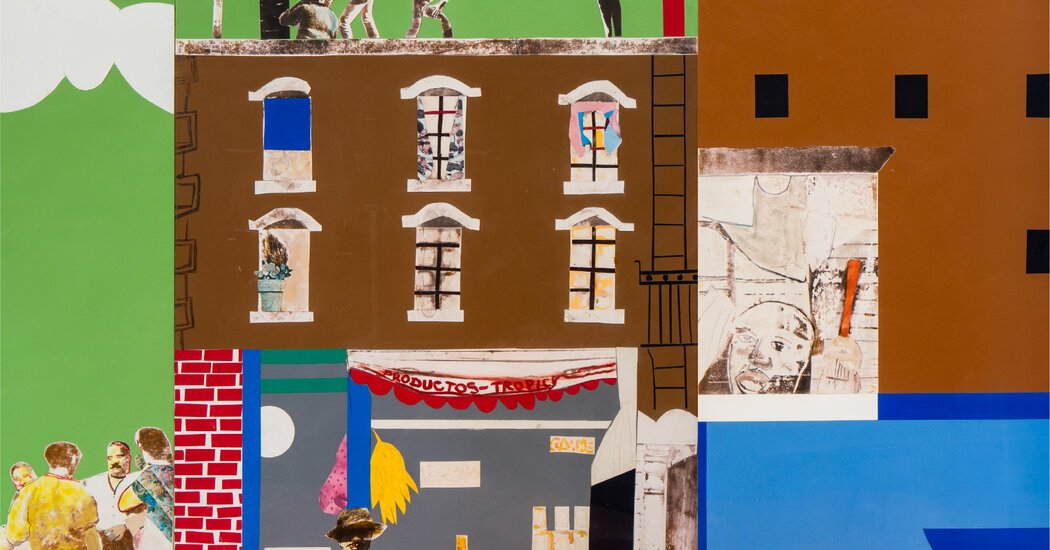
If you enter Bellevue Hospital through the front door, on the East Side of Manhattan, and make your way up a flight of stairs near the emergency department, you’ll find this mural by the influential Black artist Romare Bearden, tucked into this out-of-the-way, fluorescently lit corner. I recently watched a group of Bellevue nurses use the mural as a healing tool for their burnout — more on that later.
Here since 1983, the mural is 26.5 feet long and 7.5 feet tall. This is life on a city block in 1970s New York, reimagined using cut-out photographs, paint, giant rectangles of colored paper and fabric, laid out with glue in a grid.
Outside, kids are playing …
… adults are chatting …
… kites are flying.
An eye embedded in brick in the center of the mural suggests an omniscient presence that pulls us inside …
… through the windows and into interior lives.
Where you can spy tender moments between a mother and a child …
… a family gathered beneath a portrait of Lincoln …
… and an annunciation that juxtaposes the sacred and the profane.
“Cityscape” was not Bearden’s first larger-than-life work drawn from his city.
In 1971, he produced “The Block,” an 18-foot-long, four-foot-tall mural of an actual block in Harlem — Lenox Avenue between 132nd and 133rd Streets.
(This mural lives at the Metropolitan Museum of Art, though it’s not currently on view.)
Bearden was inspired by the view from the window of a friend, the author and scholar Albert L. Murray. In a 1980 documentary called “Bearden Plays Bearden,” he revisits the spot and describes his original process:
He likened making “The Block” to jazz, creating intervals and space, looking for repetition, and responding to the things that were happening on the page, one after another, as he cut, glued, cut, glued.
Bearden was born in North Carolina in 1911 but grew up in Harlem, after his family moved north as part of the Great Migration. His mother was a journalist and activist, and frequent guests at her salons included Duke Ellington, W.E.B. Du Bois, Paul Robeson and other luminaries.
These themes of the Harlem Renaissance would show up in his work, like in “Untitled (Jazz II)” from 1980:
He also often made work about his Southern roots, like this 1964 collage, “Tomorrow I May Be Far Away,” set in the rural South:
As a young man, Bearden was an accomplished enough baseball player to have a chance at a major league contract nearly two decades before Jackie Robinson — but it would have meant passing for white, so he refused. For more than 30 years, he held down a day job as a case worker for the New York City Department of Social Services. It gave him special insight into the lives of others. As his biographer Mary Schmidt Campbell said: “He had to go into people’s homes. He knows what he’s talking about.” He left the job in his 50s to create art full-time.
Bearden originally created “Cityscape” as a commission for Lincoln Hospital in the Bronx. The year 1976 was a rough time for the hospital and the borough.
“It’s the city of New York at its lowest point,” Ms. Schmidt Campbell said.
The Bronx was burning, and six years earlier a Lincoln Hospital building was occupied by the Young Lords, a group of Puerto Rican activists who were fighting for better care and to replace a decrepit building.
Members of Young Lords guarding barricaded door at old Lincoln Hospital nursing school.
“Cityscape,” said Ms. Schmidt Campbell, deliberately portrays scenes of care and intimacy. “All of these scenes inside that militate against the stereotypical images coming out of New York City, of everything falling apart and everybody falling apart,” she said.
But the mural captured only hints of the neighborhood’s Latino culture, like this sign in Spanish:
The local city councilman didn’t think the mural represented the neighborhood and considered it obscene. After less than a week, it was hauled to storage, where it remained for seven years, before it was moved to its current home.
Bellevue is the oldest public hospital in America, with roots back to 1736. It’s also one of the busiest, with more than half a million outpatient visits per year. (Bearden himself was hospitalized there in the 1950s after a nervous breakdown.) Seventy percent of patients are on Medicaid or are uninsured, and Bellevue has a policy to “turn no one away.” The hospital system is also, perhaps surprisingly, a major collector of art, and its 8,000 art works make up one of the largest public collections in the country.
The vast collection makes possible its “Arts in Medicine” program, which uses art to help health care workers fight the exhaustion and burnout that runs high in the job.
On a recent morning, I joined 13 nurses and two educators from the Whitney Museum of American Art in front of the mural.
“What would this place smell like?” said Camilo Godoy, one of the educators. “Weed!” one nurse yelled. What would it sound like? What are some of the tastes? What do you see?
The group broke out into chatter, walking around the painting, pointing. One nurse made a connection between the diversity of people in the mural and the wide range of patients at Bellevue. There’s a community at work here on this wall, she said, and also at work here in the hospital.
“I actually see isolation,” she said. “Everyone is isolated in their own little space.”
“I see myself,” another said.
Then everyone walked downstairs to a table covered in scissors, paper, pencils, tape and glue. Sharon Itkoff Nacache, the other educator and an art therapist, asked about burnout among the staff.
“We can’t turn off,” one of the nurses said. “We just went through two years, three years of the Covid experience.”
She added later: “We just don’t turn off anymore. We feel like we have to keep giving to work, to help.”
Ms. Itkoff Nacache cited a study showing that even small periods of time spent with art — either viewing or making — can boost well-being. “Two minutes is all we need to feel some kind of physiological shift,” she said.
With that, the nurses started cutting.
This is an installment in our series of experiments on art and attention. If you liked this one, you may like these past exercises: a finished, unfinished portrait; a sudden rain over a bridge; a unicorn tapestry; some buckets from Home Depot; and a Whistler painting.
Sign up to be notified when new installments are published here. And let us know how this exercise made you feel in the comments.
About The Author