The petition seeks the immediate withdrawal of BRTC buses currently used for government transport and their reinstatement on regular commercial routes for public service.
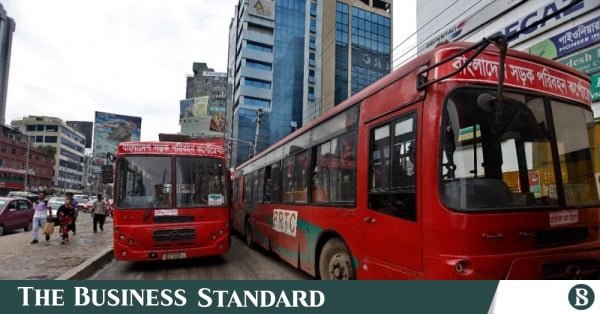
Bangladesh Road Transport Corporation (BRTC) buses. Photo: BSS
“>

Bangladesh Road Transport Corporation (BRTC) buses. Photo: BSS
A Supreme Court lawyer has filed a public interest writ petition seeking a ban on leasing or renting Bangladesh Road Transport Corporation (BRTC) buses to government ministries and institutions and their deployment for public transport to help ease the country’s public transport crisis.
Lawyer Md Mahmudul Hasan Mamun filed the writ today (28 September), naming the Cabinet secretary, secretaries of the Road Transport and Bridges Ministry and the Finance Division, and the BRTC chairman as respondents.
The petition argues that Sections 5 and 22 of the Bangladesh Road Transport Corporation Act, 2020, legally require BRTC buses to be used as public transport in the public interest.

However, BRTC buses are being leased or rented to various government ministries, statutory bodies, and local authorities to transport their officials and employees, which the petition claims is beyond the corporation’s legal authority.
The petition also cites the BRTC Bus Leasing Policy 2007, under which only experienced commercial transport operators are eligible to lease buses. Clause 5(17) of the policy prohibits leased buses from being transferred to any third party.
Leasing buses to government institutions therefore directly violates the policy, the petition claims.
It further argues that keeping buses purchased with taxpayers’ money for government officials instead of making them available to the general public goes against Articles 27 and 31 of the Constitution, which provide for equality before the law and protection of the law for citizens.
The petition also raises economic concerns, arguing that when government institutions rent buses from BRTC, state funds merely move from one government sector to another, creating a closed cycle.
According to the petition, this restricts the circular flow of income and weakens the fiscal multiplier effect. It argues that if government institutions hired buses from private transport operators instead, the spending could create employment and contribute to economic activity.
The petition further claims that the use of a large number of BRTC buses for government transport has worsened the public transport crisis, leaving ordinary commuters, women, and students facing severe difficulties on a daily basis.
The writ seeks a rule asking why the leasing or renting of BRTC buses to government and autonomous institutions should not be declared illegal and prohibited.
It also seeks specific directions to immediately withdraw all BRTC buses currently being used for government transport and reinstate them on regular commercial routes for public passengers.
Speaking to journalists, Mamun said the hearing could take some time as vacation benches are currently conducting proceedings.
“I have mentioned the writ for hearing before the bench of Justice Bhishmadev Chakraborty and Justice Sheikh Tahsin Ali. I hope we will be able to have the hearing very soon,” he said.
About The Author