The initiative aims to improve learning outcomes from pre-primary to Grade 5, strengthen teaching and school management, and provide additional support to children falling behind in their studies.
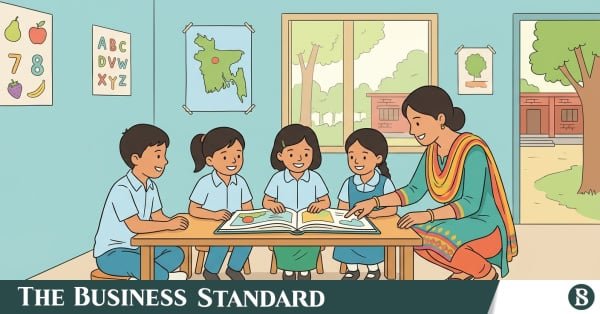
Representational image. Photo: AI
“>

Representational image. Photo: AI
The World Bank has approved $300 million in financing to improve the quality of pre-primary and primary education for 2.6 crore children in Bangladesh, with a focus on foundational skills in reading, writing and mathematics.
The financing was approved by the World Bank Group’s Board of Executive Directors yesterday (6 November) for the Learning Enhancement and Acceleration in Primary Education Programme, which will support the government’s Fifth Primary Education Development Programme, according to a press release.
The initiative aims to improve learning outcomes from pre-primary to Grade 5, strengthen teaching and school management, and provide additional support to children falling behind in their studies.

Although Bangladesh has achieved near-universal access to primary education, learning quality remains a major challenge.
Around 50% of 10-year-olds in the country cannot read and understand a simple, age-appropriate text, compared with 42% in Malaysia and 47% in Brazil, both upper-middle-income countries, according to the World Bank.
“Quality primary education is one of the building blocks for a globally competitive workforce,” said Jean Pesme, World Bank Division Director for Bangladesh and Bhutan.
He said the World Bank Group had helped bring nearly all children into schools over the past two decades, and the new financing would help them learn better and remain in school, laying the foundation for better employment opportunities.
Bangladesh’s primary education system serves more than 2 crore children in government and non-government schools, kindergartens and madrasas.
Under the programme, the World Bank will support a foundational literacy and numeracy package that includes teaching materials, structured lesson plans and teacher training.
It will also provide leadership training for headteachers in 90% of government primary schools and strengthen school management systems.
The programme will offer remedial learning support to children who are falling behind, with particular attention to districts with the weakest learning outcomes.
“Strong foundational learning is a critical step towards the accumulation of skills for better jobs. To ensure that no children are left behind, the programme will support remedial learning for children who are falling behind, with a focus on districts that lag the furthest,” said Tashmina Rahman, World Bank Senior Education Specialist and team leader for the programme.
She said the initiative would also support better teacher and school leadership, more accountable budget use and stronger use of data to guide decisions.
The programme will train and support government primary school teachers to deliver improved literacy and numeracy lessons.
It is also expected to improve pre-primary education in government primary schools, helping children develop basic skills and become better prepared for formal schooling.
The World Bank estimates that the programme will generate 843,000 more and better-paid jobs in government primary schools.
The financing comes from the International Development Association, the World Bank Group’s fund for lower-income countries. It has a 25-year term, including a five-year grace period.
About The Author