Prime Minister Tarique Rahman urged doctors to earn people’s trust through compassionate, quality care and a humane approach, saying stronger confidence in the country’s healthcare system could help prevent an annual outflow of around $5 billion spent on treatment abroad today (11 July).
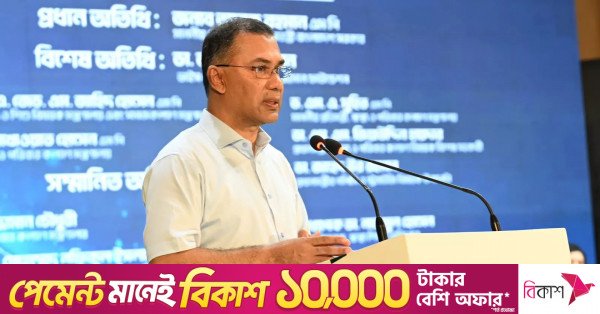
“Every year, around $5 billion flows out of the country as thousands of our people travel abroad for medical treatment. As a result, we also lose valuable foreign exchange,” he said he said while addressing the inaugural programme of DMC Day-2026, organised to mark the 80th anniversary of Dhaka Medical College (DMC).
He said the situation could not be changed through laws or institutions alone without the help of the physicians.

Tarique said, as a political worker now entrusted with the responsibility of running the government, he expected both practising doctors and those who would join the profession in the future to help change the situation by strengthening people’s trust and confidence in the country’s doctors and healthcare system.
“Why can’t we change this situation? Why can’t we strengthen our people’s trust and confidence in our doctors?… It is only possible through your humane approach and proper treatment,” the Prime Minister told doctors, medical teachers and students.
“On the occasion of this anniversary, I have one expectation not only from DMC, but from every hospital and every medical college in Bangladesh—from all doctors and medical students. I hope that, in the future, the people of this country will have complete trust and confidence in our doctors,” Tarique said.
The Prime Minister said the government has given the health sector its highest-ever budgetary allocation in the current national budget and plans to raise health spending to five percent of GDP over the next five years.
He said the government has also reduced taxes and duties on a range of essential medical equipment and materials including dialysis filters, heart valves, pacemakers, oxygenators, peripheral vascular stents, radiofrequency ablation catheters, intraocular lenses and raw materials used for manufacturing cancer medicines.
These measures, Tarique said, would significantly reduce treatment costs and provide relief to many families as most healthcare expenses in Bangladesh are still paid directly by patients.
Highlighting plans to improve healthcare services in other major cities, he said the government would upgrade 51-bed upazila hospitals to 101-bed facilities.
He noted that only five upazilas currently have 100-bed hospitals despite more than 70 percent of the country’s population living in rural areas.
The Prime Minister also said every upgraded upazila hospital would have a solar power system with battery storage to ensure uninterrupted electricity during surgeries and emergencies.
The Prime Minister also stressed the importance of proper medical waste management and maintaining cleanliness in hospitals.
He called on doctors, students and healthcare workers to take collective responsibility for keeping hospitals clean instead of leaving the task solely to cleaning staff.
Drawing inspiration from Japan, Tarique recalled how Japanese football fans cleaned stadiums after world cup matches without being instructed to do so and urged Bangladeshis to develop a similar civic sense.
“We all have a responsibility to keep our hospitals clean. A modern building alone is not enough; we must also ensure a clean and healthy environment,” he said.
Tarique said the government has already taken initiatives to promote advanced medical research, modern technology and international-standard training, although achieving meaningful progress would take time.
He expressed confidence that these efforts would gradually produce the desired results.
The Prime Minister also recalled how doctors had provided relentless and dedicated care to his ailing mother and former Prime Minister Khaleda Zia until her death, saying no amount of money could have bought such sincere and compassionate care abroad.
Tarique also attended an interactive session titled “DMCians’ Thoughts on the Modernisation of Bangladesh’s Healthcare System” at the college auditorium, where he exchanged views with current and former students of the institution.
Responding to various questions, he assured them that the problems they raised would be addressed gradually.
The Prime Minister also expressed hope that negative reports about the health sector and doctors would decline in the coming days.
Earlier in the day, Tarique inaugurated DMC Day-2026 by releasing balloons and pigeons on the Dhaka Medical College campus. He was accompanied by his wife, Dr Zubaida Rahman, a former student of the college.
The Prime Minister and Dr Zubaida Rahman later planted two saplings—an Arjun tree and a Neem tree—on the campus.
They were also each presented with a painting of Dhaka Medical College, while a documentary highlighting the institution’s history and contributions to the country was screened during the programme.
About The Author