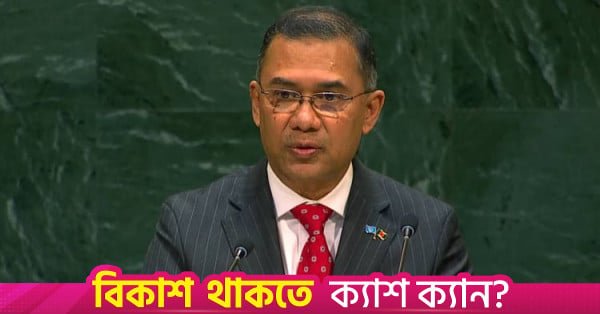
Addressing the 81st session of the United Nations General Assembly in New York today (25 September), Tarique said the government was pursuing the 3-R strategy as the country embarked on what he described as a new path of democracy.
Prime Minister Tarique Rahman addresses the 81st session of the United Nations General Assembly at the UN Headquarters in New York on Thursday. Photo: Screengrab from video
“>

Prime Minister Tarique Rahman addresses the 81st session of the United Nations General Assembly at the UN Headquarters in New York on Thursday. Photo: Screengrab from video
Highlights
- Tarique outlines the 3-R strategy: Recovery, Restoration, and Reconstruction.
- Reconstruction prioritises education, health, technology, and investment.
- The government plans $50 million for youth startup initiatives.
- Education spending will reach 5% of GDP within five years.
Prime Minister Tarique Rahman has outlined a three-pronged strategy—Recovery, Restoration, and Reconstruction—to repair what he described as a Bangladesh “ravaged by fascist rule and exploitation.”
Addressing the 81st session of the United Nations General Assembly in New York today (25 September), Tarique said the government was pursuing the 3-R strategy as the country embarked on what he described as a new path of democracy.

“Bangladesh became free from fascism in 2024, bringing an end to more than one and a half decades of fascist rule and exploitation,” he said.

“Having freed itself from the scourges of enforced disappearances and killings, abductions, corruption, looting, and money laundering that had become the norm under fascist rule, Bangladesh is now once again embarking on the path of democracy.”
“To repair Bangladesh, which was ravaged by fascist rule and exploitation, the government is pursuing a 3-R strategy—Recovery, Restoration, and Reconstruction.”
Recovery
The recovery component focuses on reviving the economy and creating opportunities for the country’s large working-age population, according to the measures Tarique outlined in his speech.
The government has begun programmes to turn the demographic dividend into skilled human resources while taking measures to create employment and develop Bangladesh as a manufacturing hub.
The government has also allocated $50 million in the current fiscal year for young entrepreneurs, researchers, and innovators to implement start-up initiatives.
Restoration
The restoration component is reflected in the government’s plans to strengthen democratic institutions and improve people’s economic and social security.
Tarique said the government wants to ensure “not only electoral democracy but also the democratisation of the economy” so that the benefits of economic growth reach every family and citizen.
The government has introduced social protection programmes including the Family Card, Farmers’ Card, Sports Card, and e-Health Card.
The prime minister also highlighted measures aimed at women, including expanded opportunities for cash financing for women in the small and medium-sized industries sector and free education for women up to the undergraduate level.
Reconstruction
The reconstruction component centers on building a new economic and social framework through employment, education, infrastructure, technology, and investment.
Tarique said the government is seeking to develop Bangladesh as a manufacturing hub while prioritising education, health, and sports.
It plans to gradually raise education spending to 5% of GDP within the next five years and has introduced a curriculum with greater emphasis on technical and practical education.
The government is also seeking to expand access to technology and research, with Tarique warning that “we do not want today’s digital divide to become tomorrow’s artificial intelligence divide.”
He said Bangladesh needs technology transfer, skills development, and affordable access to modern technologies in developing countries.
The three-pronged approach, as presented in the UNGA address, therefore combines economic revival, restoration of democratic and social systems, and longer-term reconstruction through human-resource development, education, technology, investment, and social protection.
Tarique concluded his vision for the country with the slogan “Bangladesh First: Bangladesh for All.”
About The Author