

Credit…Erik Bernstein for The New York Times. Food Stylist: Barrett Washburne.
A bit of a sticky situation
The second the weather dipped below 70 degrees in New York, I went into project-bake mode. Fall is when I’m reminded of why I love baking. Summer baking is wonderful, of course, because it often requires very little effort to make something delicious. But something about that first autumn chill makes me want to get tactile with my baking.
For the October Monthly Bake, I wanted to take on something that calls on all our senses and makes baking feel like more of a craft. I imagined walking into my kitchen and smelling enriched yeasted bread entwined with warm fall spices and buttery sweet maple.
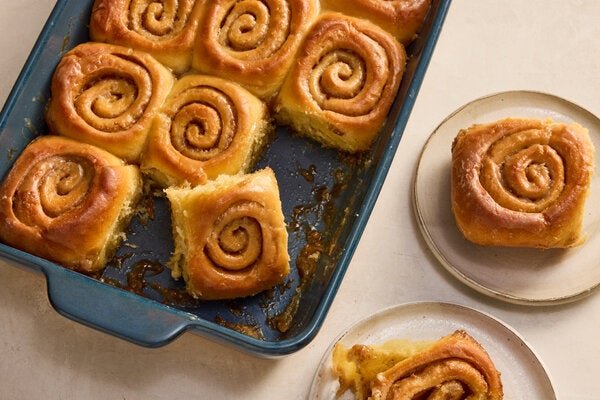
So was born the idea for maple cardamom sticky buns. And my goodness, bakers, this could be the best Monthly Bake to date. The softest, most pillowy buns ever, with a gooey spiral of spiced filling, shellacked with a maple glaze and eaten warm. It’s my idea of heaven.

Credit…New York Times Cooking
Two critical steps got me to that dreamy, plush texture. The first is something called a tangzhong, which is a roux-like paste made from scalded milk and flour that helps make the dough super soft and keeps it from getting stale too quickly. The technique is found in a lot of East Asian baking recipes, including milk bread, and I first learned it from the inimitable Claire Saffitz’s morning buns.
I arrived at the other technique much less ceremoniously, via TikTok. My boyfriend, Kevin, sent me a “hack” for pouring a little heavy cream into the bottom of the pan before baking canned cinnamon rolls. In the name of research, we cracked open a cylinder of Pillsbury, and were pleasantly surprised at the results. While it definitely improved the rolls, it mainly got my gears turning about how it would work with a homemade version.
In tandem, the two techniques produced the best roll or bun I’ve ever had. Of course, the spiral of cardamom filling and sticky maple glaze are the star flavor players, but they’d be nowhere without the dough. I’ve had multiple co-workers tell me I may never top this recipe, and I’m OK with that.

Credit…Erik Bernstein for The New York Times. Food Stylist: Barrett Washburne.
The enriched dough is really sticky, so it’s easiest done in a stand mixer with a dough hook. If you want to make it by hand, just make sure your hands and scraper are greased well. It requires a couple proofs, so if you wake up early enough, you can start the recipe and have them in time for breakfast. But I think they’re even better, and more convenient, after a slow second rise overnight in the fridge. Just factor in a couple hours in the morning to finish proofing and baking them. If you’re a bun novice, don’t fear! They’re much easier than they look.
OK, OK. Enough talk. I can’t wait for y’all to try this one. But fair warning: You may be making these every weekend from here on out.
The Monthly Bake
Share your photos!
I’m going to miss seeing those cute bear claws in my inbox, but I can’t wait to be hypnotized by your cardamom spirals. Share your sticky buns with me on Instagram @vaughn or send them to me by email at baketime@nytimes.com. (By submitting photos to us via email, you agree to our reader submission terms here.)

Credit…Erik Bernstein for The New York Times. Food Stylist: Barrett Washburne.
Maple Cardamom Sticky Buns
Click here to view this recipe in the app.
Total time:
Prep time: 15 minutes
Cook time: About 4 hr (about 1½ hr active time, plus about 2½ hr inactive time)
Yield: 12 buns
INGREDIENTS
For the dough:
1¼ cups/300 grams whole milk
¼ cup water
4½ cups/576 grams all-purpose flour, divided, plus more for rolling
2¼ teaspoons active dry yeast (one 7-gram packet)
¼ cup/50 grams granulated sugar
2 large eggs
2 teaspoons kosher salt, such as Diamond Crystal or 1 teaspoon fine salt
8 tablespoons/113 grams unsalted butter, softened, plus more for greasing
For the filling:
1 cup/226 grams unsalted butter, softened
¾ cup/165 grams light brown sugar
1 tablespoon ground cardamom
2 teaspoons ground ginger
1 teaspoon ground cinnamon
1 teaspoon kosher salt, such as Diamond Crystal or ½ teaspoon fine salt
¼ teaspoon ground black pepper
For the assembly and glazing:
½ cup heavy cream, for baking
4 tablespoons butter
¼ cup maple syrup
2 teaspoons vanilla extract
¼ teaspoon kosher salt (such as Diamond Crystal) or ⅛ teaspoon fine salt
½ cup/51 grams powdered sugar, sifted
PREPARATION
Start the dough:
-
In a small saucepan, heat the milk over medium for about 3 minutes, just until it’s steaming and small bubbles form around the edges, but it’s not yet boiling. Take it off the heat and pour it into a heatproof glass measuring cup. Return ½ cup/120 grams of the milk to the pan and pour the rest into the bowl of a stand mixer fitted with a dough hook.
Make the tangzhong:
-
Add ¼ cup water to the milk in the saucepan (still off heat) and whisk in ¼ cup/32 grams of the flour. Return the mixture to medium heat and whisk constantly until it holds the lines of the whisk and is the consistency of potato purée, 1 to 2 minutes. Take it off the heat and let it cool slightly.
Finish the dough:
-
By this point, the milk in the bowl should have cooled slightly so that it’s lukewarm, around 100 degrees. (If it’s hot to the touch, let it cool a little longer so that it doesn’t deactivate the yeast.) Sprinkle the yeast over and gently mix it with a spoon or spatula, then let it sit undisturbed to bloom for 5 to 10 minutes, until it looks foamy in spots.
-
Add the remaining 4¼ cups/544 grams flour to the bowl, followed by the sugar, eggs and salt. Use a flexible spatula to start mixing everything up until it looks a bit shaggy, then scrape in the tangzhong. Mix with the dough hook on medium-low speed for 5 minutes, until the dough comes together and is evenly mixed (it’ll be quite sticky).
-
With the mixer running, add the butter, one tablespoon at a time, mixing for 30 seconds after each addition. Once all of the butter has been absorbed into the dough, continue kneading for another 10 minutes, until the dough is no longer clinging to the sides of the bowl (it may still cling to the bottom) and it looks smooth and supple.
Proof the dough:
-
Meanwhile, lightly grease a large bowl with butter. Once the dough is done kneading, scrape it out into the buttered bowl. Pull the sides of the dough into the center to make a coin purse or dumpling shape, then use a bowl scraper or spatula to help flip it over onto the seam so that the smooth, taut side is facing up. Cover the bowl with plastic wrap and let it proof for an hour, until it’s almost doubled in size. If your kitchen is warm, check the dough after 45 minutes.
-
While the dough proofs, make the filling: In a medium bowl, mix together the butter, brown sugar, cardamom, ginger, cinnamon, salt and pepper with a spatula until a smooth paste forms. Line a small baking sheet or large platter with parchment paper.
Roll, fill and cut:
-
Uncover the dough (saving the plastic wrap) and scrape it onto a lightly floured surface. Dust it with more flour and use the heels of your hands to flatten the dough into a rough rectangle. Use a floured rolling pin to roll the dough into a 20-by-14-inch rectangle that’s about ¼-inch thick, with one of the long sides facing you, dusting the work surface and dough with more flour as needed.
-
Spread the filling evenly over the dough, leaving a 1-inch border on the 2 short sides and the long side furthest from you but spreading the filling all the way to the edge on the long side closest to you. Starting with the long side closest to you, roll the dough into a tight log. Arrange the log seam-side down. Using a very sharp knife or serrated bread knife, trim off the doughy tapered ends off the log, then cut the log crosswise into two equal halves, taking care not to smush the filling.
-
Place the two logs on the parchment-lined baking sheet. Freeze for 20 minutes to firm up the filling and make the logs easier to cut into neat rolls. Meanwhile, grease a 9-by-13-inch metal baking pan with butter.
-
Remove the dough from the freezer and slice each log into 6 rolls, wiping your knife down between each slice for the cleanest cuts. Place the buns in the buttered pan, spiraled sides up, in a 4-by-3 grid (don’t worry if they’re not perfectly round at this stage). Cover tightly with the reserved plastic wrap. At this point, they can be refrigerated overnight (up to 12 hours) before baking, bearing in mind that the second rise may take a bit longer.
Proof again, then bake:
-
Let the buns rise for 30 to 45 minutes, until the rolls are puffy and starting to touch (if you refrigerated them overnight, this rise will take 1½ to 2 hours.) When poked, the dough should hold an indentation and spring back slowly. While the buns rise, heat the oven to 350 degrees.
-
When the buns are ready to bake, uncover the pan and pour the heavy cream into the gaps between the rolls, making sure the bottom of the pan is evenly coated. It’s OK if a little cream splashes onto the surface of the dough. Bake the buns for 28 to 32 minutes, until they’re puffed and golden. Let them cool in the pan for 10 minutes before glazing.
While the buns are baking, make the glaze:
-
In a small saucepan, heat the butter over medium heat. Once it starts to bubble, add the maple syrup, vanilla and salt, and whisk thoroughly. Turn the heat to low and gradually whisk in the powdered sugar, continuing to whisk until any lumps dissolve and a smooth glaze forms. Transfer to a glass measuring cup with a spout and let the glaze cool slightly.
-
When the buns have cooled for 10 minutes, give the maple glaze a quick stir and pour it evenly on top, using the back of a large spoon to coax it if needed. Let the glaze set for a minute or two, then serve the buns warm. (They’ll keep covered tightly at room temperature for up to a day.)

Credit…Erik Bernstein for The New York Times. Food Stylist: Barrett Washburne.
Thanks for reading (and baking)! See you next week.
Was this email forwarded to you? You can sign up for Bake Time here.
Thanks for reading and cooking. If you like the work we do at New York Times Cooking, please subscribe! (Or give a subscription as a gift!) You can follow us on Instagram, Facebook and Pinterest, or follow me on Instagram. Reach out to my colleagues at cookingcare@nytimes.com if you have any questions about your account.
About The Author