It was August 2007. A Ukrainian father and son arrived in Bangladesh for what was supposed to be a brief stopover on their way to Vietnam, where they were considering setting up a business.
While staying at a hotel, the son, Lavryk Andrity, began wondering why they should travel on to Vietnam when Bangladesh itself might offer what they were looking for.
“I had heard about Bangladesh’s tanneries and leather industry. So, I asked my father why we should go to Vietnam when Bangladesh has a huge population and could be a good place to establish a company,” he recalled.

Then came an unlikely lead: a copy of the Yellow Pages.
Andrity picked it up at the hotel and spotted an advertisement for the Bangladesh Export Processing Zones Authority (Bepza). He and his father decided to pay the authorities a visit.
“We visited Bepza, liked the people there and received full support. We then decided not to go to Vietnam and instead establish our company in Bangladesh. We are happy with that decision,” he told The Business Standard.
That unplanned stopover eventually gave birth to the company Super Protective Shoes (Pvt) Ltd at Adamjee Export Processing Zone in Narayanganj, a business that now exports around $25 million worth of military boots, safety shoes, and other specialised footwear annually to markets across the world.
From Adamjee to global markets
Nearly two decades after production began, Super Protective Shoes now exports to around 60-70 countries, including Ukraine, Germany and other European and international markets.
The company produces safety, work, industrial and military footwear, including boots, PU products and insoles. Military footwear accounts for around 10% of its exports, with most going to Ukraine.
Super Protective Shoes has so far invested around $13 million in Bangladesh and employs nearly 1,000 workers. Depending on orders, the factory produces around 5,000-6,000 pairs of shoes a day.
Andrity, now chairman and managing director of the company, said it has offices in Ukraine, elsewhere in Europe and in the Middle East, including the UAE. It also operates a large warehouse in Germany, from where products are supplied to different markets.
The company plans to raise annual exports to $50 million within the next two years as it expands production capacity and introduces technology for technically advanced and ultra-light safety footwear.
“We also plan to invest an additional $10 million in Bangladesh,” Andrity said.
Where machines meet hands
Inside the Adamjee factory, that global business takes shape one pair at a time.
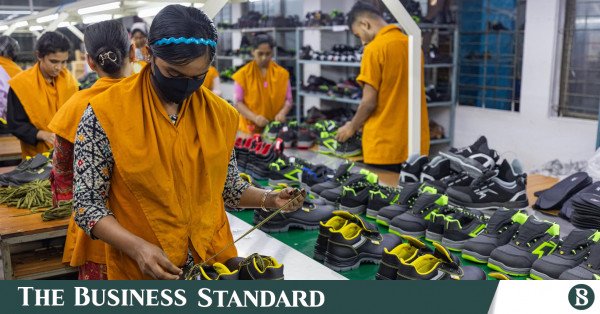
During a visit by The Business Standard this week, workers were seen operating modern machinery across different stages of production.
At one end, leather was being cut according to shoe designs. Elsewhere, workers stitched components, matched them with designs, assembled soles and finished shoes, while some monitored production through computer screens.
The process combines modern machinery with manual skills, moving through cutting, stitching, assembling, moulding and finishing before the shoes reach the packaging section.
Most of the leather used in the footwear is sourced from Brazil, Ukraine, India and Turkey, while some also comes from Pakistan and Bangladesh, according to the company.
Among those on the production floor was Liza Akter, operating a machine that cuts leather according to shoe designs. She said the workplace provides good facilities and that she earns around Tk23,000 a month.
In the packaging section, Niamat Ali was busy packing finished shoes. He studied up to class eight and has worked at the factory since 2019.
Niamat said the salary and working environment were good, which encouraged him to remain with the company rather than look for work elsewhere.
Making safety shoes lighter
Super Protective Shoes is now introducing specialised technology aimed at making safety footwear lighter while maintaining durability.
“We are bringing new technology to produce ultra-light safety shoes. This technology is new to Bangladesh and, as far as we know, is among the first of its kind in the world,” Andrity said.
The company is producing specialised outsoles using advanced machinery to reduce the weight of safety shoes while retaining their durability.
Andrity said demand for lightweight footwear was growing among younger consumers and in markets including Bangladesh, Europe and China. But durability remained crucial for people who wear safety shoes at work.
“That is why we are introducing this technology – to produce safety shoes that combine durability with an ultra-light design,” he said.
The company has purchased machinery from Europe, Taiwan and China, depending on the type of equipment required.
It is also installing new machinery that will raise production capacity to around 10,000 pairs a day. The company plans to increase its workforce alongside the expansion.
Sourcing more from Bangladesh
As Bangladesh’s footwear technology and supporting industries have developed, Super Protective Shoes has also been able to source some tools and production equipment locally.
“Different tools and production equipment are now being produced locally, which is very helpful for us because we can source some of these items locally,” Andrity said.
The company’s growth comes as Adamjee EPZ continues to attract export-orientated investment.
Md Abdur Rahman Bhuiyan, executive director of Adamjee EPZ, said uninterrupted supplies of gas, electricity and water have helped generate investor interest in the zone.
In FY26, 47 factories operating at Adamjee EPZ exported goods worth $1.179 billion.
“With 10 more factories currently under construction coming into production, annual exports can potentially reach $1.5 billion,” Bhuiyan said.
Growing, but running out of room
For Super Protective Shoes, however, further growth has brought another challenge: finding space.
“We are looking for space to expand our business, but we are unable to find available space in this export processing zone,” Andrity said.
He added that the company would consider investing elsewhere in Bangladesh if it could find land with facilities similar to those offered by Bepza.
Nearly two decades after a father and son changed their travel plans and chose Bangladesh over Vietnam, the company they built here is now looking for its next place to grow.
About The Author