Transparency International Bangladesh (TIB) has found widespread governance gaps in the institutional activities of political parties, including a lack of transparency and accountability, weak democratic practices, limited participation and inclusion, and inadequate measures to prevent irregularities and corruption.
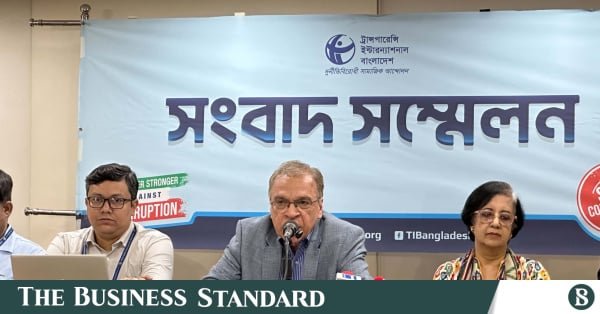
The findings were presented at a press conference at the TIB office today (1 November), marking the release of a research report titled ‘Institutional Governance of Political Parties in Bangladesh’.
The study, conducted in two phases from June 2023 to February 2024 and from June 2025 to September 2026, covered 32 political parties.

It identified opacity in party income and expenditure, family-based and non-transparent leadership selection, irregular conventions, nomination trading, party constitutions inconsistent with legal provisions, the influence of black money, limited progress in women’s political participation and leadership, concentration of decision-making power in individuals, and widespread abuse of power.
Businessmen dominate parliamentary elections
The study found a significant dominance of businessmen among candidates and elected lawmakers from the ninth to the 13th parliamentary elections.
Businessmen accounted for 47.4% of candidates and 56.6% of elected MPs in the ninth parliamentary election. The figures rose to 56.9% and 57.7%, respectively, in the 10th election.
In the 11th parliament, businessmen made up 51.2% of candidates and 60.3% of elected MPs. The figures stood at 57.6% and 65.3% in the 12th parliament.
In the 13th parliamentary election, 48.5% of candidates and 59.9% of elected MPs were businessmen, according to the research.
Women’s representation remains limited
Women’s representation in the central committees of political parties remains low, the study found.
Although the Representation of the People Order (RPO), 1972, sets a target of at least 33% women in committees at all levels, most parties have failed to meet it.
Of the 32 parties studied, only two had women making up at least 33% of their central committees, while two had no women members.
Thirteen parties fielded no women candidates in the 13th parliamentary election. Women accounted for just 3.1% of candidates nominated by 12 parties, compared with 7.9% among independent candidates.
The study also found that nominations for reserved seats for women prioritised symbolic representation, loyalty to party leadership and political identity over political contribution and commitment.
Political violence claims thousands of victims
Citing statistics from Ain o Salish Kendra (ASK), TIB said 4,280 incidents of political violence over the past 13 years and eight months had left 46,351 party leaders and activists injured and 746 political workers dead.
The violence largely stemmed from clashes between rival parties and internal conflicts within parties, the report said.
TIB clarified that these figures did not include casualties from the July 2024 uprising, as data on civilians killed during the movement were separate.
Family-based leadership and long tenures
The study found evidence of family-based succession in the leadership of 10 political parties: the now-banned Bangladesh Awami League, BNP, Jatiya Party, Zaker Party, Bangladesh Muslim League, National People’s Party (NPP), Bangladesh National Awami Party-Bangladesh NAP, Bangladesh Khelafat Majlish, Jatiya Ganatantrik Party (Jagpa) and Bangladesh Justice Party.
The report said many parties had become excessively dependent on the personal image of their top leaders. Concerns that a change in leadership could lead to a party’s collapse or political decline had contributed to individuals holding top positions for extended periods.
Of the 32 parties studied, 12 had leaders who had served for at least 10 years. The chief of the now-banned Awami League had held the position for 45 years, while the BNP chief had served for 41 years, although the BNP has recently undergone a change in leadership.
16 parties do not hold regular conventions
Although party constitutions provide for regular national conventions, 16 parties do not hold them regularly, the report said.
The BNP has not held a national convention for more than 10 years. The study also found that council meetings were often used to formally approve decisions already made in advance, rather than facilitate meaningful internal democratic debate.
Lack of transparency in committee formation and finances
The study found that the constitutions of Bangladesh Khelafat Majlish, Khelafat Majlish and Gono Odhikar Parishad did not specify fixed terms for their central committees. The constitution of Bangladesh Khelafat Majlish also lacked a clear process for committee formation.
The constitutions of Nagorik Oikya and Gono Odhikar Parishad did not specify the tenure of their local committees. In the case of the Communist Party of Bangladesh (CPB), the central committee determines the rules for forming local committees.
The report also found that the same individuals often remained in leadership positions in local committees for extended periods.
Party constitutions lacked clear provisions for financial management, accounting, auditing and accountability. The parties did not prepare annual budgets, while much of their income and expenditure was managed through programme-based and informal processes.
The study further found that 18 parties did not include minimum standards of integrity and ethics in their membership eligibility criteria. They also lacked effective mechanisms to prevent people accused or convicted of crimes from becoming members or holding important positions.
This creates opportunities for individuals involved in extortion, human trafficking, smuggling, arms and drug businesses, among other crimes, to enter political parties, the report said.
Three parties face clear allegations of nomination trading
TIB identified clear allegations of nomination trading against three influential political parties in the selection and nomination of candidates for parliamentary elections: the BNP, Jatiya Party and Awami League.
The study also found that party constitutions lacked clear provisions for accountability when nominated candidates violated electoral codes of conduct and other state regulations.
It found no examples of effective action by parties against such violations. Despite allegations that party leaders and activists had accumulated wealth through criminal activities, irregularities and corruption, parties had not taken visible action in many cases, the report said.
In some instances, parties imposed minor punishments and treated the matter as resolved.
About The Author