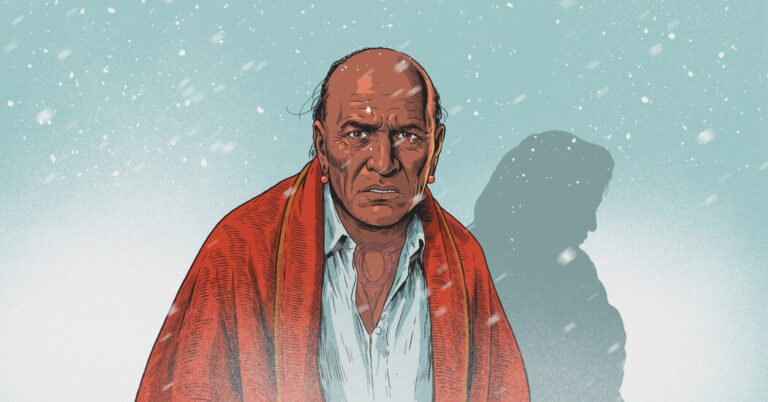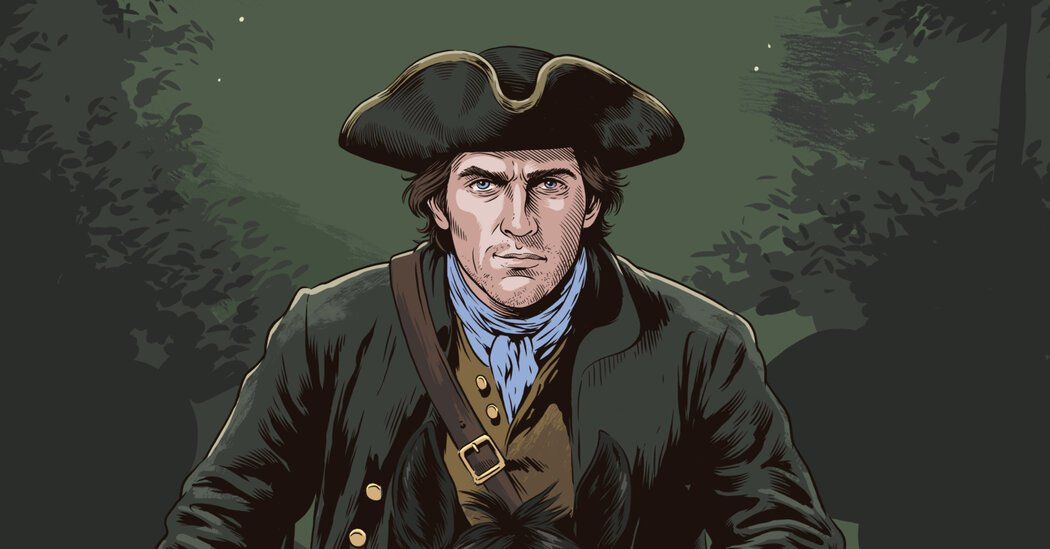
Husband himself was far from downtrodden. The firstborn son of a wealthy Maryland family, he had accumulated some 10,000 acres of land in the North Carolina backcountry by the time of the Battle of Alamance. But his sense of justice tilted him toward the underdog. He once sided against his own Quaker congregation in a dispute about how to handle the case of a girl accused of insufficiently resisting a sexual assault. For his efforts, the congregation kicked him out.
Most farmers, though, faced hard work and even harder business conditions: A chronic shortage of cash — Parliament had restricted the printing of paper money — left creditors demanding gold, silver or hard assets when debts came due. Husband later described sheriffs’ collecting taxes from neighbors in the form of the very horses and cows they needed to work their way back to solvency, as if “to stab ourselves to the very Heart, and dry up our Fountains.”
In early 1766, protests by a shadowy resistance network called the Sons of Liberty, which included several future signers of the Declaration of Independence, forced Parliament to repeal the Stamp Act, a wildly unpopular tax on legal documents, newspapers and pamphlets. And that gave Husband an idea. What if farmers formed their own organization, aimed not at pressuring King George III or Parliament but at restraining internal oppressors, right there in North Carolina? That summer, Husband posted a call to discuss “whether the free men of this Country labor under any abuses of power,” and in the series of meetings that followed, the association that would come to be known as the Regulators took shape.
In pamphlets and in person, Husband enumerated the many “grievous oppressions” that farmers faced. Lawyers were permitted to charge their clients no more than 15 shillings per case, but they regularly billed as much as 5 pounds — nearly seven times the lawful sum. County clerks exacted fees so high that farmers often had to work them off, for instance by raking hay or shoveling manure on the clerk’s farm, sometimes for months. Husband reported the case of one backcountry farmer, William Few, who was sued for a £10 debt, then charged another £60 in court costs when he lost. One early Regulator referred to clerks, attorneys and other members of his county’s courthouse ring as “hungry Caterpillars.”
Husband was jailed on treason charges for his role in stirring up the Regulators but was quickly released. For a short time, he was even able to transform his advocacy into a seat in North Carolina’s Colonial Assembly. But this experiment with working within the system came to a rapid end: Colleagues there expelled him, claiming he had published a libel against a provincial judge. For their part, many Regulators contended that the assemblymen who deserved to be expelled were many lawyers who dominated the assembly. In fact, they argued, the body should bar them from serving altogether.
Husband remained a Quaker and a pacifist; his only weapons were his words. But violence was in the air. The increasingly organized protesters were banding together to withhold tax and rent payments, and some were going a step further to violently recover property the sheriffs had seized or mob the courts where merchants went to collect debts. Others had made pacts — if one of them was thrown in jail, the rest would break him out.
Such efforts prompted the North Carolina Assembly to adopt a law based on the English Riot Act, which in earlier decades not only outlawed the act of private assembly but also authorized the use of deadly force against anyone who did unlawfully assemble. It was on this basis that Governor Tryon formed the militia that ultimately met the rebels at Great Alamance Creek.
A month after the battle, six Regulators were hanged for treason. To the provincial gentry, the fugitive Husband stood as an even greater villain. He had betrayed not only the government but also his class. Tryon put a bounty of 1,000 acres of land plus £100 on four remaining figures of the revolt — three escaped fighters and Husband, whose only crimes were writing and speaking.
It would seem difficult to survive long with such a bounty on your head, much less re-enter the political world. But Husband, while still an outlaw in the eyes of the North Carolina authorities, managed to build a new home out at the foot of the Allegheny Mountains in western Pennsylvania.
At first this refuge suited him. After the colonies declared independence, Pennsylvania — the adoptive home of Benjamin Franklin and Thomas Paine — enacted what was then arguably the world’s most democratic constitution. Assemblymen had to face the voters every year, and no court had the power to overturn their legislation. Laws could not be stopped by the senate or governor, either, because Pennsylvania had neither. In 1777, Husband ran for a seat in Pennsylvania’s newly formed General Assembly. The voters backed him, and he again took his place within the system, for a single yearlong term.
Within a few years, Husband would find himself once again working from the outside. In 1781, the Assembly voted in a law that resembled Parliament’s earlier ban on paper money, requiring farmers to pay their debts using hard currency — silver and gold. Husband went to work, publishing a series of anonymous pamphlets at his own expense inveighing against the law and against the Assembly’s confiscatory taxes and the ongoing exactions of local officials. More so than in North Carolina, Husband also attacked those problems at the root. As he saw it, even post-independence Pennsylvania, with its ostensibly democratic Constitution, was ruled by the rich. And he had an unusual idea about why.
Husband believed that Pennsylvania’s legislative districts, which spanned entire counties, contained far too many voters. An average of 25,000 people lived in each county. In theory every voter among them was a potential officeholder. But then as now, to be elected, you had to be well known — and Husband understood that name recognition was highly correlated with wealth. “Our own Men in the Township,” he lamented in a 1782 pamphlet, were simply “not enough known to have any Influence in the other Parts of the County.” Poor and middle-income candidates stood no chance of winning.
Some wealthy office seekers, especially merchants and tavern keepers, enjoyed an additional political advantage. Today consumers typically owe money to the banks that issue their credit cards and finance their homes. But in the 18th century, you ran tabs with the retailers themselves, be it the crossroads store or the local pub. In the days before the secret ballot, these debts conferred enormous influence on wealthy creditors. They could ease up on debtors who voted their way and crack down on those who didn’t.
In Pennsylvania’s oversize election districts, only a fraction of voters regularly ran into their representatives on the street or at church. A majority had no chance to ask their assemblyman how he had voted on important issues. “Thus blindfolded,” Husband wrote, citizens could not call representatives “to any Account” on Election Day.
Husband believed Pennsylvania could erase much of the wealthy candidate’s advantage over the ordinary farmer by shrinking Pennsylvania’s election districts. Allowing every hamlet to send its own representative to the Assembly would make it unwieldy. So instead, Husband suggested that the towns elect delegates to new countywide legislatures. Each of these would then choose that county’s delegation to the State Assembly.
At the base of this pyramid would be new election districts that were so small that even dirt farmers would be well enough known within them to win seats in the County Legislature. It could in turn send many of those same farmers on to Philadelphia.
Husband thought county legislatures would also combat another obstacle to popular rule — a psychological one. Ordinary Pennsylvanians were likely to see themselves as “too insignificant” to serve in the State Assembly, he wrote. But the county legislatures would provide aspiring statesmen essential experience. That in turn would give them the self-confidence they needed to secure higher office and succeed there. The local assemblies would “prove as a School to train up and learn Men” in “the Nature of all publick Business, and give them Utterance to speak to the same,” Husband wrote.
Another of the township representatives’ duties would be to take home all the laws that had passed the State Assembly and “cause them to be read in Publick.” Every townsman would vote on each law, and their local representatives would transmit these town tallies back up through the county legislatures to Philadelphia. The statewide aggregates of these town votes would determine which laws would be affirmed and which would be repealed.
By such means, Husband aimed to transform Pennsylvania from a republic of the elite into a radical democracy for all. Washington, Hamilton and other prominent Americans warily monitored Husband as he continued his effort to turn their secession from Britain into a radical internal revolution. Many among the elite pronounced him insane.
Most of the 55 notable citizens who gathered in Philadelphia in the summer of 1787 to write the U.S. Constitution saw the problem of democracy very differently from Husband. Rather than seeking to give greater power to a majority of Americans, the architects of the new national government set out to curb what some among them called the “excess of democracy” out in the states.
The framers were wealthy and well educated, and as such, they made up a small minority in a nation of farmers and tradesmen. They had little faith in the wisdom of the masses and worried that large numbers of indebted farmers might, for instance, force Congress to grant them relief from their much less numerous creditors.
They developed several ways to fight the potential tyranny of such majorities. Most straightforwardly, under the Constitution, voters would have no direct say in the selection of the president, federal judges or — until the 17th Amendment in 1913 — U.S. senators. The framers also decided that individual members of the federal Congress would represent far more constituents than their state counterparts — eight times as many in Pennsylvania, and even more in some other states. Charles Cotesworth Pinckney, a Constitutional Convention delegate from South Carolina, made the thinking behind this decision plain. In the gargantuan new federal election districts, he said, the “little demagogue of a petty parish or county” will “find his importance annihilated.”
And in a final effort to restrain the majority, the Constitution would also, in James Madison’s words, “extend the sphere” of the most important decision-making from the state to the federal level. Once indomitable state majorities would cancel one another out at the national level, freeing wise officeholders to vote their consciences. In a private letter to Thomas Jefferson, Madison pronounced “Divide et impera” — divide and conquer — to be the only policy “by which a republic can be administered on just principles.”
The Constitution was ratified in the summer of 1788, and that fall, the Pennsylvania Assembly decided that the state’s delegation to the First Congress, set to meet in New York City the following spring, would be elected at large — that is, by voters from across the whole state. Husband complained that the assembly “might as well have empowered the officers and wealthy men to have held those elections without mocking the public” with the farce of casting ballots. Soon, public pressure forced the assemblymen to move from the at-large system to the congressional district system — but the districts were still huge, leaving Husband’s original grievance unsettled.
By that time, the extent of Husband’s alienation was evident in his violating, albeit anonymously, the universal taboo against criticizing George Washington. Washington, the victorious commander in chief, had persuaded Congress to give his officers pensions equal to five years’ pay. Enlisted men received a comparative pittance, though many had lost their farms in their absence.
As the electoral college was unanimously elevating Washington to the presidency in 1789, Husband wrote that he wished Washington had shown as much concern for the regular people who were “half ruined” by the war “as he did for the officers, who made their fortunes by the war.”
For decades, Husband had based his political writings on biblical prophecy. He believed his reforms would not only give ordinary Americans a say in government but also “commence that Thousand Years Reign with Christ.” He differed with the biblical prophets in only one particular: He thought the new Jerusalem would rise up not in the Holy Land but in North America, just beyond the Allegheny Mountains.
By 1794, Husband’s disillusionment with the new republic had reached the point where he decided to do something he hadn’t done for 23 years. He joined in a rebellion.
He felt he had no choice. Alexander Hamilton, the first secretary of the Treasury, had formulated a plan for the federal government to assume the states’ war debts — and to finance the move with a national tax on distilled spirits. Farmers at that time often used whiskey to settle debts when cash was scarce, and many in western Pennsylvania relied on it as the only commodity valuable enough to profitably transport back east over the mountains. Making matters worse, word had gotten around that the purpose of the whiskey tax was to pay off wealthy speculators who had bought up Revolutionary War bonds at a fraction of their face value.
Many western Pennsylvanians, having already endured tremendous hardship during the Revolution, were unwilling to suffer again for the sake of the speculators. Instead, bands of resistors began to attack tax collectors, tarring and feathering them. Some set fire to the home of a regional tax official, and a growing mass marched on Pittsburgh. Hamilton derided this Whiskey Rebellion, even as federal troops headed west to crush it.
Neither in the first major bloodletting of the founding era, at Great Alamance Creek in 1771, nor in the last, in western Pennsylvania in 1794 and 1795, did Americans battle British soldiers. In each, they fought other Americans. Nor were these bookends the era’s only internal conflicts. Tenants resisted their landlords. Slaves exploited wartime chaos and labor shortages to claim their freedom. Young men rioted against the draft, and soldiers mutinied or deserted en masse. Women ran their absent husbands’ businesses and in many cases refused to call them master when they finally returned.
Husband had tried to keep the whiskey protest peaceful. His only contributions were helping erect a “liberty pole” and attending a handful of meetings. Yet in Pennsylvania in 1794 as in North Carolina in 1771, such was the threat this eloquent American posed that he made the most-wanted list. President Washington sent Hamilton’s army west with the names of only three insurgents to jail. One was Hermon Husband.
Husband, now 70, was one of the first people arrested. Like many of the people imprisoned in the Philadelphia jail during the winter of 1794-95, he became gravely ill. In May 1795, a grand jury declined to indict him for treason but did bring a charge of sedition. On that second charge, the trial jury found him innocent and released him. Heading home, Husband had traveled only a few miles from the temporary federal capital when his illness killed him.
As he lay dying, the peripatetic reformer could take solace not only in the favorable verdict of the Pennsylvania jurors but also in the decision by North Carolina voters to send him to the provincial assembly a quarter-century earlier. In both instances, Husband’s respect and admiration for ordinary Americans had been heartily reciprocated. He represented the American Revolution that might have been.
About The Author