The robust, if perpetually contested, religious freedom that Americans enjoy today is one of the most important legacies of our founding. Thomas Jefferson and other revolutionaries like James Madison fought to separate the church from the state. As men of the Enlightenment, they were skeptical of dogma and prized the human mind’s capacity to reason. But they confined their trust to the reason of wealthy, educated men. Leland, too, believed in reason, but he drew that belief from a major tenet of the Reformation: that ordinary men and women had the capacity to interpret God’s will for themselves.
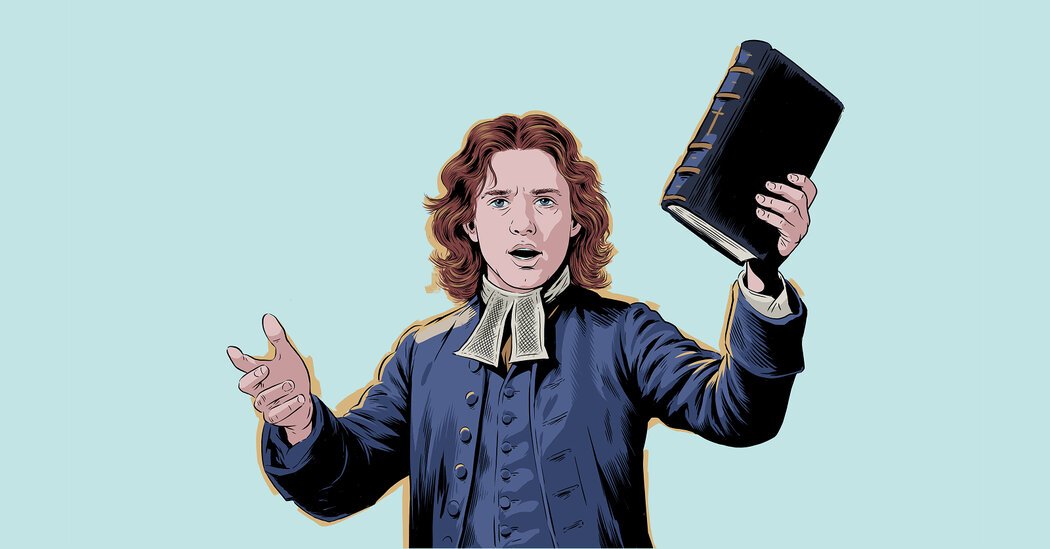
Self-taught and rough-edged, Leland traveled constantly, giving thousands of sermons and baptizing more than 1,500 people over the course of his life. By his own calculations, he logged enough miles to circle the globe four times. Born into a Congregational family in central Massachusetts in 1754, Leland had only a basic education, but he read voraciously. He was deeply moved by a series of evangelical revivals then sweeping through the colonies, known as the Great Awakening, which in turn reanimated a core notion of the Reformation: that individual conscience, illuminated by God and Scripture, is the ultimate authority in matters of faith. As explained by the likes of popular revivalist preachers like George Whitefield, those who sincerely accounted and repented their sins could experience conversion and be reborn. Thereafter, God’s spirit entered the body, offering not only the promise of salvation but also a measure of divine guidance — or “new light.”
This growing New Lights movement spoke especially to those outside the colonial gentry, like Leland, who saw little need for clergy or other authorities to tell them how to relate to God. The more radical among them felt emboldened to raise questions about established authority that went beyond matters of faith and into the realm of politics. Baptists, in particular, insisted on congregational autonomy and, fiercely protective of individual conscience, strongly opposed any state establishment of religion.
Leland studied the Bible closely and concluded that infant baptism was not only wrong but tyrannical, because it bound children to the church without their consent. When he was 20, he joined the Separate Baptists, who reserved baptism only for converted believers. Like many other self-educated converts, he almost immediately set out as an itinerant preacher on an eight-month sojourn through Virginia. It was there, working hundreds of miles to the south as an eager “volunteer for Christ,” that he had the experiences that solidified for him the importance of religious liberty.
Leland first arrived in Virginia in 1775, as independence seemed increasingly inevitable and people were debating the meaning of liberty and the role of ordinary people in government. As he made his way across the state, on horseback or on foot, word began to spread about the genial and charismatic speaker. New Light preachers were known for using everyday language to connect with their audiences, and Leland was also renowned for his humor.
New Lights met on an egalitarian footing, addressing one another as “brother” and “sister,” washing one another’s feet and exchanging the kiss of charity. They denounced wealth and pride and rejected popular pastimes like horse racing, cockfighting and dancing. Rather than spend Sunday morning sitting in pews arranged by social importance, awakened Protestants attended noisy, emotional gatherings on any day of the week, often outdoors. Their ministers did not read scholarly sermons on intricate doctrine but preached from the heart, extemporaneously.
Roughly 40 percent of Virginia’s population was enslaved, and many worshiped Allah or their own deities. White settlers from New England and the Mid-Atlantic had also been moving to the Virginia backcountry for decades, and many of them, carrying the religious fervor of the Great Awakening, were eager to hear from New Light ministers. Standing on tobacco barrels or crude stages near courthouses, crossroads and ferry landings, itinerants like Leland attracted large crowds of supporters and curious onlookers.
Across the colonies, enemies of the Great Awakening harassed dissenters with legal penalties and mob violence; nowhere was persecution more intense than in Virginia. On his preaching tours, Leland would have heard stories about the violence from earlier years and seen firsthand that much of it continued. Opponents frequently harassed or even attacked the preachers and their listeners.
The hostility toward New Lights came not from London, which had granted colonists the limited protections of the Act of Toleration. Rather, it was Virginia’s gentry, the grandees of the established Anglican Church, who used their control of the county courts and the House of Burgesses to contain the evangelical challenge. Most political offices were open only to members of the Church of England, and residents faced fines for failing to attend Anglican services. Dissenters, like everyone else, had to pay vestry taxes for the salaries of Anglican ministers, even as their own ministers and meeting houses were subject to costly licenses. Only Anglican ministers could legally marry people.
This was no kind of freedom. Leland and many Virginia Baptists increasingly came to see the patriot cause as much a battle for freedom from establishment religion as it was freedom from the Crown.
The question of religious freedom came to a head the following year, in 1776. Most of the 13 colonies had established churches. How would any union of states address those establishments? Would they embrace religious freedom in the face of revolution? And what would that religious freedom look like?
As states formed new governments, they took divergent paths. Some, like New York, did away with a state-supported church. A few others retained an established church but allowed people to designate which denomination to support with their taxes. Some declined to establish a particular denomination but nonetheless supported a small core of Protestant churches with public money or required religious tests for office.
In Virginia, the campaign for religious freedom proved especially intense and consequential. The state adopted a Declaration of Rights to guide its government, which included language declaring that “all men are equally entitled to the free exercise of religion,” but remained silent on the status of the Anglican Church, which continued to draw on taxpayer funds. It quickly became clear that most members of the new Virginia Assembly interpreted the language as guaranteeing only tolerance within the established order. For reformers, this was not nearly enough.
“The liberty I contend for, is more than toleration,” Leland would later write. “The very idea of toleration, is despicable; it supposes that some have a pre-eminence above the rest, to grant indulgence; whereas, all should be equally free, Jews, Turks, Pagans and Christians.”
The need for military recruits to fight in the War of Independence forced Virginia’s reluctant lawmakers to accommodate evangelicals who explicitly linked their support for the cause of liberty — and their willingness to fight — to ending what some Baptist preachers called “ecclesiastical tyranny.” The evangelicals flooded the Assembly with petitions calling for the disestablishment of the official church. One Baptist-led petition drew an astounding 10,000 signatures, spread across 125 pages and stitched together into one continuous roll. This, along with pressure by legislative allies like Jefferson and Madison, got them some concessions: The Assembly repealed taxes that paid Anglican ministers and allowed ministers from other denominations to marry people. But convinced that religion was key to social order, it voted down complete disestablishment and full religious freedom.
The victory at Yorktown, Va., in October 1781 ended the war, but the battle over religious establishment continued. By 1784, the Virginia Assembly had revived a bill for a general tax to fund Anglican ministers — who were now called Episcopalians after severing their ties with the Church of England. Taxpayers would be forced to pay church taxes but could choose their own denomination.
While many dissenters agreed to that compromise, Leland and his fellow radical Baptists rejected any state involvement in religion. Liberty of conscience was “inalienable,” in Leland’s view, so “the legitimate powers of government extend only to punish men for working ill to their neighbors, and no way affect the rights of conscience.” Convinced that any preacher paid by the government turned from “a Gospel ambassador” into “a minister of state,” Leland helped lead a successful Baptist petition drive that doomed the legislation.
Instead, in 1786, Virginia passed Jefferson’s Bill for Establishing Religious Freedom, a direct precursor to the First Amendment and one of three achievements, along with writing the Declaration of Independence and establishing the University of Virginia, that Jefferson saw fit to have memorialized on his tombstone. One historian called it “the mother of all church-state separation statutes.” The act decreed that people could not be compelled to attend or support a church against their will, and it asserted freedom of religion as a natural right. What Leland and his fellow Baptists had fought for in Virginia since before the Revolution had finally come to pass.
Virginia had embraced religious freedom, but Leland’s work was by no means finished. In 1787, the Constitutional Convention, meeting in Philadelphia to revise the Articles of Confederation, instead produced an entirely new system of government. The new Constitution had to be ratified by nine of the 13 states to become law. Supporters and opponents, known as Federalists and Anti-Federalists, squared off.
Leland was against the proposed Constitution, largely on the basis that religious liberty was not “sufficiently secured.” While the Constitution, unlike many state charters, imposed no religious test for office, it also did not explicitly forbid a religious establishment. It was “very dangerous,” Leland warned, to leave religious liberty up to “the Mildness of Administration,” rather than building a “Constitutional Defence.” Doubtful that state bills of rights could compensate for the Constitution’s silence on fundamental liberties, he joined the calls for a federal bill of rights.
Leland had by then developed a large following, and his views were influential in Virginia, where Baptists constituted a formidable voting bloc. When Madison, a Federalist, decided in early 1788 to run for election to Virginia’s Ratifying Convention, he courted Leland at the urging of his political advisers, who warned him that Leland, having “much weight with the people,” was against the new Constitution. They urged Madison to meet with him. He most likely did, and it is equally likely that he assured Leland he would protect religious freedom.
With Leland’s support, Madison was elected to represent Virginia at the Convention. His vote contributed to the narrow margin that made Virginia the 10th — and by far the largest and most influential — state to ratify the Constitution. The following February, in 1789, Madison sought election to the first session of Congress, charged with putting the new Constitution into effect. To allay Baptist fears over religious liberty, Madison pledged to introduce a bill of rights. Once again, Leland helped swing the election in Madison’s favor, though he was modest in his warm letter of congratulation. “If my Undertaking in the Cause conduced Nothing else towards it,” he wrote, “it certainly gave Mr. Madison one Vote.”
In Congress, Madison dutifully pressed for a bill of rights. His 20 proposals became 12 amendments, 10 of which the states ratified. Virginia cast the decisive vote in December 1791. Added to the end of the Constitution, they became the Bill of Rights, limiting the powers of the federal government and guaranteeing individual civil and procedural rights. The First Amendment stipulated that “Congress shall make no law respecting an establishment of religion, or prohibiting the free exercise thereof.” Leland reportedly wrote Madison that the Baptists were “entirely satisfied.”
Leland continued his work for years, but even as other evangelicals began to enter the establishment, he remained an outsider. In 1792, he moved his family to the small town of Cheshire in western Massachusetts, where he continued to argue for the complete disestablishment of the church at the state level.
If modern Americans have heard of Leland at all, it is usually in connection with the “mammoth cheese.” In July 1801, Leland suggested that the farm women of his Baptist community in western Massachusetts produce what he would bill as “the greatest cheese in America — for the greatest man in America.” The cheese was a gift for Thomas Jefferson, Leland’s hero as a champion of religious freedom and republicanism, who was narrowly elected in 1800 to the presidency. The women responded with zeal, producing a monstrous wheel of cheese that required the milk of 900 cows, weighed 1,235 pounds and measured more than four feet in diameter. They decorated the top with the third president’s personal seal: “Rebellion to Tyrants Is Obedience to God.”
Leland transported the cheese from Cheshire to Washington by sleigh, sloop and wagon, preaching along the way to enthusiastic crowds keen to hear the “mammoth priest.” On New Year’s Day in 1802, Jefferson personally accepted the cheese and had it displayed in the East Room of the White House, where it remained for at least a year until, according to one account, it became a maggot-filled mess that was dumped into the Potomac.
Two days after presenting the cheese, Leland preached to Congress at Jefferson’s invitation. A Federalist congressman from Massachusetts named Manasseh Cutler, who was also a Congregational minister, judged the colorful cleric “a poor ignorant, illiterate, clownish creature” who preached in typical evangelical style — he “bawled with stunning voice, horrid tone, frightful grimaces, and extravagant gestures.” Cutler claimed that “shame or laughter appeared in every countenance.”
In his condescension, Cutler betrayed his fears about religious populism and the young nation’s future. Nearly powerless in the 18th century, evangelicals went on to become a force in the 19th century, providing ordinary Americans with their own unique voices in religion and politics. Freed from state control, evangelicals flourished in a competitive religious marketplace, honing the populist techniques — mass preaching, moral crusades, political mobilization — that would continue to define American politics to the current day.
Leland helped make evangelicals’ triumph possible, but he increasingly disagreed with them. As they became more mainstream in the decades after the Revolution, it seemed to Leland that they began to mimic the establishment they had once fought. They forgot their previous struggles for religious freedom and instead promoted sabbath laws and denounced Catholicism. Leland objected to their emphasis on building institutional power, which seemed to him more concerned with fleecing common Americans than saving their souls. Evangelicalism, Leland feared, was turning its back on poor, self-educated, self-supporting itinerants like him.
Back in 1802, on the same New Year’s Day that Leland delivered his mammoth cheese, Jefferson forged a line that would echo far beyond its moment, shaping legal arguments and appearing in Supreme Court opinions as if part of the Constitution itself. Writing to the Danbury Baptist Association in Connecticut to explain his reluctance to proclaim public days of fasting and thanksgiving, Jefferson observed that the First Amendment’s establishment clause had “built a wall of separation between Church and State.”
Scholars and jurists continue to disagree over the meaning of Jefferson’s metaphor. Did he merely mean that everyone should be able to worship as they wished without discrimination or partiality, or something more?
For Leland, the problem was not merely favoritism among Christian sects; it was the very notion of a “Christian Commonwealth,” a notion that in his view should be “exploded.” He certainly believed that evangelical Christianity was the surest way to God. Yet, echoing the language of Jefferson’s Virginia statute, Leland proclaimed that all should be free to worship “either one God, three Gods, no God, or twenty Gods.” It was precisely such convictions about spiritual independence that led Leland to yoke his pulpit to political activism. “Let Christianity operate in its own natural channel,” he wrote, “and it is a blessing of immense worth, but turn it into a principle of state policy, it fosters pride, hypocrisy and the worst kind of cruelty.”
Leland died in 1841 at 86, eight years after Massachusetts — the last holdout among the states with official churches — disestablished the Congregationalists. Like his hero Thomas Jefferson, Leland composed his own epitaph. And like Jefferson, he noted his fight for religious liberty, commemorating his 67-year “labor to promote piety, and vindicate the civil and religious rights of all men.”
About The Author