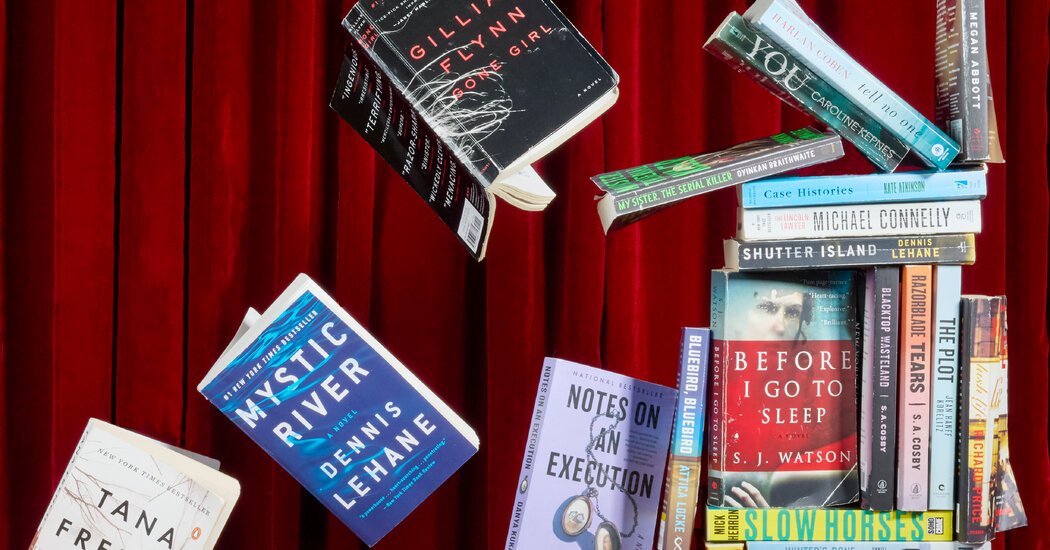
Naila Ruechel for The New York Times
As voted on by 291 crime novelists, editors, booksellers, librarians and other book lovers. See how their ballots stack up.
After we at The New York Times Book Review asked hundreds of experts to help us choose the 100 Best Books of the 21st Century, we realized that our list was too short. There simply wasn’t enough room to encompass all of the great work being done across genres like fantasy, romance, horror and thrillers.
As we looked to expand our 21st-century literary canon, that last category felt particularly ripe. So we sent ballots to writers of every kind of crime fiction, from legal thrillers to spy novels to cozy mysteries, as well as librarians, editors, critics and Bookstagrammers. What, we asked them, are the 10 best thrillers published since 2000?
Freida McFadden and Lee Child took part. So did S.A. Cosby, Gillian Flynn, John Grisham, Alyssa Cole, Stephen King and hundreds of others. You can too. No doubt you’ll have already read at least a few of these great thrillers and remember some of their shocking twists. But we guarantee you’ll find something new to bring with you on your next vacation, beach-bound or not.

50
None of This Is True
Alix Summers, a successful podcaster, meets Josie Fair at her local pub, where — coincidentally — they’re each celebrating their 45th birthday. Before long Alix has agreed to make Josie the subject of an upcoming show. But as Josie tells her story and the women’s lives become increasingly entwined, Jewell’s expertly constructed slow-burn moves from mildly disquieting (why is Josie always wearing at least one form of denim?) to actively creepy (doesn’t she have her own house?) to unputdownably terrifying (what is she doing on Alix’s ring camera?). Until the last page, you won’t know who, exactly, to believe.


49
Magpie Murders
This fiendishly clever nesting-doll of a novel comprises two stories — wildly different, equally delicious — for the price of one. In the first, a British book editor named Susan Ryeland reads the latest submission by a famous, irascible mystery writer (no one sends up his own profession as delightedly as Horowitz) and finds it dotted with clues to a real-life crime. In the second, there is the manuscript itself, a pitch-perfect Agatha Christie pastiche set in a quaint English village and featuring the proudly umlauted detective Atticus Pünd. Like Pünd’s dim but enthusiastic sidekick, you’ll find yourself in the dark until the very end. Read our review.


48
All the Colors of the Dark
“All the Colors of the Dark” opens in 1975 when two teens, Patch and Grace, fall in love in the blacked-out basement where they’re being held by their kidnapper. “I liked the idea that they’d never seen each other,” Whitaker told The Times in an interview, “just two people getting to know each other when everything else was stripped away.” His poetic blockbuster unspools over 27 years while Patch — freed from captivity but still tortured — searches for his lost love.


47
The Push
“I think the baby hates me,” Blythe Connor confesses days after giving birth. Abandoned by her own mother, abused by her grandmother, she has approached parenthood with reluctance. Now she is convinced her daughter, Violet, is fundamentally evil, a suspicion seemingly confirmed by a family tragedy. Written almost entirely as a tense second-person confession to her skeptical husband, Audrain’s debut is an ice bath in book form. Read our review.


46
Before I Go to Sleep
Christine Lucas, diagnosed with not one but two forms of amnesia, is doing what she can to get on with her life. But as her memories begin to flicker and return, the stomach-churning details flooding her mind don’t add up with the story she’s long been told by her husband and her psychiatrist. In the thriller world, an amnesia diagnosis, a sinister husband and an unreliable shrink may be all-too-familiar tropes, but Watson deftly exploits them as, in the words of our reviewer, “goose bumps rise.” Read our review.


45
Mexican Gothic
A crumbling manor, an impulsive marriage, a miasma of family secrets: Moreno-Garcia’s historical horror novel takes all the hallmarks of a classic Gothic thriller and transposes them to 1950s Mexico. The socialite Noemí Taboada is unsettled when her cousin, recently married to a scion of an English silver mining family, claims that her new husband is trying to kill her. When Noemí flies to her side, she discovers that things at the family’s estate are even more ominous than she’d imagined. Moreno-Garcia exposes the horrors of extractive colonialism while taking readers on a hallucinatory roller coaster ride. Read our review.


44
Jar of Hearts
We all did things in high school we later regret . But almost certainly not as much as Georgina “Geo” Shaw, who was smitten enough with a volatile heartthrob named Calvin to help cover up his rape and murder of her best friend, the beloved clique queen bee Angela. That loyalty landed Geo a five-year prison sentence as an accomplice and sent her now-ex away for life. So when a series of brutish copycat crimes begins soon after her release, another member of their old friend group — now a detective with the Seattle P.D. — is determined to uncover the truth. Trust us, it’s ugly. Read our review.


43
Lush Life
Price’s soulful eighth novel, set on the gentrifying Lower East Side of Manhattan, begins when three men — one based on the New York restaurant owner Keith McNally — are mugged, and one dies. An N.Y.P.D. detective struggles to make sense of this barbarity. Some criminals are “athletes of evil,” he thinks, while others are merely “stupid and fantastically self-centered.” Price is an old pro in his prime here. The pace is quick. The restaurant scenes are superb; so is the author’s poised assessment of life in the big city, and of the varieties of urban dreams. Read our review.


42
You
When Guinevere Beck sashays into the East Village bookstore where he works, Joe Goldberg is beguiled — and, as the reader learns from his self-deprecating narration, soon becomes obsessed. After learning everything he can about Beck online (“the internet was designed with love in mind,” he notes), Joe begins to remove every obstacle to their inevitable romance. Long before he became a streaming sensation, Kepnes’s chilling, funny stalker charmed unwitting readers just as he charmed the unwitting Beck.


41
Tell No One
David Beck fell in love with his wife, Elizabeth, in second grade, and he is still grieving her loss eight years after her abduction and murder on an anniversary trip to Lake Charmaine, where they shared their first kiss. So when a coded email that could only have come from her arrives in his inbox — and two more bodies are discovered near the lake, with evidence that incriminates him — David is forced to investigate, and finds a far more complicated truth. “There were some night paths the mind was better off not traversing,” he says.


40
Dark Matter
A “Sliding Doors” for the science-minded set, this what-if thriller follows a college professor named Jason Dessen who wonders how things might have turned out if he’d pursued his passion for quantum physics instead of choosing a quieter life of family and academia. He gets the chance to find out when he is taken at gunpoint by a masked man and wakes up in a world where his wife is now a stranger and his son was never born. What follows is a heady, hallucinatory tale of layer-cake multiverses, alternate selves and terrifying mystery cubes. You may need a whiteboard just to keep up. Read our review.


39
Fingersmith
Dickens never wrote a Victorian novel like this one, an absolute ripper of a tale about a thieving orphan named Sue who is conscripted in a moneymaking scheme to pose as a maid for a wealthy, sheltered heiress — and ends up falling for her instead. Add an unhinged mental asylum, a daisy chain of family secrets, and at least one double-triple cross (the story is told from both girls’ perspectives, “Rashomon”-style) and the book becomes not just a twisty Gothic melodrama but a proto-feminist swashbuckler, brimming with queer eroticism and adventure. Read our review.


38
I Am Pilgrim
Who is Pilgrim? A former top-shelf secret agent known among his peers for writing a niche but influential handbook on forensic pathology, he’s happily slipped into retirement. But when it appears that a gruesome murder scene in a seedy New York hotel has taken very specific inspiration from his book, he is drawn into a case whose tentacles reach all the way to the Middle East, and to a looming biochemical threat. If Hayes’s vivid, hard-boiled storytelling seems to gallop like a movie script, that’s because he’s written many, including two “Mad Max” sequels. Read our review.


37
Your House Will Pay
Grace Park works at her family’s pharmacy in a Korean American enclave of the San Fernando Valley; Shawn Matthews, who’s Black, is trying to escape his past in a downtown Los Angeles neighborhood. Separated by race and culture, the two might never have met but for the reverberations from a three-decade-old murder, which juxtaposes their personal dramas against the city’s larger dynamics. Inspired by a real shooting, the novel combines the elegance of literary fiction with the nail-biting suspense of a classic thriller. Read our review.


36
The Silent Patient
After Alicia Berenson tied her husband to a chair and shot him five times in the face, she never spoke again. Theo Faber, a new psychotherapist at the facility where she’s been sent, has long been obsessed with her crime and believes he can convince her to open up. The seemingly simple two-narrative premise is rendered with subtlety and suspense by Michaelides, who unfurls each character’s story with a screenwriter’s panache (he was one). As we begin to understand the reality of Alicia’s past — and Theo’s — everyone becomes unreliable, and everyone becomes connected. The conclusion is shocking, unsettling and unforgettable. Read our review.


35
All the Sinners Bleed
“The soil of Charon County, like most towns and counties in the South, was sown with generations of tears,” Cosby writes in “All the Sinners Bleed.” But even 200-plus years of race massacres, cannibalism and malaria outbreaks don’t fully prepare Titus Crown, Charon’s first Black sheriff, for the ugliness that stems from the killing of a popular local teacher by a former student. Cue the barely concealed cabal of local white supremacists, a heartbreaking pile of previously undiscovered Black and brown bodies, and more humid Southern atmosphere than you can shake a rattlesnake at. Read our review.


34
The Likeness
The body of a young woman who was stabbed and left to die is discovered in the Irish countryside, and not only is she the spitting image of Cassie Maddox, a Dublin homicide detective, but her name — Lexie Madison — is fake, invented by Cassie in an earlier undercover operation. The investigation sends Cassie undercover again, this time taking on the borrowed identity of the dead woman. Can she figure out who Lexie was, and solve her murder? Set aside your skepticism about this implausible scenario, and luxuriate instead in French’s gorgeous investigation of identity, secrecy, longing and guilt. Read our review.


33
The Witch Elm
The charmed life of a Dublin art gallery rep shatters when he is savagely beaten during a burglary. Broken and traumatized, he moves back to his ancestral home to recuperate, only to find another kind of violence there: a human skull hidden in the hollow of a centuries-old elm tree on the property. The setup is a corker, but French, in her sole stand-alone novel, has much more in mind than standard mystery-of-the-week thrills: “The Witch Elm” brims with big-sky ideas about identity, privilege and memory. Read our review.


32
Notes on an Execution
Ansel Packer is set to be executed for serial murder — in 12 hours, to be exact. And he’s guilty; we know that from the start. The suspense in this chilling novel comes from learning how he got here: by listening to the myriad stories and voices of the women in his life. What made him snap? Was it his mother, his marriage? As soon as one theory emerges, Kukafka explodes it. What could feel preachy or didactic is instead a fascinating, unexpected study in empathy. Against the backdrop of a ticking clock, Kukafka makes us question everything, and everyone, until the last page. Read our review.


31
Defending Jacob
For such a smart guy — he’s an assistant district attorney, and a good one — Andy Barber can’t seem to believe that his taciturn 14-year-old son, Jacob, may have stabbed a classmate to death, even when a scary knife turns up in the kid’s room. (“It was like one of those lovely deadly things in nature, a lick of flame or the claw of an enormous cat.”) Andy’s wife, Laurie, is more cleareyed. The family’s story, refracted through two courtroom trials, plays out in almost unbearably tense scenes. There are two gut-punch twists at the end, and you’ll never see either one coming. Read our review.


30
The Sympathizer
This striking debut novel, the winner of the 2016 Pulitzer Prize for fiction, blurs genres. It’s a spy thriller, an effervescent political satire and what you might call a literary novel. The main character — an unnamed, conflicted Communist spy who’s a North Vietnamese mole in the South Vietnamese Army — was once a cultural adviser on the production of an American film that sounds a bit like “Apocalypse Now.” This novel is all about dual identities. It never grows leaden. “Besides my conscience,” the narrator says, “my liver was the most abused part of my body.” Read our review.


29
The Plot
Jacob Finch Bonner is a washed-up novelist turned writing teacher when one of his students, Evan Parker, shares his idea for a surefire best seller. The concept sticks with Bonner, who adopts it as his own when he learns Parker has died. The resulting book is indeed a huge hit; all is going swimmingly for Bonner until he receives a message that says, simply, “You are a thief.” Then come the threats. Korelitz is a master of sly humor and skies that darken so slowly, you barely notice until you’re sitting in the pitch black. Read our review.


28
The Perfect Nanny
“The baby is dead,” begins Slimani’s bone-chilling domestic thriller about a Frenchwoman who, having been hired as a nanny by a wealthy Parisian couple, becomes increasingly, insidiously enmeshed in the family she so meticulously cares, cleans and cooks for — until the day she murders both of her young charges. The suspense in this novel has little to do with the gruesome act itself, the details of which are clear from the outset; Slimani’s achievement is in building a tortuous portrait of the tensions between parent and caretaker, the racial and socioeconomic forces underpinning the balance of domestic responsibility in upper-class households, and the unthinkable extremes to which humans can be driven by their own loneliness. Read our review.


27
Big Little Lies
Even if you think you know the story because you’ve seen the marquee HBO series (it won eight Emmys and four Golden Globes), Moriarty’s source material is a different animal, full of texture and detail. Her sharp-eyed portrait of several mothers whose lives intersect at the primary school in an idyllic Australian coastal town quickly flips its sun-soaked atmosphere, revealing a wasp’s nest of secrets that include spousal abuse, an extramarital affair and schoolroom bullying. But Moriarty is also a writer of real acuity and insight, and her story more than earns the non-murderous intrigue that surrounds its central mystery. Read our review.


26
The Da Vinci Code
It’s hard to convey to readers who weren’t there what a sensation this book was in the mid-2000s. Whole sections of big chain bookstores were devoted to knockoffs, spinoffs and earnest explorations of pagan and Christian symbolism in Western art and culture. What a time to be alive! But even after that craze subsided, this remains Brown’s best, most Brownian novel. The character names are impeccable (Leigh Teabing; Bezu Fache); Robert Langdon’s death-defying symbological derring-do is played for almost plausible stakes; and Paris and London provide a perfect touristic backdrop. Read our review.


25
Winter’s Bone
At 16, Ree Dolly has already had adulthood forced upon her. Not only is she the caretaker for her two younger brothers and her heavily medicated mother in their ramshackle house deep in the Ozarks, she’s the sole provider, too. When a sheriff’s deputy arrives to tell her that her meth-cooking father — who put up their home and the land it sits on as his bond — has disappeared a week before his court date, Ree must find him on her own or lose everything she knows. Woodrell packs his sentences with potent backwoods atmosphere (many squirrels get skinned), but it’s the scrappy, fiercely indomitable Ree whose voice lingers. Read our review.


24
The Dry
A book that gives new, parched meaning to “atmospheric.” The Melbourne federal agent Aaron Falk hasn’t been back to Kiewarra, his drought-ridden hometown, since he was 16. And when he returns for the funeral of his onetime best friend — dead in an apparent murder-suicide — he discovers the place is a tinderbox of secrets, ready to ignite. “Harper throws out so many teasing possibilities that it’s hard to believe this is her first novel. And even harder to believe that she learned to write fiction via a literary agency’s online writing course,” our critic wrote. A decade after it was published, “The Dry” remains an evocative model of small-town suspense. Read our review.


23
The Goldfinch
When a terrorist’s bomb detonates at the Metropolitan Museum of Art, it kills several patrons, including the single mother of a 13-year-old boy named Theo. In the ensuing chaos, a dying man in the crowd convinces a shellshocked Theo to steal a small but priceless Dutch masterpiece. After that (literally) explosive start, Tartt pivots, unfurling a complex character study of one grieving kid trying to find his way in the world while saddled with the terrible secret of his crime. The hallmarks of a good thriller are present — international intrigue, devious art thieves — but they’re nestled in a moving and richly imagined coming-of-age tale. Read our review.


22
The Constant Gardener
Though she’s murdered offstage in a remote corner of Kenya in the opening chapter, Tessa Quayle — a champion of the poor and disenfranchised — is this book’s most vivid character. Her death spurs her husband, a British government functionary in Nairobi, to emerge from his bureaucratic torpor and “plunge into the heart of her secret world,” however dangerous that might be. He follows Tessa’s trail into a plot by a pharmaceutical company to use unsuspecting Africans as guinea pigs for a dodgy new drug. This is vintage post-Cold War le Carré, a howl of outrage against a world order he found increasingly repugnant. Read our review.


21
Room
What can children know, except the world you build around them? Donoghue pulls off an ingenious literary trick in having her novel narrated from the point of view of a 5-year-old boy whose whole universe is in fact one room: the 11×11 garden shed in which he and his Ma have been imprisoned by the kidnapper and sexual abuser he knows only as Old Nick. When Ma decides to break for freedom, she’ll need her little boy’s complete cooperation and trust to escape their captor. But getting away isn’t the end of the story; terrors of a different kind still lurk. Read our review.


20
Broken Harbor
The murders are as horrifying as they come: a frenzied attack on a family of four that left the father and children dead, the mother clinging to life. That it took place in one of the few occupied homes in a half-built Irish luxury development that went bankrupt during the Great Recession adds an element of state-of-the-nation horror. As in all her Dublin Murder Squad books (this is the fourth), French interweaves the detectives’ own stories with their investigation of the crime at hand to create something far greater than the sum of its parts. Read our review.


19
Sharp Objects
A collection of teeth, a passel of dead girls, some unexplained illnesses — Flynn’s debut is a stew of seriously creepy ingredients, darker and more disturbing than “Gone Girl.” Once you visit Wind Gap, Mo., you’ll know why Camille Preaker, a Chicago newspaper reporter prone to self-harm, fled this tiny, dysfunctional town as soon as she could. When her editor sends her back home to cover a murder, she’s forced to look deep inside her family, all the way back to the death of her beloved younger sister, years ago. This is Southern Gothic at its most unnerving.


18
11/22/63
Few crimes have captured the American imagination as much as the broad-daylight murder of John F. Kennedy. For King, like many in his generation, it remains one of history’s great turning points — how would the rest of the Sixties have unfolded had Kennedy lived? In this novel, the Maine schoolteacher Jake Epping gets the opportunity to go back in time and stop Lee Harvey Oswald from pulling the trigger that day in Dallas. Save the president, save the world. Easy enough, right? Not when your main antagonist is time itself. Read our review.


17
Shutter Island
September 1954: a hard-bitten cop; an isolated hospital for the criminally insane on an island in Boston Harbor; a murderer on the loose. Trust Lehane to drop readers into this combustible mix, throw in a major weather event — a vicious hurricane bearing down on the island — and still find ways to upend every expectation of where it’s all headed. As the U.S. Marshal Teddy Daniels doggedly pursues a convicted child killer through the maelstrom, the novel’s narrative vise tightens, slowly and then explosively. Read our review.


16
The Lincoln Lawyer
How many thriller writers dream up not one but two indelible series characters? Thirteen years after the dyspeptic L.A.P.D. homicide detective Harry Bosch first appeared in “The Black Echo,” Connelly introduced us to his half brother, Mickey Haller, a brash, sleazy defense attorney who conducts his business from the back seat of a Lincoln Town Car and gives his favorite bail bondsmen Planters nut tins stuffed with cash at Christmastime. Mickey flicks away thoughts of guilt or innocence “because everybody was guilty. Of something.” Watching him wheel, deal and scheme his way through a complex assault case is pure theater. Read our review.


15
Dare Me
“Lord of the Flies” gave us boys gone wild; “Dare Me” suggests that the fairer sex can more than match them for feral, cruel and downright diabolical behavior. Abbott’s sixth novel is immersed in the hothouse world of a high school cheerleading squad whose charismatic new coach, Colette, upends the team’s power dynamic and sends the girls’ competitive instincts into overdrive. When a man in their orbit turns up dead, it’s like gasoline poured on a fraught mix of friendship, ambition and teen sexuality. Abbott lights the match. Read our review.


14
We Need to Talk About Kevin
The question of nature versus nurture haunts Shriver’s taut, unnerving novel, a standout in the already rich field of books about bad-seed offspring. Relayed as a series of letters from a woman whose teenage son has committed a school massacre, the narrative offers one of the all-time thorny portraits of motherhood, slowly peeling back the layers of ambivalence, avoidance and outright hostility that led to the unthinkable. Read our review.


13
Case Histories
Here we go! In the first of Atkinson’s six Jackson Brodie books — twisty, thinky, gritty detective stories that are just weird enough to keep you looking over your shoulder — Brodie, a cop turned private investigator, gets a call that draws him deep into the past. As various plot threads connect, forming an ever more twisted web of family secrets and community shame, one of the main characters lays her cards on the table: “Novels gave you a completely false idea about life, they told lies and they implied there were endings when in reality there were no endings, everything just went on and on and on.” Read our review.


12
The Girl on the Train
Rachel Watson is a hard character to love: a messy, flailing alcoholic whose behavioral issues have led to both the end of her marriage and the loss of her job. Still, she continues to commute into the city every day, in part because she can catch a voyeuristic glimpse of her ex’s happy new life and spy on another seemingly perfect couple on whom she becomes increasingly fixated. When she believes she’s witnessed something terrible one day, what is seen from the train does not stay on the train; the series of reveals that follow upend everything, and give outrageous new meaning to the term “gaslighting.” Read our review.


11
Blacktop Wasteland
This Southern noir crime novel, about a mechanic with a checkered past who’s pulled back for one final heist to support his family, was Cosby’s breakthrough. It leaves scorch marks in its wake. The protagonist is Beauregard “Bug” Montage, once the best getaway driver in the region. Now he runs a failing auto shop. The author is a Black man in the American South, and below his novel’s surface rush (muscle cars, illegal street racing, an ambitious robbery), he has a great deal to express about the realities of race and class in small-town Virginia. Read our review.


10
Bluebird, Bluebird
Welcome to a meandering stretch of Highway 59, which links rural communities in the Piney Woods of Deep East Texas, and meet Darren Mathews. The Texas Ranger has been suspended from his job, and “without the badge, he was just a Black man traveling the highway alone.” Still, he can’t resist chasing the case of two bodies found in a local bayou. As he navigates race, identity and secrets in an insular region that plays by its own rules, Mathews — committed to justice but all too aware of what he’s up against — begins to question what it really means to belong. Read our review.


9
Slow Horses
The title of this book — the first in what is so far a nine-volume series — comes from Slough House, a godforsaken suite of offices in London where the British intelligence service sends its misfits. This island of broken toys is overseen by Jackson Lamb, an MI5 lifer with a filthy mouth and unspeakable personal hygiene. Herron has been hailed as a successor to John le Carré, which is a bit misleading. These books aren’t as much about geopolitics or spycraft as they are about the intrigue and indignity of modern office work, albeit with gunplay and terrorist threats and crackerjack prose. Read our review.


8
Razorblade Tears
This is a pulpy (in the best way) novel of revenge. It’s about two aging ex-cons, Ike Randolph and Buddy Lee, who live in rural Virginia. Their sons — one Black, the other white — are married to each other and have a baby daughter. When those sons are brutally murdered, the dads go looking for heavy payback. Ike and Buddy happen to be homophobic. They’re going to have to wrestle with that while they crack some skulls. This novel of racism, toxic masculinity, fatherhood, grief and redemption hits like a fist. Read our review.


7
The God of the Woods
Losing one child in a family is a tragedy. Having two go missing, 14 years apart? That’s either carelessness or conspiracy. Moore’s masterly novel weaves together the twinned timelines of the privileged but fatefully unlucky (or so it seems) siblings Bear and Barbara Van Laar. Eight-year-old Bear disappears from the family estate in 1961; Barbara, already a rebel at 13, vanishes in 1975. The book’s denouement is no slouch in the revelation department, but Moore is as interested in exploring the timeless vagaries of class and social status — and the depths of maternal grief — as she is in cracking open her clever puzzlebox mystery. Read our review.


6
My Sister, the Serial Killer
Thrillers tend to evoke a range of primal emotions; laughter is rarely one of them. Braithwaite’s breakout debut doesn’t short on body count, but it swerves from the usual grim template in its darkly comic portrayal of two unusually close Nigerian sisters, one of whom keeps inconveniently killing her boyfriends. Each time, the gorgeous and possibly sociopathic Ayoola claims self-defense; Korede, a nurse, isn’t so sure. Still, she always helps her baby sister clean up her messes — until the day Ayoola catches the eye of Korede’s work crush, a kindhearted doctor. Read our review.


5
No Country for Old Men
Don’t settle for Joel and Ethan Coen’s (superb) film version. This is McCarthy’s most direct and relentless piece of storytelling, nearly impossible to put down. It takes its title from the first line of W.B. Yeats’s poem “Sailing to Byzantium,” and it deals out its themes (fate, violence, moral decay) with an implacable confidence. Set in 1980 along the Texas-Mexico border, it’s about the aftermath of a drug deal gone bad — and about killings with a pneumatic cattle-gun. McCarthy’s bleak vision of life is consistently on display. Read our review.


4
The Girl With the Dragon Tattoo
Larsson’s Millennium juggernaut began here, with one of the more indelible literary creations of the 21st century: a goth-punk Swedish computer hacker named Lisbeth Salander whose technical brilliance is matched only by her antisocial tendencies. She’s an unlikely match for the middle-aged journalist Mikael Blomkvist, but when the pair are thrown together to research the long-ago disappearance of a wealthy industrialist’s great-niece, the cold case becomes a hot pursuit of truth and justice in a vast, spidery conspiracy. Read our review.


3
In the Woods
On an ordinary day in 1984 suburban Ireland, three children walk into the woods; only one, bloodied and stunned, comes out. The boy remembers nothing, and the case remains unsolved. Flash forward two decades and he’s become a homicide detective with a new name, a new accent and a lot of survivor’s guilt. His subsequent assignment to the killing of a 12-year-old girl at a local archaeological site provides the book’s contemporary hook, but French’s Edgar Award-winning debut is much more than the launch of her Dublin Murder Squad series: It’s an astute and wildly atmospheric portrait of loss, memory and the endless mysteries of human behavior. Read our review.


2
Mystic River
Lehane remains one of the most naturally cinematic writers in the genre (no wonder so many of his novels have been turned into movies, often very good ones). But it’s hard to top the torque and flow of “Mystic River,” in which the consequences of a fraught incident experienced by three boyhood friends in working-class 1970s Boston reverberate across decades. When one of those now-grown boy’s teenage daughters is murdered 25 years later, the book becomes an enthralling study in remorse, revenge and the long tail of emotional trauma, told in Lehane’s inimitably tender and profane style. Read our review.


1
Gone Girl
Flynn’s sly, trick-mirror tour de force begins as the fairly straightforward tale of a Missouri woman named Amy Dunne who goes missing on her fifth wedding anniversary. Could her husband, Nick, be responsible? After all, he’s moody, struggling financially, maybe even having an affair. But Amy’s diaries, which flash back to the couple’s former life in New York and the much rosier beginnings of their romance, reveal other complicating factors. (This story has so many sides, it’s practically a polyhedron.) The narrative, with its nimble switchbacks and misdirections, excels at building tension right up to the final thunderclap reveal. But it’s Flynn’s stinging, whipsmart insights — let us all pause here to honor the iconic “cool girl” monologue — that land “Gone Girl” its richly deserved spot in the modern pantheon. Read our review.

Share your book lists!

Methodology
In collaboration with The Upshot — a department at The Times focused on data and analytical journalism — we sent ballots to hundreds of novelists, editors, librarians, booksellers, podcast hosts, critics and more, asking them to submit their picks for the best thrillers of the 21st century. (We allowed voters to submit up to 10 titles; some submitted fewer.)
“Best” could mean whatever they wanted it to mean; the only rule was that any selected book had to be a work of fiction published in the United States, in English, on or after Jan. 1, 2000.
After casting their ballots, voters were given the option to pick which of two randomly selected thrillers was better in a series of matchups. We combined data from these prompts with the vote tallies to create this list of top 50 thrillers, as chosen by our 291 voters.
About The Author