Some teachers believe this year’s results reflect a shift in how students are being assessed, rather than a sudden deterioration in the quality of education.
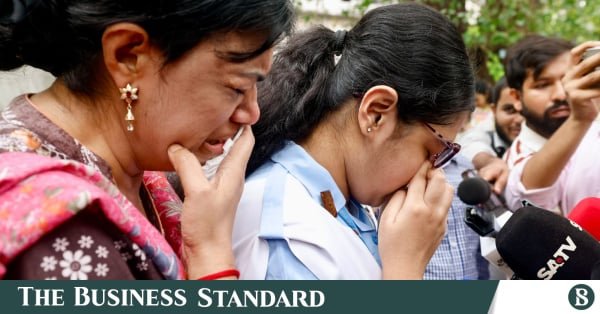
Tears of joy mixed with grief as HSC student Bornali Biswas and her mother embrace after she secured a GPA-5 from Viqarunnisa Noon School and College. Bornali’s father tragically passed away a month before the results, unable to witness his daughter’s success. The photograph was taken at the school’s main Bailey Road branch on 31 October 2026. Photo: Syed Zakir Hossain/TBS
“>

Tears of joy mixed with grief as HSC student Bornali Biswas and her mother embrace after she secured a GPA-5 from Viqarunnisa Noon School and College. Bornali’s father tragically passed away a month before the results, unable to witness his daughter’s success. The photograph was taken at the school’s main Bailey Road branch on 31 October 2026. Photo: Syed Zakir Hossain/TBS
The pass rate in this year’s Higher Secondary Certificate (HSC) and equivalent examinations has fallen to its lowest level in 22 years – only 52.12% – raising fresh questions about the quality of teaching and learning in the country’s schools and colleges.
Teachers and educationists point to a combination of factors behind the poor results: a return to examinations based on the full syllabus, changes in assessment, learning gaps left by the Covid-19 pandemic, shortages of qualified teachers and students’ declining interest in studies.
Teacher shortages

The shortage of qualified teachers, particularly in subjects such as English and ICT – which recorded the highest number of failures – is making it difficult for students to build a strong academic foundation.
According to data from the Bangladesh Bureau of Educational Information and Statistics (Banbeis) and the Directorate of Secondary and Higher Education (DSHE), 2,842 teaching posts remain vacant in government secondary schools. The number of vacancies in MPO-listed private secondary institutions is much higher, at 77,227.
The gaps are also evident at the subject level. Some 3,861 schools have no ICT teacher, while 2,744 lack a mathematics teacher and 2,625 have no English teacher.
Without teachers specialising in these subjects, students are often left without the guidance they need to develop essential skills and grasp basic concepts.
Infographics: TBS
“>

Infographics: TBS
Changes in assessment
Some teachers believe this year’s results reflect a shift in how students are being assessed, rather than a sudden deterioration in the quality of education.
Mazeda Mujib, a teacher at Tejgaon Model College, said it is unlikely for an entire batch to perform dramatically better or worse overnight. Nor, she argued, could the overall quality of education change substantially within just a year or two.
“What we are seeing now is the result of a change in policy. Previously, there was a tendency to prioritise quantity and present better-looking results. Now the focus has shifted to quality,” she said.
“Although this may look like a disastrous result at first, it will ultimately be beneficial. Students will become more attentive, and it will also challenge teachers to improve. Overall, this could bring the qualitative changes that the education system needs.”
Educationist and professor emeritus at Brac University Manzoor Ahmed said the poor results were not entirely unexpected, but that did not make them acceptable.
He said the standard of education had been declining steadily since the Covid-19 pandemic, with shortages of subject-specific teachers becoming increasingly apparent.
Manzoor said there had been efforts to make this year’s assessment more transparent, but students should not be blamed for the outcome. The deeper problem, he said, was the lack of coordinated initiatives to address weaknesses across the education system.
He also criticised the government’s failure to act on earlier reform proposals. The government’s 31-point agenda had included a commitment to establish an education development commission, but no visible progress had been made.
“During the interim government’s tenure, 118 recommendations covering nine areas of the education sector had also been put forward. The elected government has yet to take action on those proposals,” he said.
Professor Akhtaruzzaman, chairman of the Dhaka Secondary and Higher Secondary Education Board, said the results reflected both shortcomings in the education system and a lack of classroom engagement among students.
“Our observation is that efforts are being made to ensure that assessments are accurate and fair. But we have yet to establish a rational education system. Students have not been attentive in class. On average, only 30-35% of students attend classes, while the pass rate this year was 52%. Those who attended classes and sat for the examinations passed,” he said.
He added that students in the humanities group were particularly weak in ICT. A shortage of teachers and a syllabus that was difficult for them had compounded the problem.
Prime Minister’s Adviser for Education and Primary and Mass Education Mahdi Amin yesterday (31 October) said the government has completely moved away from the old culture of artificially inflating pass rates or the number of GPA-5 achievers.
“Moving away from the culture of artificially inflating GPA-5 scores or pass rates, the focus has shifted toward the genuine assessment of merit, maintaining the quality of question papers, and ensuring the integrity of the answer-script evaluation process,” he said.
Infographics: TBS
“>

Infographics: TBS
Classroom disruptions, political upheaval
The academic disruption following the 2024 mass uprising may also have affected this year’s candidates. Several educational institutions experienced unrest and interruptions to academic activities during the period, while some of the students who sat for the 2026 HSC examinations had just entered college.
Teachers say the disruption may have affected regular classes, continuity in teaching and students’ preparation for examinations.
Mohammad Shahidul Islam Pathan, a teacher at Notre Dame College, said the batch had been struggling with learning gaps since the pandemic.
“These students have had gaps in their foundational knowledge since Covid. They have also become less interested in textbooks. The political situation in 2024 further affected their academic lives. They struggled to keep up with frequent changes in the syllabus, while the uncertainty caused by flooding during the examination period also disrupted their concentration,” he said.
Mohammad Arifur Rahman, an English teacher at Residential Model College, also pointed to several contributing factors, including the impact of the July uprising and the election.
“There was some disruption to studies during the July period. The election also had an impact,” he said.
He noted that students sat for examinations based on the full syllabus this year, making the assessment fairer than in previous years.
“Students no longer had access to the unethical advantages they might have enjoyed before. These are among the main reasons behind the results,” he said.
The results of all education boards were published simultaneously at 11am yesterday.
A total of 6,46,685 students passed the examinations, while 40,084 secured the highest Grade Point Average (GPA) of 5.
Girls have outshone boys in the pass rate, while boys have secured more GPA-5s, the highest grade.
A total of 293 educational institutions across the country have recorded a zero pass rate.
The last time the pass rate was lower was in 2004, when 47.74% of students passed the HSC and equivalent examinations. That year, 3,036 students achieved GPA-5. At the time, examinations were held under seven general education boards.
An analysis of the results shows that the pass rate gradually increased after 2004. In 2005, the pass rate was around 59%, with 5,509 students securing GPA-5.
The Madrasah Board this year, however, achieved a higher pass rate of 61.07%.
About The Author