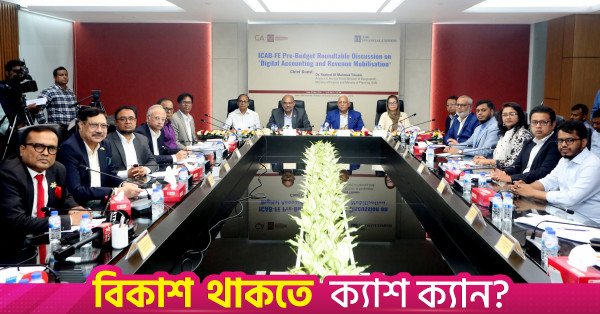
Prime Minister’s Adviser on Finance and Planning Rashed Al Mahmud Titumir today (7 May) said taxpayers will be able to see how their money is being spent from the upcoming national budget.
Speaking at a pre-budget discussion organised by the Institute of Chartered Accountants of Bangladesh (ICAB) and The Financial Express in Dhaka, Titumir outlined a plan aimed at rebuilding trust between citizens and the state.
“When citizens pay taxes in the future, they will receive an acknowledgement receipt clearly stating what percentage of the budget has been allocated to education, health and social safety programmes,” he said.

“This will allow citizens to ensure accountability of the institutions spending public money,” he added.
Titumir said Bangladesh’s weak tax culture stems from a disconnect between the state and citizens, arguing that people are less willing to pay taxes when they do not see corresponding public services.
“People will pay taxes only when they believe they are receiving services in return,” he said. “If citizens do not think their money is being used properly, why would they pay taxes?”
He noted that Bangladesh’s tax-to-GDP ratio remains among the lowest in the world at around 6.6%, blaming political patronage, tax exemptions for influential groups and widespread tax evasion for the situation.
“The biggest problem is the patronage-based system where politically connected groups receive various benefits, including tax advantages,” he said.
According to Titumir, the government wants to create a tax system based on both “engagement” and “disengagement” by reducing direct interaction between taxpayers and officials while increasing transparency over public expenditure.
He said the government does not plan to increase tax rates, but instead aims to raise revenue collection through greater economic activity and employment generation.
“Revenue collection can increase without raising tax rates,” he said.
The adviser added that expanding direct taxes ultimately depends on creating more jobs and increasing taxable income through wage growth.
He also said the government is working to integrate the informal sector into the formal economy through digital financial systems, SME reforms and incentives for cottage and small industries.
Titumir said Bangladesh Bank has already started discussions with banks under the “One Village, One Product” initiative to support small entrepreneurs with special financial packages.
He further highlighted plans to develop a digital public infrastructure under the concept of “One Citizen, One Digital Wallet,” citing Family and Farmers’ Card as examples of efforts to bring more people into formal financial networks.
The adviser also reiterated the government’s vision of building a “humane and democratic welfare state,” where citizens would receive social protection at different stages of life, from birth to old age.
About The Author