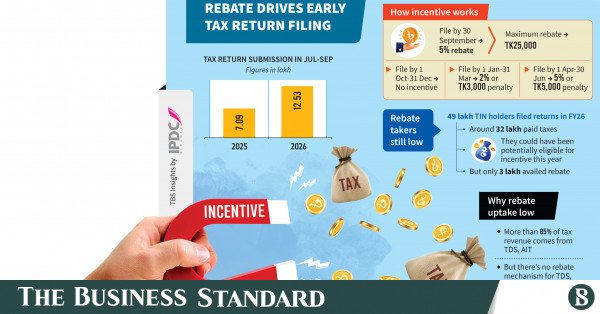
Driven by government rebates for early filing, individual tax return submissions reached 12.53 lakh for the 2026-27 tax year during the July-September period, a 77% surge compared to the same period last year.
According to National Board of Revenue (NBR) sources, approximately three lakh taxpayers claimed the incentive, which offers a 5% rebate, capped at Tk25,000, on payable tax. The rebate is adjusted directly against a taxpayer’s liability at the time of payment.
“In the July-September quarter last year, 7.09 lakh tax returns were submitted, while filings jumped to 12.53 lakh during the same period this year,” a senior NBR official told The Business Standard, requesting anonymity.

He said around 300,000 taxpayers availed themselves of the rebate by filing their returns within the government-stipulated deadline.
Announced on 2 August, the NBR’s incentive-based framework marks a shift away from a traditional fixed deadline.
Under the new system, individual taxpayers filing by 30 September qualify for the 5% rebate. Returns filed between 1 October and 31 December will receive no incentive.
Meanwhile, late submissions carry escalating penalties: filing between 1 January and 31 March incurs a penalty of 2% of payable tax or Tk3,000 (whichever is higher), rising to 5% or Tk5,000 for returns submitted between 1 April and 30 June.
For small taxpayers, the rebate provided a tangible push. Mohammad Ismail, a small trader, filed his return on 30 September and received a rebate of roughly Tk1,000 against his Tk20,000 tax liability.
“As the government offered an incentive, I was encouraged to file my return within the deadline,” he said. “Though the amount is small, it was still a matter of joy for me.”
Low uptake despite growth
Tax experts have welcomed the policy’s direction, but note that overall participation remains low relative to the country’s broader taxpayer base.
Snehasish Barua, tax expert and managing director of SMAC Advisory Limited, pointed out that around 49 lakh e-TIN holders filed returns in the 2025-26 tax year, with roughly two-thirds, about 32 lakh, paying taxes.
This suggests roughly 32 lakh taxpayers were potentially eligible for the incentive this year.
“The sharp rise in submissions shows the policy is moving in the right direction,” Barua told TBS. “However, the number of taxpayers who actually availed themselves of the incentive remains relatively low.”
TDS and AIT create structural barrier
Barua attributed the low uptake to a fundamental flaw in the framework’s design: taxpayers whose liabilities are settled upfront through Tax Deducted at Source (TDS) or Advance Income Tax (AIT) are disqualified from receiving the rebate.
“Official data shows that over 85% of total tax revenue is collected via source deductions and AIT,” Barua explained. “Because the vast majority of taxpayers have already settled their dues upfront, they gain no tangible benefit from filing early leaving them with little motivation to do so.”
He urged the policy team to redesign the incentive so that all compliant early filers benefit, regardless of how their tax was collected.
The sentiment is shared on the ground. Abdullah Al Mamun, a senior accounts officer at a private firm in Narayanganj, said his income tax is deducted monthly at source.
“Since I have no way to claim the rebate, I had no real interest in submitting my return before the September deadline,” Mamun said.
Closing the gap
Addressing the persistent gap between Bangladesh’s 1.3 crore registered e-TIN holders and active filers, Barua stressed the need for two structural priorities.
“Closing this gap requires a two-pronged approach: first, enforcing Proof of Submission of Return (PSR) requirements more strictly on the ground; and second, expanding the tax base by tracking actual income and wealth through system integrations introduced under the Finance Act 2026,” he said.
About The Author