The investment could create around 200,000 jobs, he added.
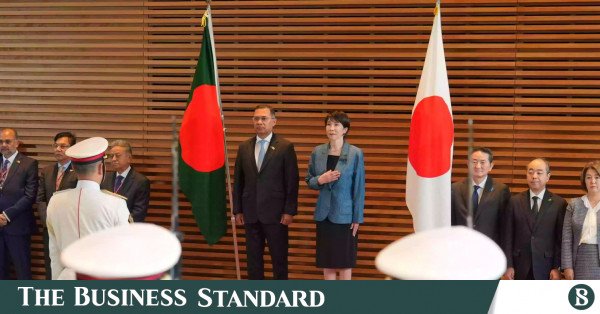
Bangladesh Prime Minister Tarique Rahman and Japanese Prime Minister Sanae Takaichi stand side by side during their summit meeting in Tokyo on 27 October. Photo: Courtesy
“>

Bangladesh Prime Minister Tarique Rahman and Japanese Prime Minister Sanae Takaichi stand side by side during their summit meeting in Tokyo on 27 October. Photo: Courtesy
Prime Minister Tarique Rahman has said Bangladesh and Japan discussed emergency financial assistance of 50 billion yen, equivalent to around $320 million, to strengthen Bangladesh’s energy security.
In a post made on his Facebook page in the early hours of Wednesday (Japan time) following his bilateral summit with Japanese Prime Minister Sanae Takaichi in Tokyo on yesterday (27 October), Tarique said the assistance was explored under Japan’s Partnership for Power Asia initiative.

“We explored emergency financial assistance of JPY 50 billion (approximately USD 320 million) under Japan’s Partnership for Power Asia initiative to strengthen Bangladesh’s energy security,” he said.

The prime minister described his visit to Japan as an important step towards strengthening the long-standing friendship and strategic partnership between the two countries.
He said the two leaders reaffirmed their shared commitment to democracy, the rule of law, economic development and a peaceful, stable and prosperous Indo-Pacific.
Tarique also said the two countries held encouraging discussions on the potential for up to 1 trillion yen, or around US$6.34 billion, in Japanese private-sector investment in Bangladesh over the next five years.
The investment could create around 200,000 jobs, he added.
The prime minister said the proposed investment could accelerate industrialisation, expand manufacturing capacity and create new opportunities for Bangladesh’s young workforce.
He said he proposed establishing a Bangladesh-Japan Tech Park to promote cooperation in artificial intelligence, cloud computing, robotics, electronics manufacturing and advanced technologies.
The two sides also discussed cooperation in space science and satellite engineering, as well as Japanese technical and financial support for high-speed rail connectivity linking six major divisional cities and the development of modern transport infrastructure.
A significant outcome of the summit was the shared commitment to advance the Bay of Bengal Industrial Growth Belt (BIG-B) initiative into a new framework for shared prosperity, Tarique Rahman said.
The initiative will focus on the integrated development of energy, deep-sea ports, industrial infrastructure, technology and regional connectivity, strengthening Bangladesh’s position as a bridge between South and Southeast Asia.
Tarique and Takaichi also discussed early implementation of the Bangladesh-Japan Economic Partnership Agreement and the proposed establishment of a ministerial-level joint commission to turn shared priorities into concrete results.
On the Rohingya crisis, Tarique expressed appreciation for Japan’s continued humanitarian assistance and called for its sustained engagement in ensuring the refugees’ voluntary, safe, dignified and sustainable return to Myanmar.
Recalling the historical ties between the two countries, he said his father, Shaheed President Ziaur Rahman, helped lay the foundations of the relationship, while his late mother, former Prime Minister Khaleda Zia, further strengthened it through her visits and engagement with Japan.
The prime minister thanked the Japanese government and people for their long-standing friendship and support, saying his government is determined to build an economy driven by investment, innovation, infrastructure development and meaningful employment opportunities.
About The Author