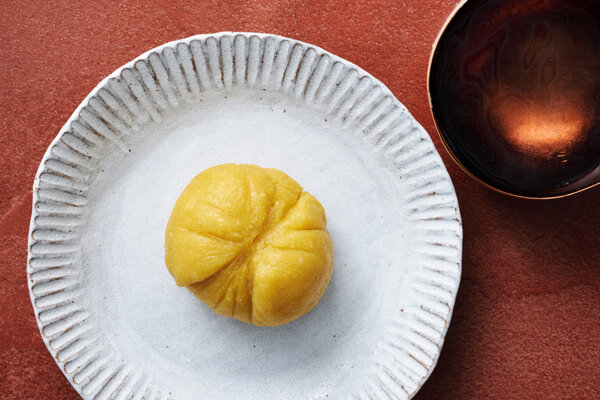
Across Africa and its diaspora, swallows evoke not an avian image but a vessel and an act.
A dumpling-like dough made from a cooked starch and meant to accompany soups and stews, swallows are a full category of foods in our recipe index.
Known generally to the Yorùbá-speaking people of South West Nigeria as òkèlè, to the Igbo-speaking people in the South East as ụtara and to the Fulani and Hausa people of the Sahel and savanna regions of the North as tuwo or nyiir, they get their English name (swallows) for their ability to be eaten without the need to chew. If you’ve ever molded a starch with your fingers, and then used it to scoop a flavored broth or sauce directly to your mouth, then you understand the modest role of a swallow.
I love considering the powerful interplay between dishes. Light broth, thickened stew, hearty porridge, sinewy draw soup or pepper sauce — all are opportunities to hover my whole face over, to intimately understand the dish’s qualities with all my senses. These are the comforting kinds of meals I make most often at home. Whether I’m trying to master a novel soup that I’ve experienced on a recent outing or conjure a stew straight out of dreams from my Nigerian childhood, I’m always thinking about which kind of swallow will be its brilliant sidekick.
Learning to make swallows will invite you into a world of starches and redefine your relationships to your favorite dishes. It’s a topic I’ve covered before, but I’ve found myself wanting to say more. There’s always something to be said about swallows.
The list below is by no means comprehensive. I would have loved to have gone deeper into others, like the East African Highland banana swallow, made from matoke, a green fruit similar to plantain. There’s also Ghana’s firm kenkey, made from fermented maize, and the dainty omo tuo (tuwo), from cooked rice. And don’t forget about bespoke banku, a mix of cassava and maize. Some styles cross many parts of Africa, such as àmàlà, made from a dried, fermented plantain or yam flour, and semolina, made from durum wheat.

Ingredients to make swallows, from top to bottom: ugali, fresh yam and garri.Credit…Kelly Marshall for The New York Times. Food Stylist: Roscoe Betsill. Prop Stylist: Paige Hicks.
Ingredient availability defines the styles, and, in essence, any available starch is an opportunity. Swallows contain myriad possibilities, and that’s what should keep you coming back. With an understanding of a few key techniques, you can broaden your relationship to the starches that sustain you.
Traditionally, making swallows is a multistep process of simmering a starch in a pot until it softens. A large mortar and pestle is then used to crush and pound the tender pieces into a dough. While still hot, the dough is kneaded against the side of the mortar until it’s rich, smooth and elastic.
My preparation has you instead make a slurry, and then cook it while stirring to avoid any lumpy pockets. It thickens into a soft dough, which is repeatedly folded and kneaded against the side of the pot over heat. In both cases, after a bit of an arm workout, the starches relax and take on a glutenlike stretchy texture in a process that is quite magical to behold.
I’m learning to cook, eat and exist with significant changes in my abilities, including the loss of digits on both hands. The classic technique of pinching and rolling a small bit of swallow in between my index, middle finger and thumb is a distant desire. But my prosthetic hands are a point of pride, an enabler of sorts. Meals have become a time for discovery, when I find myself wielding a fork or spoon to eat my swallow. We should each bring the swallow to our lips however we’re able. It will nourish us all the same.

At first, the swallows will resemble a thick, chalky-looking dough.Credit…Kelly Marshall for The New York Times. Food Stylist: Roscoe Betsill. Prop Stylist: Paige Hicks.

The dough transforms into something glossy and stretchy after minutes of folding.Credit…Kelly Marshall for The New York Times. Food Stylist: Roscoe Betsill. Prop Stylist: Paige Hicks.
A staple crop across the Caribbean, West and Central Africa and South America, the West African yam, not to be confused with a sweet potato, grows underground as a magnificently large tuber. It goes by many regional names: ìyán in the Yorùbá-speaking part of Nigeria, igname pilée in Benin, yam fufu in Ghana and foutou in Ivory Coast, to name a few.
The process of making it can be exhilarating and exhausting. It never fails to surprise me how the crumbly looking starch is transformed into something glossy and stretchy after minutes of repeated folding. As a yam swallow, ìyán shares the name of its main ingredient. As dense as it is, it provides nourishment and sustenance throughout the day.
This recipe is for anyone who truly enjoys the subtle and mild taste that only fresh yam can provide. It skips a few steps for convenience: The peeled yam is puréed in a blender, and then cooked into a stiff pliable dough.
PAIR IT WITH Vegetable-rich stews like èfọ́ rírò, ègúsí or a saucy braised meat for a deeply satisfying meal — comfort in a bowl.

When making ugali, don’t use a yellow cornmeal.Credit…Kelly Marshall for The New York Times. Food Stylist: Roscoe Betsill. Prop Stylist: Paige Hicks.

Masarepa can be an adequate substitute for the mahindi flour often used.Credit…Kelly Marshall for The New York Times. Food Stylist: Roscoe Betsill. Prop Stylist: Paige Hicks.
Flours milled from grains or any starch can be the basis for swallows, with each imparting a particular flavor and texture. Grains such as maize, millet and sorghum, and tubers such as yam, cassava and potatoes all star in different swallows across Africa. Across East Africa, a swallow, like this one, made from milled white maize flour (called mahindi flour), goes by different names: ugali, posho, nsima and sadza.
Although you may be tempted to use a yellow cornmeal, you may not get the same results. The white cornmeal is starchy and lends itself well to vigorous folding.
PAIR IT WITH Any vegetable soup such as light soup, the spinach-rich cagaar, the coconut-laden kuku paka or any grilled beef kebabs.

Although most swallows are served unseasoned, this recipe has been enriched with a bit of red palm oil for a mild, floral taste.Credit…Kelly Marshall for The New York Times. Food Stylist: Roscoe Betsill. Prop Stylist: Paige Hicks.

This garri swallow is shaped in plastic wrap to form an indented ball.Credit…Kelly Marshall for The New York Times. Food Stylist: Roscoe Betsill. Prop Stylist: Paige Hicks.
Cassava shows up in different dishes and in many forms — grated, crushed, fermented and dried — across Africa. It’s also found as a flour, known as garri or gari across West and Central Africa, and farofa in Brazil. Cassava swallows have a woodsy depth and can range from mild to sour, depending on how lengthy the fermentation process has been.
When garri is made into a swallow, it is known as eba or generally as fufu in the diaspora. The garri swallow recipe here is lightly seasoned with a bit of red palm oil to give it a notable bright color and a floral taste.
PAIR IT WITH Eru, okra soup with shrimp and greens or ègúsí soup, and top with ọbẹ̀ onírù or any braised meat.
Follow New York Times Cooking on Instagram, Facebook, YouTube, TikTok and Pinterest. Get regular updates from New York Times Cooking, with recipe suggestions, cooking tips and shopping advice.
About The Author