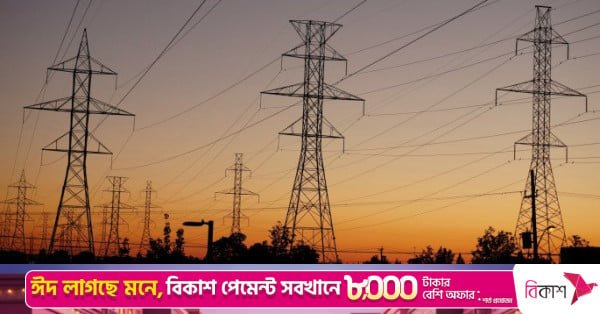
A proposal to raise wholesale electricity tariffs by up to Tk1.50 per unit drew strong opposition from political leaders, consumer rights activists, business groups and industry representatives at a public hearing organised by the Bangladesh Energy Regulatory Commission (BERC) today (20 May).
The hearing, held at the Krishibid Institution Bangladesh auditorium in the capital, saw participants warn that another rise in electricity prices would deepen pressure on households and further erode the competitiveness of local industries.
The Bangladesh Power Development Board (BPDB) proposed raising wholesale electricity tariffs by Tk1.20 to Tk1.50 per unit – an increase of around 17% to 21% from the current average wholesale rate of Tk7.04 per unit.

The utility also said the government was currently providing a subsidy of around Tk5.47 per unit of electricity sold.
Wholesale electricity, also known as bulk power, refers to electricity sold in large quantities by power generators to utility companies before it reaches consumers.
In Bangladesh, BPDB purchases electricity in bulk from state-owned plants, private power producers and imported sources before selling it to six distribution companies supplying homes, businesses and industries.
Wholesale rates differ depending on the distribution utility purchasing the power from BDPB. Current rates range between Tk4.36 and Tk6.45 per unit.
Under the existing structure, the Bangladesh Rural Electrification Board (BREB) pays Tk4.36 per unit, BPDB Tk 5.91, West Zone Power Distribution Company (WZPDCL) Tk5.38 and Northern Electricity Supply Company (Nesco) Tk5.05. Dhaka Power Distribution Company (DPDC) and Dhaka Electric Supply Company (Desco) both pay Tk6.45 per unit.
According to BPDB projections, electricity generation costs could rise to Tk143,108 crore in FY2026-27, with average generation costs reaching around Tk12.91 per unit. At current tariff rates, projected revenue would stand at Tk77,553 crore, leaving a deficit of nearly Tk65,555 crore.
BPDB said a Tk1.20 per unit increase would reduce the deficit by Tk1,329 crore per month, while a Tk1.50 increase could cut the shortfall by Tk1,666 crore.
At the meeting, BPDB Chairman Rezaul Karim said the proposed increase would not fully eliminate the deficit but could reduce government subsidy requirements by around one-fifth to one-fourth.
However, the proposal met fierce resistance from nearly all stakeholders attending the hearing, who argued that ordinary consumers and industries should not bear the burden of what they described as policy failures, corruption and inefficiencies in the power sector.
Consumer Association of Bangladesh (CAB) Organising Secretary Dr Syed Mizanur Rahman sharply criticised the proposal, saying the authorities were focusing on government finances rather than public hardship.
“Everyone is talking about subsidies and government losses, but nobody is thinking about people who are already struggling to survive,” he said.
He also questioned BERC’s role, saying reforms to the commission’s legal framework were needed instead of repeated tariff increases.
Leaders of left-leaning political parties also criticised the hearing process.
Communist Party of Bangladesh (CPB) Secretary General Ruhin Hossain Prince said the hearing had become “a show” because electricity prices were increased almost every time after such consultations.
Consumer rights activist and CAB leader Advocate Humayun Kabir said the government should continue providing subsidies if necessary rather than raise electricity prices again.
Business leaders warned that higher electricity tariffs could further hurt Bangladesh’s export-oriented industries, which are already under pressure.
Speaking at the hearing, Bangladesh Knitwear Manufacturers and Exporters Association (BKMEA) director Jamal Uddin Miah also opposed the proposed power tariff increase.
“Industries are already grappling with declining exports and rising production costs, and another power tariff increase would worsen the situation,” he said.
Representatives of small businesses and mobile phone traders also expressed frustration, saying they had expected electricity prices to fall under the new administration rather than rise further.
Meanwhile, BERC’s technical evaluation committee told the hearing that subsidies would no longer be needed if electricity tariffs were raised by around 77% – a remark that drew sharp criticism from participants.
The hearing also highlighted the rapid rise in electricity generation costs over recent years. Power sector data show that average generation costs increased from Tk2.13 per unit in FY2020 to nearly Tk13 at present, mainly due to higher fuel prices and depreciation of the taka against the US dollar.
Alongside BPDB, the country’s sole transmission utility, Power Grid Bangladesh PLC, proposed increasing transmission charges from 30-31 paisa per unit to 48-49 paisa.
Several distribution utilities also sought retail tariff increases, citing mounting financial losses. Desco proposed a 9.67% increase, while DPDC sought a 6.96% rise.
BERC Chairman Jalal Ahmed said the commission would consider all opinions presented at the hearing before making a final decision on electricity tariff adjustments.
About The Author