South Korea will support Bangladesh in developing a skilled workforce for the ship recycling, shipbuilding and ship maintenance sectors under a $15 million capacity-building and knowledge-sharing project, a senior official of the Korea International Cooperation Agency (Koica) said today (13 September).
The project, scheduled to run from 2027 to 2031, will focus on modern technology, advanced welding techniques, updated work practices and technical training to improve productivity and value addition in Bangladesh’s ship recycling industry, said Hyunwoo Yang, deputy country director of Koica Bangladesh.
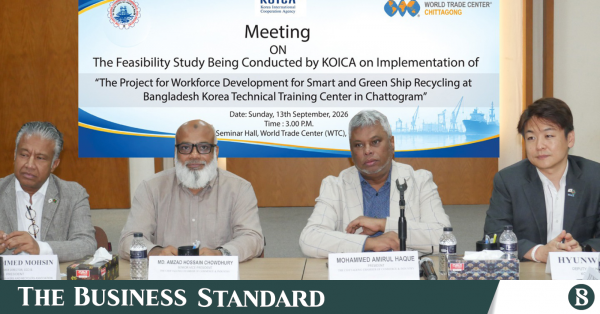
“South Korea is interested in supporting the development of modern technology and skills in Bangladesh’s ship recycling sector,” he said at a meeting with business and ship recycling industry leaders at the World Trade Centre in Chattogram.

Under the project, Koica will support infrastructure development, curriculum modernisation, teacher training and student training at the Bangladesh-Korea Technical Training Centre, according to the agency.
Yang said the Korean and Bangladeshi governments had agreed to work jointly on the initiative.
“Korean ship recycling companies want to recycle ships at yards in Bangladesh. That’s why we conducted a study on Bangladesh’s ship recycling sector,” he said.
The study found a significant shortage of skilled workers in the industry, with only around 1–2% of the required workforce having the necessary skills, he said.
Koica plans to address the gap by expanding training opportunities across ship recycling, shipbuilding and ship maintenance.
The discussion was organised by the Chittagong Chamber of Commerce and Industry to assess the industry’s demand for skilled workers and identify areas where Korean assistance could support the development of a smart and green ship recycling industry.
Chamber President Mohammad Amirul Haque said Chattogram was emerging as a major investment and logistics hub, while the government was planning to develop a green shipbuilding hub at Matarbari in Cox’s Bazar.
“One of Asia’s largest ship recycling industries is located along the coast of Sitakunda in Chattogram. So we welcome Korea’s new initiative to build capacity and develop skilled human resources in this sector,” he said.
Haque said South Korea had significant experience in technology and technical training, recalling its role in helping establish the foundations of Bangladesh’s garment industry.
“We hope Koica’s new initiative will help make the ship recycling sector more sustainable and develop a skilled workforce,” he said.
He said shipyard owners were increasingly adopting modern technologies and converting their yards into green yards to make the industry more sustainable.
Industry leaders at the meeting said the training programme should not be limited to ship recycling workers. They called for skilled manpower development in shipbuilding and ship maintenance as well, saying these sectors could create wider employment opportunities and strengthen Bangladesh’s maritime industrial base.
They also urged the authorities to develop internationally recognised skills so that trained workers could secure jobs in South Korea and other overseas markets.
A documentary on a feasibility study for skills development in Bangladesh’s ship recycling industry was presented at the meeting by Koica expert Chung Yup Kim.
Bangladesh Ship Breakers and Recyclers Association President Mohammad Mohsin and adviser Zahirul Islam Rinku, Master Steel and Oxygen Ltd Chairman Master Abul Kashem, HR Ship Management CEO Mohammad Mahbubur Rahman, Bangladesh Technical Training Centre Principal Engineer Palash Kumar Barua, chamber directors and representatives of Koica and ship recycling companies attended the meeting.
The initiative comes as Bangladesh’s ship recycling industry faces growing pressure to improve occupational safety, environmental management and compliance with international standards while preparing for greater competition in the global market
About The Author